This $11 Billion ETF Owns the Companies Wiring America’s $68 Billion Data Center Boom
An $11.5 billion ETF is quietly betting on the contractors physically building America's data center surge, but a brutal week of double-digit losses raises a pointed question: valuation flush or the first crack in a booming backlog story?

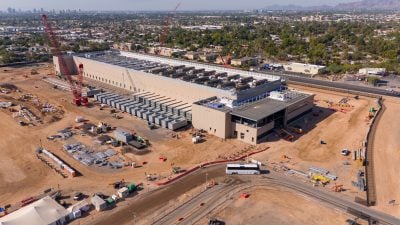
The First Trust RBA American Industrial Renaissance ETF (NYSEARCA:AIRR) offers an unusual angle on the AI buildout: exposure to mechanical and electrical contractors physically wiring data centers rather than chipmakers. AIRR has swelled to roughly $11.5 billion in net assets as of June 30, 2026, up from about $8.4 billion at the end of March. The fund closed at around $112, and while AIRR is up about 14% year to date and roughly 22% over the past year, it also fell about 10% in the past week alone. That volatility defines the opportunity.
What AIRR Actually Owns
AIRR is a broad American industrial renaissance fund with only partial data center exposure. Holdings include contractors, regional banks like F.N.B. Corp (2.43%), Associated Banc-Corp (1.29%), and Wintrust Financial (1.30%), and logistics names like C.H. Robinson (4.08%), Saia (3.53%), Landstar (1.40%), and Ryder (1.31%), which dilutes the data center thesis.
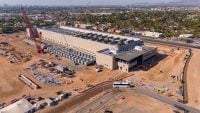
The AI-focused core sits in the top holdings. Sterling Infrastructure (NASDAQ:STRL | STRL Price Prediction) is the largest position at 6.00%, handling site development for data center campuses. Comfort Systems USA (NYSE:FIX) at 4.42% manages HVAC and modular cooling. EMCOR Group (NYSE:EME) at 3.75% is a mechanical and electrical prime contractor. Powell Industries and IES Holdings round out the AI-exposed core at 2.48% and 2.02% respectively, building medium-voltage switchgear and handling low-voltage electrical work inside buildings.
The headline’s $68 billion figure refers to a widely-cited industry estimate of North American data center construction spend. Verified backlog numbers come from the contractors themselves: Comfort Systems’ backlog hit a record $14.1 billion, up 73% year over year; EMCOR’s remaining performance obligations reached $17.14 billion, up 44%; Sterling’s combined backlog is $5.6 billion, up 150%. The power, cooling, and networking suppliers behind those numbers are the ones we broke down in a free report on seven AI infrastructure stocks that aren’t chipmakers.
Macro Factor: Hyperscaler AI Capex
Hyperscaler capital spending from Amazon, Microsoft, Google, and Meta drives AIRR’s data center contractors. Every quarterly capex guidance update and earnings call from these four matters. Cross-reference their 10-Qs against Census Bureau construction spending data for “computer/electronic manufacturing” and “power” categories.
The critical threshold: if any two hyperscalers cut forward capex guidance in the same quarter, the backlog growth story breaks. Sterling’s CEO told investors “the Texas market is going to be bigger in the next three years than any other market related to data centers,” and EMCOR management said the data-center demand profile remains unchanged despite public-market concerns. That confidence is priced in. A guidance cut unwinds it.
Fund-Specific Factor: Backlog Duration vs. Price Sensitivity
Monitor whether contractor backlogs continue extending in duration. EMCOR noted that historically about 85% of RPOs burned within 12 months; the current level is closer to 75% to 76%, locking in revenue further out. Sterling’s CEO said projects historically viewed as three-year opportunities could now last “five to eight to 12 years.”
That is the bull case. The bear case sits in recent price action. Sterling fell about 18% in a week, IES dropped roughly 18%, and Powell gave up about 14%, even after Powell landed a mega data center order in excess of $400 million. These momentum stocks trade at rich multiples: IESC carries a trailing P/E of 61, and POWL trades at 38. Watch October and November quarterly bookings and same-store backlog figures. A soft bookings report at Comfort Systems or Sterling confirms whether the recent selloff is a valuation reset or early demand softening.
Bottom Line
The macro signal is hyperscaler capex guidance from the four largest US cloud buyers. The fund-specific signal is the next round of same-store backlog and book-to-burn ratios at Sterling, Comfort Systems, and EMCOR. If both hold, the recent 10% weekly drop looks like a valuation flush. If either breaks, AIRR’s blended exposure to banks and truckers will not cushion the fall.
Contact [email protected] for any questions or corrections.
Jake has been been working in financial media for almost 15 years. He focuses on all things personal finance for 24/7 Wall St. with high hopes to educate and entertain. Most recently, Jake spent 12 years working various roles at The Motley Fool. He started copy editing fool.com content, worked on premium and marketing campaigns, and helped launch The Ascent, a personal finance brand.
His work has been featured on platforms like MSN, Yahoo Finance, USA Today, and more. He's written about credit cards, social security, ETFs, savings accounts, and just about anything else you can imagine when thinking about money. Jake love to cook, play golf, and tell people he's never had a cavity. (It's true!)