Between Your Last Paycheck and Age 73 Are the Lowest Tax Years of Your Life. These 3 ETFs Are Where That Money Goes
For many retirees, a quiet window between their last paycheck and first required distribution hides a rare tax opportunity, and the funds sitting inside that window determine whether the advantage compounds into something real or quietly evaporates.

This post may contain links from our sponsors and affiliates, and Flywheel Publishing may receive compensation for actions taken through them.
You stopped collecting a paycheck, and Social Security has not yet started. Required minimum distributions do not hit until age 73. For maybe a decade, your taxable income sits at a level you have not seen since your twenties, and the IRS notices. This is the Roth conversion window, and once you cross into RMD territory, the IRS forces the money out whether you want it or not. The question is where the converted dollars go once they land in that Roth. Three funds do the heavy lifting for people in exactly your situation: Invesco NASDAQ 100 ETF (NASDAQ:QQQM), Avantis U.S. Small Cap Value ETF (NYSEARCA:AVUV), and Vanguard S&P 500 ETF (NYSEARCA:VOO).
Why This Window Matters
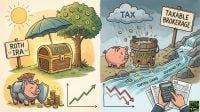
The 2026 standard deduction sits at $32,200 for married couples filing jointly and $16,100 for singles. The 12% bracket runs up to $100,800 for joint filers, and the 22% bracket does not kick in until $100,800. If you convert traditional IRA dollars into a Roth now, you pay tax at those low rates and everything after grows tax-free forever (we sized up this quiet stretch between your last paycheck and your first RMD in a free Roth guide here). The problem is choosing what those Roth dollars own, because they need to compound aggressively enough to justify paying the conversion tax up front. Concentrated growth, deep value, and a diversified core is a clean way to divide the pie.
QQQM: The Growth Engine
Your Roth is the one account where taxes will never touch the gains, so it deserves your highest-growth holdings. QQQM tracks the Nasdaq-100. Its top positions read like the AI infrastructure map: NVIDIA at 8.130%, Apple at 7.260%, Microsoft at 5.298%, Amazon at 4.604%, and Broadcom at 3.357%. The fund manages roughly $97.2 billion in net assets as of the May 31 filing, and it is up 17.11% year to date and 103.85% over five years. QQQM is the cheaper sibling of QQQ, built for buy-and-hold accounts like yours. Put growth here because tax-free compounding on a fund tilted toward large tech is the single best gift you can give your 80-year-old self.
AVUV: The Diversifier That Actually Diversifies
Filling a Roth with only mega-cap tech is a bet that the last 15 years repeat. AVUV is the counterweight. It is an actively managed small-cap value fund from Avantis with about $27.1 billion in net assets, spread across 300-plus positions in banks, industrials, energy, and consumer names like Bank OZK, ArcBest, Five Below, and Alaska Air Group. Small-cap value has historically delivered a return premium over the broad market when you can hold it through the volatility, and a Roth is the perfect wrapper because the eventual gains never get taxed. The fund is up 25.03% year to date and 34.56% over the past year, a reminder that this corner of the market moves on its own schedule.
VOO: The Core That Ties It Together
Anchor everything with VOO. Vanguard’s S&P 500 fund carries a 0.03% expense ratio, which means you keep $997 of every $1,000 working for you. It is the definition of a core holding: 500 of the largest U.S. companies, weighted by size, at a cost that is essentially free. VOO is up 13.16% year to date, 20.69% over the past year, and 314.68% over the past ten years. Once your RMDs eventually begin, the Roth is not subject to them, but the discipline of a low-cost core keeps the account simple to manage when you would rather be doing anything else.
The Trade-Off
None of these funds throw off much income. QQQM and AVUV both lean towards growth in different ways, and even VOO yields modestly. If you are converting to a Roth expecting a monthly check, you are in the wrong vehicle. This portfolio is built for the account you touch last in retirement. Fill your taxable brokerage or a bond allocation with income producers. Use the Roth for the assets you want to grow untouched for two or three decades. That is the whole point of paying the conversion tax now while your bracket is a gift.
Contact [email protected] for any questions or corrections.
Ryne Mauck is an investment writer covering exchange-traded funds, retirement planning, and portfolio strategy. Through his work at 24/7 Wall St. and other investment platforms, including Seeking Alpha, he aims to provide clear, research-driven insights that help investors make more informed decisions while maintaining a long-term approach to investing.
Ryne holds a B.Sc. in Finance and an M.A. in Political Science. He is a formerly registered Municipal Advisor Representative and has passed the Series 50, Series 63, and Series 65 exams. His articles are not intended to be, nor should they be interpreted as, financial advice.