Why JEPI’s Total Return Has Outpaced Its Payout
JEPI's share price keeps climbing while its monthly cash payments quietly shrink, and the reason behind that split reveals something most income investors never check before buying a covered-call fund.

This post may contain links from our sponsors and affiliates, and Flywheel Publishing may receive compensation for actions taken through them.

JPMorgan Equity Premium Income ETF (NYSEARCA:JEPI) has had a total return near 8% over the past year, but the cash it paid out over that stretch fell. Distributions over the trailing 12 months came to $4.56 per share, down about 4% from $4.75 in the prior 12 months.
With shares near $57, the trailing yield still works out to an ultra-high 8.2%, and the fund charges 0.35% a year. Retirees want to know if the monthly check will hold up as the price pulls away from it.
Two Engines Behind Every Monthly Check
JEPI pays income from two places. A defensive portion of large U.S. stocks pays ordinary dividends. Equity-linked notes (ELNs) supply the rest. ELNs are bank-issued securities that pass along the premium earned from selling out-of-the-money S&P 500 call options. That option premium is generally taxed as ordinary income, so much of the payout misses the lower qualified-dividend rate in a taxable account.
Option premiums rise and fall with market volatility, so the check changes every month. The latest payment of $0.34 was the lowest of 2026. At the current annualized rate, the forward yield is closer to 7.2%.
| Month | 2026 | 2025 |
|---|---|---|
| October | $0.34134 | $0.36102 |
| September | $0.37142 | $0.36826 |
| August | $0.36664 | $0.35772 |
| July | $0.38716 | $0.39953 |
| June | $0.389 | $0.54001 |
| May | $0.44761 | $0.48792 |
Four of those six months came in lower than a year earlier. June shows the widest gap, a reminder that one strong options month can significantly boost the trailing yield.
Why Calm Markets Squeeze the Payout
Selling call options caps upside in exchange for cash today. When stocks rise steadily, implied volatility tends to fall, and each new batch of calls brings in less premium. That same calm market raises the stock portion and drives shares higher. The past year fits this pattern: the price rose while the payout drifted lower. A volatility spike would likely flip it, raising premiums while squeezing the price.
AbbVie Is the Closest Call Among Top Holdings
The latest available holdings come from a filing dated June 30, 2026, so current weights may differ. The fund held 129 positions and $44.7 billion in net assets. Each ELN made up less than 1% of assets. The largest stocks:
- AbbVie (NYSE:ABBV | ABBV Price Prediction), 1.7% weight, yields 2.4%. Its $6.83 annual dividend exceeds GAAP EPS of $3.54, a 193% payout ratio. A forward P/E of 18 indicates analysts expect earnings to recover well above the dividend, and coverage depends on that recovery.
- Howmet Aerospace (NYSE:HWM), 1.7%, yields 0.3%. A 10% payout ratio makes the dividend very safe, though it adds little income.
- Johnson & Johnson (NYSE:JNJ), 1.7%, yields 2.0%. EPS of $6.59 covers the $5.28 dividend, an 80% payout.
- Eaton (NYSE:ETN), 1.6%, yields 1.2%. A 44% payout ratio leaves plenty of room.
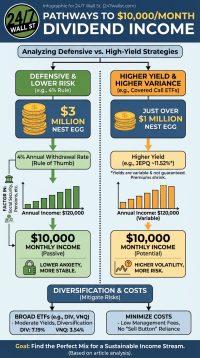
These dividends are well covered but small. Most of JEPI’s 8% yield comes from the options overlay, which is why the check moves with volatility rather than with any single company’s payout policy. For readers trying to convert a nest egg into a predictable monthly income stream, we have laid out the full mix, payment calendar, and withdrawal order in a free guide: The Paycheck Portfolio Method.
A Durable Payout, but Plan for Less
The fund’s total return is up more than 6% this year and 42% over five years. The distribution looks durable: the options premium resets every month, and the stock portion holds well-covered dividend payers. It is still variable, and it has been drifting down.
The forward rate of about 7% is a more realistic income baseline than the trailing figure, and holding the fund in an IRA removes the ordinary-income tax drag. Over time, holders have benefited from rising share prices on top of their income distributions. A payout that grows every year is more typical of dividend-growth funds, and a strategy that caps upside tends to trail in strong bull markets.
Contact [email protected] for any questions or corrections.
Trey has been an editor and author at 24/7 Wall St. for more than a decade, where he has published thousands of articles analyzing corporate earnings, dividend stocks, short interest, insider buying, private equity, and market trends. His comprehensive coverage spans the full spectrum of financial markets, from blue-chip stalwarts to emerging growth companies.
Beyond 24/7 Wall St., Trey has created and edited financial content for Benzinga and AOL's BloggingStocks, contributing additional hundreds of articles to the investment community.
Trey's editorial expertise extends across multiple publishing environments. He served as production editor at Dearborn Financial Publishing and development editor at Kaplan, where he helped shape financial education materials. Earlier in his career, he worked as a writer-producer at SVE. His freelance editing portfolio includes work for prestigious clients such as Sage Publications, Rand McNally, the Institute for Supply Management, the American Library Association, Eggplant Literary Productions, and Spiegel.
Outside of financial journalism, Trey writes fiction and has been an active member of the writing community for years, moderating workshop sessions at regional conventions.