This Little-Known ETF Owns QQQ’s Stocks Without the Big Bet on Nvidia
QQQ investors hand nearly 8 cents of every dollar to a single chipmaker without realizing a quieter fund holds every same stock with none of that concentration risk.

This post may contain links from our sponsors and affiliates, and Flywheel Publishing may receive compensation for actions taken through them.

Most people who buy Invesco QQQ Trust (NASDAQ:QQQ) want broad exposure to the NASDAQ-100. That portfolio leans heavily on a few chipmakers and tech platforms. Retirees and near-retirees who like the growth of those 100 companies but don’t want so much riding on a few of them can look at a smaller fund. It holds the same holdings on very different terms: the Direxion NASDAQ-100 Equal Weighted Index ETF (NASDAQ:QQQE).
NVIDIA Holds 7.6% of QQQ but Under 1% of QQQE
QQQ seeks to track the investment results, before fees and expenses, of the Nasdaq-100 Index, and it weights each company by market value. As of June 30, 2026, NVIDIA (NASDAQ:NVDA | NVDA Price Prediction) was its largest holding at 7.60% of net assets. QQQE owns the same company, but as of July 31, 2026, NVIDIA made up only 0.97% of the fund. Using those two filing dates, QQQ held about 7.8 times as much NVIDIA per dollar invested.
The same pattern holds. Apple (NASDAQ:AAPL) was 6.67% of QQQ as of June 30, compared with 1.01% of QQQE as of July 31. That’s a ratio of roughly 6.6 to 1. The two filings are a month apart, so the weights have moved since then. The gap itself is built in, though. QQQE regularly rebalances every holding back to a roughly equal piece, while QQQ lets its biggest winners keep growing.
Six Giants Take Up a Third of QQQ
In QQQ’s June 30 filing, its six largest holdings, led by NVIDIA and Apple, added up to about 32.4% of the fund. In QQQE’s July 31 filing, those same six names came to roughly 5.9%. QQQE’s equity weights ran from 0.4425047962% to 1.3017191224%, and most positions sat near 1%. The money that QQQ puts into its giants is spread across health care, industrials, utilities, consumer and software companies. In QQQ, those companies get much smaller slices.
A $1.33 Billion Fund Next to a $490 Billion Giant
QQQE reported $1.33 billion in net assets as of July 31, 2026. QQQ reported $490.1 billion as of June 30, which makes it roughly 368 times larger. Trading volume shows the same gap. On October 29, 154,014 QQQE shares changed hands, compared with 37,532,845 for QQQ. QQQ’s long track record keeps it in the spotlight.
Equal Weight Has Led Lately
| Period (through Oct. 29, 2026) | QQQE | QQQ |
|---|---|---|
| 1 Month | -0.91% | -3.06% |
| Year to Date | 17.06% | 16.45% |
| 1 Year | 15.36% | 12.52% |
| 5 Years | 46.74% | 85.27% |
| 10 Years | 296.01% | 511.45% |
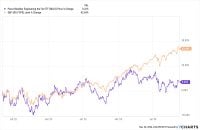
QQQE’s figures are adjusted for distributions, while QQQ’s reflect price changes only. That means the table actually understates QQQ’s long-term advantage. Over the past year and so far in 2026, QQQE has come out ahead. Over the most recent month, it fell less than QQQ did.
Know the Trade-Offs of Equal Weighting
Equal weighting falls behind when the biggest companies lead the market. Our May 20 analysis indicated that QQQ’s concentration was beating equal weight during the AI spending cycle, and the five- and 10-year figures support that view. Because QQQE keeps each winner near 1%, it gets less of any mega-cap rally. The same rebalancing also means more trading inside the fund.
QQQE’s smaller size and lower trading can mean wider bid-ask spreads, so it’s worth checking quotes before placing an order. A fund with modest assets also faces more risk of being closed than a giant does. If assets shrink, the sponsor can shut down the fund, forcing shareholders into a sale, and possibly a tax bill, on someone else’s schedule. At $1.33 billion, QQQE is well established, but it’s small next to its rival. Cost belongs in the comparison too. QQQ’s prospectus lists a management fee of 0.18%, so look up QQQE’s current expense ratio in Direxion’s fund documents before deciding.
Who QQQE Suits, and Who Is Better Off With QQQ
QQQE suits investors who are nervous about how much of QQQ depends on a few names. That includes retirees who don’t want one chipmaker’s earnings report to swing a large part of their savings. QQQ lines up more closely with investors who expect the largest NASDAQ companies to keep leading and who value deep liquidity and a huge asset base. Both funds own the same companies. The key difference is how much of your money sits in the top few. QQQE’s next portfolio filing will show how far its equal slices shifted during the fall.
Contact [email protected] for any questions or corrections.
Jake has been been working in financial media for almost 15 years. He focuses on all things personal finance for 24/7 Wall St. with high hopes to educate and entertain. Most recently, Jake spent 12 years working various roles at The Motley Fool. He started copy editing fool.com content, worked on premium and marketing campaigns, and helped launch The Ascent, a personal finance brand.
His work has been featured on platforms like MSN, Yahoo Finance, USA Today, and more. He's written about credit cards, social security, ETFs, savings accounts, and just about anything else you can imagine when thinking about money. Jake love to cook, play golf, and tell people he's never had a cavity. (It's true!)