2 Global ETFs Do the U.S.-vs.-International Rebalancing for You

This post may contain links from our sponsors and affiliates, and Flywheel Publishing may receive compensation for actions taken through them.

Holding a U.S. stock fund next to an international one means making the same decision again and again. How much belongs abroad, and when should you trim the winner to restore your split? Vanguard Total World Stock Index ETF (NYSEARCA:VT) and iShares MSCI ACWI ETF (NASDAQ:ACWI) put both portions into a single ticker and let global market values set the mix. The trade-off is performance. Over the past five and ten years, both funds trailed the S&P 500 by a wide margin because U.S. stocks led the world.
How One Global Fund Sets Your U.S.-International Mix
Both funds weight their holdings by market value. VT tracks the FTSE Global All Cap Index, which Vanguard describes as free-float-adjusted, market-capitalization-weighted. Free float means the index counts only shares available to public investors, so blocks held by founders or governments are left out. A company’s weight reflects what its publicly traded stock is worth.
As a result, the U.S. and international portions move with global markets. When American stocks outpace Europe and Japan, the U.S. share of the fund grows. When foreign markets lead, the international share expands. Regional weights float with prices, and the fund has no fixed target to return to. What the fund takes off your plate is the task of selling U.S. shares to buy foreign ones, or the reverse.
The usual do-it-yourself version pairs Vanguard Total Stock Market ETF (NYSEARCA:VTI) with Vanguard Total International Stock ETF (NASDAQ:VXUS). That pair gives you control over the tilt, but you have to pick the ratio, keep it in place, and avoid selling the foreign side after a few lean years. A one-fund setup hands that call to the market.
VT Casts the Widest Net, Small Caps Included
VT is the closest you can get to having the entire investable global stock market with one ticker. Its index covers large-, mid-, and small-capitalization stocks of companies located around the world. That small-cap layer is VT’s real edge. It gives you smaller companies in Japan, Europe, and emerging markets that ACWI leaves out.
Index rules also shape the regional mix. The two index providers split on South Korea (MSCI classifies South Korea as emerging, FTSE as developed). So the two funds will disagree slightly on how much sits in emerging markets.
For retirees, the payout schedule matters. VT pays out quarterly, and its trailing 12-month total came to $2.41 per share. The amounts vary from one quarter to the next. The September payment was $0.41, down from $0.56 in June. The timing lines up with regular spending, but the cash itself will vary.
VT returned 7% over the past year with distributions reinvested. It also dropped about 10% over the past month to roughly $142, a reminder that having the whole world offers no shelter from a broad selloff. The small-cap portions can add a bit of volatility, and you give up any ability to lean toward or away from the U.S.
ACWI Sticks to Large and Mid Caps Under MSCI’s Rules
ACWI tracks the MSCI ACWI Index, which covers large- and mid-cap stocks across 23 developed and 24 emerging markets, weighted by market value. Its N-PORT filing listed 2,273 holdings as of July 31, 2026.
It held roughly $32 billion[1] in net assets. For investors wanting the established big-company core of world markets without a long tail of small companies, that tighter roster is the appeal.
That same filing shows how much U.S. megacaps drive a fund sold as global. Apple alone was about 4%[2] of net assets, Amazon about 3%, and Broadcom about 2%, with Alphabet held in two share classes. A rough quarter for American tech will show up here.
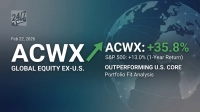
ACWI pays out semi-annually, usually in June and December, and its trailing 12-month total reached $2.25 per share. Retirees who rely on distributions will get fewer and lumpier checks. Over the past year, it returned 7%, in line with VT. The MSCI framework suits investors already using iShares funds or measuring themselves against MSCI benchmarks.
Your Stock-Bond Split Still Needs Rebalancing
Both of these are all-stock funds. If you also hold bonds or cash, you still have to rebalance between those holdings and your global fund. After a strong year for stocks, equities will make up more of your portfolio than you intended, and your risk rises with them.
A global fund makes one decision: how much to keep abroad. Your overall risk level is still yours to manage. Many investors check once a year or whenever stocks drift a set amount from target. Retirees taking withdrawals can sell from whichever side is overweight and rebalance as they spend.
What Owning the World Cost Versus the S&P 500
The comparison below uses iShares Core S&P 500 ETF (NYSEARCA:IVV), with total returns through the latest close and distributions reinvested.
| Fund | 1 Year | 5 Years | 10 Years |
|---|---|---|---|
| VT | 7% | 45% | 190% |
| ACWI | 7% | 46% | 192% |
| IVV | 7% | 58% | 269% |
Over the past year, all three came in close together. Over five and ten years, both global funds trailed IVV. IVV returned 269% over the decade, compared with 190% for VT and 192% for ACWI. That gap was the cost of having international stocks during a stretch when U.S. stocks led. None of these windows tells what comes next.
Before choosing either fund, consider these risks:
- Currency swings: foreign holdings trade in yen, euros, and other currencies, so a stronger dollar lowers their value for U.S. investors even if the stock prices themselves don’t move.
- Foreign market and political risk: sanctions, capital controls, and weaker governance in some emerging markets can hit prices in ways that U.S. investors rarely face at home.
- Heavy U.S. megacap weight: ACWI’s largest disclosed positions are American tech giants, so a global label still carries concentrated exposure to a handful of companies.
- Long stretches of lagging: trailing the S&P 500 for a decade tests patience, and selling after the gap opens locks in the shortfall.
Picking Your One-Ticker World Portfolio
VT fits long-term investors who want the broadest possible ownership, small caps included, and quarterly distributions. ACWI suits investors who prefer a large- and mid-cap core under MSCI’s categories, especially those already invested in iShares funds who can live with twice-yearly payouts. Whichever one you hold, decide on a bond allocation and rebalance it on a schedule, because neither fund does that for you.
Contact [email protected] for any questions or corrections.
Ryne Mauck is an investment writer covering exchange-traded funds, retirement planning, and portfolio strategy. Through his work at 24/7 Wall St. and other investment platforms, including Seeking Alpha, he aims to provide clear, research-driven insights that help investors make more informed decisions while maintaining a long-term approach to investing.
Ryne holds a B.Sc. in Finance and an M.A. in Political Science. He is a formerly registered Municipal Advisor Representative and has passed the Series 50, Series 63, and Series 65 exams. His articles are not intended to be, nor should they be interpreted as, financial advice.