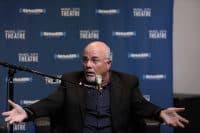
Dave Ramsey: “This Guy Is 100% Controlling, and That’s 100% a Financially Abusive Situation”
Financial control in marriage isn’t just bad budgeting—it’s abuse. When one spouse weaponizes money to manipulate and punish, it threatens the entire family’s wellbeing. On a January 2026 episode of The Dave Ramsey Show, a caller in her mid-40s with…

This post may contain links from our sponsors and affiliates, and Flywheel Publishing may receive compensation for actions taken through them.

Financial control in marriage isn’t just bad budgeting—it’s abuse. When one spouse weaponizes money to manipulate and punish, it threatens the entire family’s wellbeing.
On a January 2026 episode of The Dave Ramsey Show, a caller in her mid-40s with six children revealed her husband had intentionally reduced their family income, depleted their savings, then hid accounts from her. After 20 years of financial dependence, she was cut off from the family credit card and forced to use a card in her own name while he threatened to ruin her credit.
“He artificially reduced the amount of money in our family income so that it was below how much we needed,” she explained. “We basically blew through all of the extra savings that were in that account.”
Ramsey’s co-host immediately identified the pattern. “This guy is 100% controlling, and that’s 100% a financially abusive situation,” he said. “I guarantee you this is not the only place that he’s asserting control.”
Where the Advice Holds Up
The assessment was accurate. Financial control appears in 99% of domestic violence cases according to the National Network to End Domestic Violence. This near-universal presence reveals something critical: financial abuse isn’t a side effect of violent relationships, it’s the foundation. Abusers know that without money, victims can’t leave, can’t hire lawyers, and can’t start over. This caller’s experience follows that exact blueprint: her husband systematically reduced family income, then restricted her access to funds while threatening financial consequences.
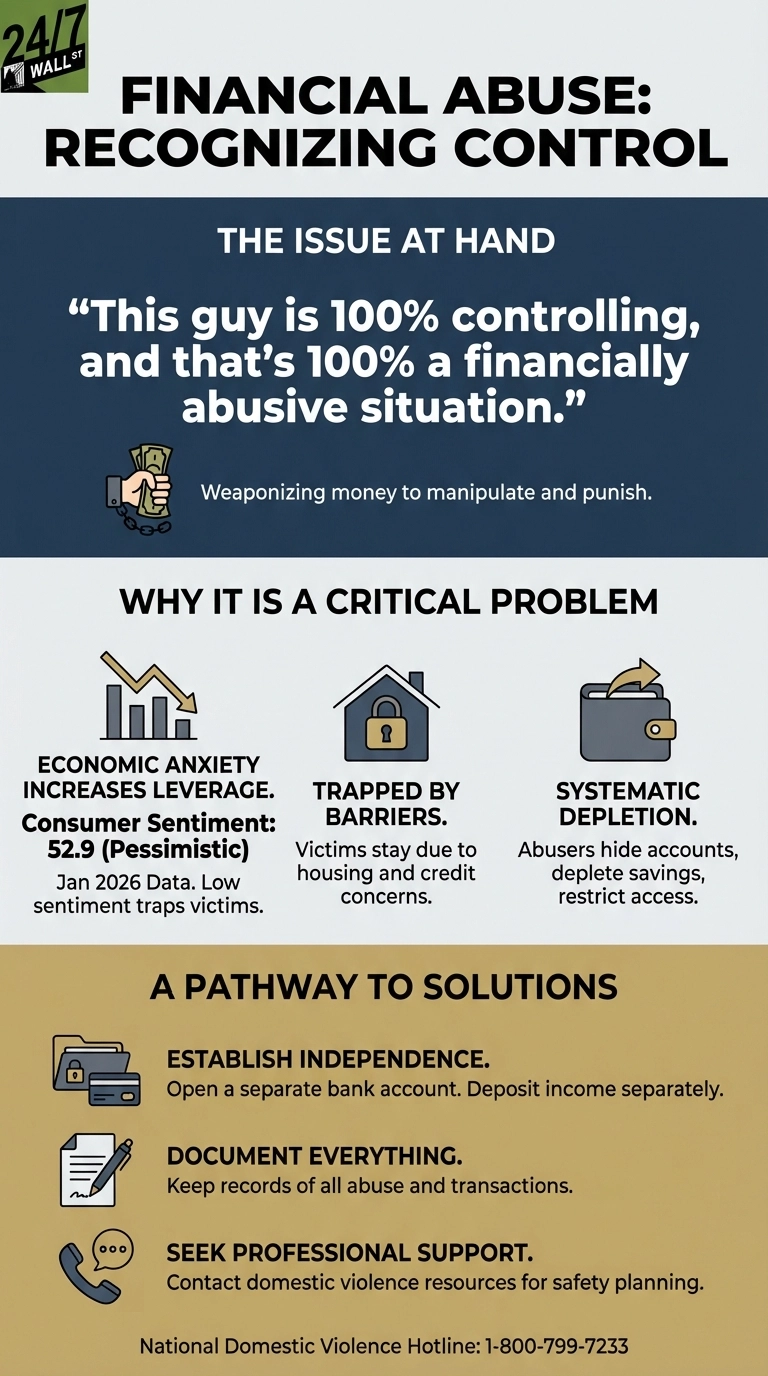
The immediate action steps were sound. Ramsey advised getting a debit card tied to the joint account that day, depositing her personal check into a separate account, and demanding transparency. “You have to create your own bubble over here because this person isn’t safe,” Ramsey said. For someone with six children and no independent access to money, establishing a financial safety net isn’t betrayal—it’s survival planning.
The Context That Matters
What the show didn’t address: leaving is harder than it sounds. Research shows most domestic violence victims remain with abusers primarily due to economic reasons. After 20 years without separate income or credit history, this caller faces practical barriers—housing, credit, legal fees—that can’t be solved with a debit card alone.
The current economic environment compounds these challenges. Consumer sentiment has fallen to 52.9, reflecting the financial anxiety gripping American households. This anxiety gives abusers more leverage—when victims feel economically trapped by broader conditions, controlling spouses exploit that fear to tighten their grip.
How to Think About This Advice
If you recognize these patterns—restricted access to accounts, threats about money, punishment through financial withholding—Ramsey’s core message is correct: protecting yourself isn’t disloyal. Opening a separate account and documenting financial abuse are necessary first steps.
But financial independence takes time to build. Connect with domestic violence resources that offer economic empowerment programs, legal aid, and safety planning. The National Domestic Violence Hotline (1-800-799-7233) provides confidential support tailored to your situation.
Marriage requires equal partnership and transparency. When one spouse refuses both despite repeated requests, the other must prioritize safety—especially when children are involved.
Contact [email protected] for any questions or corrections.
Austin Smith is a financial publisher with over two decades of experience as an investor, analyst, and advisor. He covers stocks, ETFs, Artificial intelligence and personal finance for 24/7 Wall St. Previously, he spent over a decade at The Motley Fool as a senior editor for Fool.com, portfolio advisor for Millionacres, and launched The Ascent to help reader take control of their personal finances.
His work has been featured on Fool.com, NPR, CNBC, USA Today, Yahoo Finance, MSN, AOL, Marketwatch, and many other publications. He is as an advisor to private companies, and co-hosts The AI Investor Podcast with Eric Bleeker.
When not looking for investment opportunities, he can be found skiing, running, or playing soccer with his children. Learn more about Austin's investment approach here.