People Actually Retire In Roswell. And Not Because Of The Aliens
Roswell has a branding problem. Mention the city at a dinner party and someone will roll their eyes and make a joke about little green men before you’ve finished the sentence. For most Americans, Roswell exists somewhere between a roadside…

This post may contain links from our sponsors and affiliates, and Flywheel Publishing may receive compensation for actions taken through them.
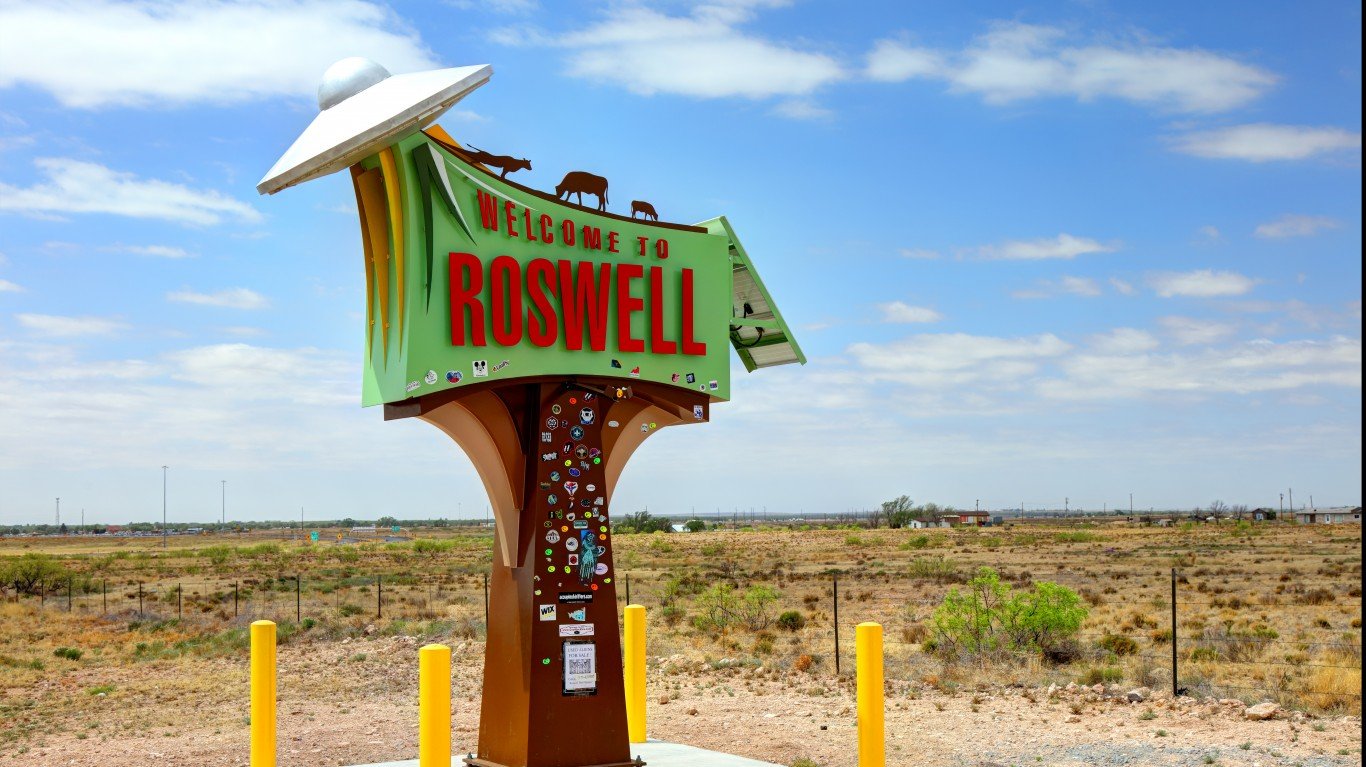
Roswell has a branding problem. Mention the city at a dinner party and someone will roll their eyes and make a joke about little green men before you’ve finished the sentence. For most Americans, Roswell exists somewhere between a roadside attraction and a punchline. What gets overlooked is that people actually live there, raise families there, and increasingly retire there. The same town famous for the world’s most famous UFO incident from 1947 also happens to offer sunshine, low housing costs, light traffic, and a cost of living that looks increasingly attractive to retirees who have been priced out of Arizona, Colorado, and much of Texas.
That does not automatically make Roswell a retirement bargain. Affordable places are often affordable for a reason. The question is whether Roswell’s lower housing costs and slower pace of life outweigh its isolation, healthcare limitations, and small-city economy. For a 67-year-old with a $500,000 portfolio and $2,500 a month in Social Security, the answer depends on whether the city’s biggest asset is its affordability or simply the fact that most retirees are looking somewhere else.
How Roswell Gives… and Takes Away
The reason Roswell appears on retirement shortlists has nothing to do with UFOs and everything to do with arithmetic. New Mexico carries a regional price parity of 92.2, well below Arizona at 100.7, Nevada at 100.0, Texas at 97.1, and Colorado at 103.1. Roswell sits toward the affordable end of New Mexico’s housing market. A serviceable three-bedroom home can still be found in the low $200,000s, a figure that barely buys a down payment in parts of Scottsdale. Property taxes help too. New Mexico’s property tax burden ranks among the lowest in the nation, and a typical Roswell homeowner may pay only $1,500 to $1,800 annually on a home worth around $220,000.
The savings are substantial, but they are not free. Roswell is a city of roughly 48,000 people surrounded by ranchland, cattle country, irrigated farms, sagebrush plains, and the kind of wide-open landscape where the horizon feels impossibly far away. The nearest major metropolitan areas, Albuquerque, El Paso, and Lubbock, are all about three hours away. Summer temperatures regularly push into the 90s and beyond. More importantly for retirees, specialist healthcare is limited. A lower mortgage payment is helpful, but it loses some of its appeal when routine medical appointments require long drives. Roswell works best for retirees who value affordability, sunshine, and simplicity enough to accept the tradeoff of living farther from the amenities and healthcare networks found in larger Southwestern cities.
The Working Budget For A Paid-Off Single Retiree
Assume the house is owned outright, leaving a $500,000 portfolio intact. Here is what the year looks like in current dollars, with CPI sitting at 334.0 and running hot:
- Property tax, homeowners insurance, maintenance reserve: about $6,800.
- Utilities, with summer cooling: about $3,600.
- Groceries on the USDA moderate plan: about $5,200.
- Healthcare, including $202.90 monthly Part B premium, Medigap Plan G, Part D, dental, and out-of-pocket: about $5,400.
- Transportation, including car, fuel, insurance, and replacement reserve: about $4,800.
- Personal, recreation, gifts, travel: about $6,000.
- Income taxes on portfolio withdrawals and Social Security: about $2,200.
That totals roughly $34,000 a year for a modest, comfortable life. A more generous version with frequent travel reaches about $42,000.
Does The $500,000 Actually Carry It
Social Security delivers $30,000 a year. New Mexico exempts Social Security entirely for single filers under $100,000 of adjusted gross income, so the state takes nothing on the benefit. Against a $34,000 budget, the portfolio gap is $4,000. Against $42,000, it is $12,000.
A $4,000 draw on $500,000 is a 0.8% withdrawal rate. A $12,000 draw is 2.4%. Both sit well below the conventional 4% guideline, meaning the portfolio supports rather than carries the retirement. With the 10-year Treasury at 4.45%, the 2-year at 4.05%, and 10-year TIPS real yields at 2.16%, a sensible mix is a five-year Treasury ladder for near-term spending, a TIPS sleeve for healthcare inflation, a broad dividend equity allocation for growth, and a small cash bucket. The portfolio can generate $4,000 to $12,000 from yield alone, the version of retirement security that lets you sleep.
The Healthcare Geography Problem
Roswell has a regional hospital and primary care, but cardiology, oncology, orthopedic surgery, and complex imaging route patients to Lubbock, Albuquerque, or El Paso, a gap most affordability analyses miss. Medicare Advantage networks in Chaves County are narrow, often excluding the out-of-area systems retirees actually use. The practical answer is Original Medicare plus Medigap Plan G, which costs more monthly but travels anywhere Medicare is accepted. That choice is already in the $5,400 healthcare line. The windshield time sits outside it. Budget two to four trips a year of 200 miles each way, plus occasional overnights, adding roughly $1,500 to miscellaneous.
Over a 25-year retirement, this geography argues for owning a reliable vehicle rather than the cheapest one, and keeping a larger cash reserve than a Phoenix retiree would carry, because same-day specialist visits are rarely an option.
What It Actually Takes
A 67-year-old with $500,000 invested and $2,500 a month from Social Security can retire comfortably in Roswell, especially if the home is owned outright. The combination of lower housing costs, modest property taxes, and a slower pace of spending means the portfolio does not need to work nearly as hard as it would in Scottsdale, Sedona, or many parts of Texas. A withdrawal rate in the low single digits can cover the gap while still leaving room for the portfolio to grow and help offset inflation over time.
The catch is that Roswell asks retirees to solve a different problem. The challenge is not usually money. It is distance. Specialist healthcare often requires travel. Major shopping trips may involve longer drives. Visiting family can mean a regional flight or several hours on the highway. Roswell’s affordability is real, but it comes paired with geographic isolation. For retirees who value sunshine, simplicity, and financial breathing room more than convenience, that trade can be worthwhile. And if the UFO stories turn out to be true after all, at least transportation options may improve dramatically.
Contact [email protected] for any questions or corrections.
Drew Wood has edited or ghostwritten nine books and published more than 1,500 articles on investing, business, politics, travel, world cultures, wildlife, and earth science. He holds a doctorate and four master's degrees and has nearly 30 years of college teaching experience. His travels have taken him to 25 countries, including three years living in Ukraine.