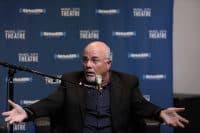
‘Who Loans Somebody $175,000 to Get an Almost Degree?’: Dave Ramsey Unloads on an Army Soldier Whose Wife Has $177K in Student Debt and No Degree
A 20-year-old soldier just married, about to become a father, and sitting across from a $177,000 student loan balance his wife racked up without ever finishing her degree. Dave Ramsey had a lot to say about who is really to…

This post may contain links from our sponsors and affiliates, and Flywheel Publishing may receive compensation for actions taken through them.

A 20-year-old active-duty Army soldier called into The Ramsey Show with a line that captures the entire episode in a single breath: “I got married a few months ago, and a few weeks ago we found out my wife is also pregnant. Yay! And we have a little bit of a debt problem.” The debt problem is roughly $177,000 in student loans his 23-year-old wife accumulated while attending a Division I out-of-state school, switching majors from education to business marketing, and ultimately walking away without a degree.
Dave Ramsey’s opening response was characteristically blunt: “Who loans somebody $175,000 to get an almost degree? Only the U.S. Congress would do that. Only there’s only one organization that’s that screwed up, and it’s the U.S. Congress.” The stakes for this family could hardly be higher. A baby is on the way, one income is military pay, the other is freelance childcare work, and the loan balance is nearly twice what the couple earns together.
Ramsey’s Plan Is Sound Because the Math Works
Ramsey’s advice holds up for one central reason: he refused to let emotion override sequencing. His plan follows a clear order of operations. Keep building cash reserves until the baby arrives, target roughly $75,000 on hand by delivery, make a large lump-sum principal payment once mother and child are healthy, then attack the remaining balance with everything the household can spare. He estimated another three to four years of aggressive repayment on their roughly $90,000 combined income.
The core mechanic is liquidity sequencing. The couple already holds about $35,470 in a mutual fund and just under $30,000 in a money market account. Liquidating all of that today and throwing it at the loan would leave them with a newborn and no cash buffer. A hospital bill, a job disruption, or a car repair would then force them back to borrowing, most likely on credit cards. The 30-day credit card delinquency rate on all commercial bank accounts fell to 2.85% in Q2 2026, the eighth straight quarterly decrease, yet the figure still sits above its pre-pandemic norm and the Federal Reserve Bank of New York has separately noted that 90-plus day delinquencies on credit card balances climbed from 7.6% to 12.8% between 2022 and early 2026. Building cash first and then landing a large principal strike is how this couple stays out of that spiral.
Run the numbers and Ramsey’s logic becomes concrete. Hitting the $75,000 target and applying it to the balance brings the debt down to roughly $100,000 before parenthood fully sets in. On $90,000 gross income, directing $30,000 to $35,000 a year toward that balance clears it in three to four years, which is exactly the window Ramsey outlined. That outcome is only realistic because their car and credit card debt are already eliminated.
The Variable That Changes Everything: Whether Both Spouses Keep Earning
Ramsey was direct that the wife cannot step back from work given the debt she carries. That single point is the pivot of the entire plan. Lose the $36,000 nanny income and the household drops to $54,000 in military pay, well below the roughly $69,000 per capita disposable income the Bureau of Economic Analysis reported for Q2 2026. At that income level, with a newborn and compounding interest, the payoff timeline stretches from four years toward a decade.
Keep both incomes and the picture changes completely. A dual-earner household at $90,000 sits comfortably above per capita disposable income benchmarks. Even with the national personal savings rate running at just 2.7% as of June 2026, this couple can realistically direct 30% to 40% of gross income toward the loan. That kind of aggressive allocation is possible precisely because their fixed obligations are already minimal and their housing is partially subsidized through military allowances.
Ramsey’s Broader Complaint Lands
Ramsey did not spare the other adults in this story. “You ought to have your butt kicked up around your neck and wear it like a collar if you let your kid do this,” he said of parents who co-sign this kind of loan package. His completion statistic explains the frustration: “54% of the people that start four-year degrees finish them. That by definition means half don’t, and you get where she is.” National enrollment research puts the four-year institution graduation rate at approximately 53.5%, which lines up almost exactly with Ramsey’s figure. Close to half of all students who borrow for a four-year credential walk away without the degree that was supposed to justify the cost.
That mismatch between borrowing and completion is what Ramsey was really targeting. The loan was extended not because the borrower demonstrated earning capacity, but because Congress structured federal lending in a way that asks no questions about likelihood of graduation, choice of major, or realistic future income. The family sitting across from $177,000 in debt for a credential that was never earned is what that policy looks like in practice.
What To Do If You Are Staring At a Balance Like This
- Build the cash floor first. Six months of expenses in a money market account before making any lump-sum principal strike, especially with a major life change on the way.
- Separate federal from private balances. Federal loans may qualify for income-driven repayment options; private loans generally do not. Pull every promissory note and list rate, balance, and lender side by side.
- Attack highest-rate debt first. Order the loans by interest rate, pay minimums on everything else, and concentrate every extra dollar on the costliest balance.
- Protect both incomes. If one spouse stepping back is under consideration, model the payoff timeline under a single income before committing to that decision.
The path forward rests on two variables: whether both incomes survive the newborn phase intact, and whether the couple holds the line on lifestyle inflation long enough to clear the balance inside the three-to-four-year window Ramsey outlined. The math is not generous, but it does work.
Editor’s note: This article has been updated to reflect the Q2 2026 credit card 30-day delinquency rate of 2.85% (the eighth straight quarterly decrease, per Federal Reserve data), replacing the prior Q1 2026 figure of 2.92%. The per capita disposable income benchmark has also been updated to approximately $69,000, reflecting Q2 2026 BEA data released July 30, 2026, compared with the previously cited Q4 2025 figure of $67,700.
Contact [email protected] for any questions or corrections.
I am a long time investor and student of business, and believe finding good companies that can become great investments is the best game on earth. After 20 years of writing and researching the public markets it is clear that individuals have never had more tools and information to take control of their financial lives. From ETFs and $0 commissions to cryptos and prediction markets there has never been a greater democratization of access to investing.
I write to help people understand the investments available to them so they can make the best choice for their portfolio, whether they're starting out or looking for income in retirement.