Everyone’s Chasing Sarasota. Smart Retirees Are Quietly Buying Here Instead
Sarasota became the reflex answer to retirement planning the way Naples was a decade ago, but the math behind that reflex has shifted in ways most buyers do not price until after closing.

This post may contain links from our sponsors and affiliates, and Flywheel Publishing may receive compensation for actions taken through them.
Every few years, someone at a dinner party names Sarasota, and half the table nods. It has become the reflexive answer to “where should we retire,” the way Naples was a decade earlier. The question worth asking is whether the reflex still pencils, and if not, where the same retirement dollar buys a comparable life.
Why Sarasota Stopped Being a Bargain
Sarasota has real assets: the Ringling, the beaches, and Sarasota Memorial. The problem is the carrying cost of a Gulf Coast address in a national housing market sitting near record highs. The S&P CoreLogic Case-Shiller U.S. National Home Price Index printed 336.7 in June 2026, its high for the supplied period, and Florida’s statewide cost-of-living index sits at 103.4 against a national average of 100.
Homeowners’ premiums in Gulf counties have risen as carriers pulled back or refused new business. Coastal Florida policies carry a separate named-storm deductible calculated as a percentage of dwelling coverage rather than a flat dollar figure. A single hurricane can produce an out-of-pocket bill several times higher than a standard deductible. Federally backed flood insurance through the NFIP adds a second premium for anyone in a mapped flood zone, and Risk Rating 2.0 has been repricing policies toward true-risk cost.
Condo buyers inherited a different problem after the 2021 Surfside collapse. Florida law now requires milestone structural inspections and fully funded reserves on older buildings, with special assessments running into the five- and six-figure range per unit. Property taxes are moderate by national standards, and Florida ranks 4th overall on the 2025 State Tax Competitiveness Index, but insurance and assessment have shifted the most.
Chattanooga as the Quiet Pick
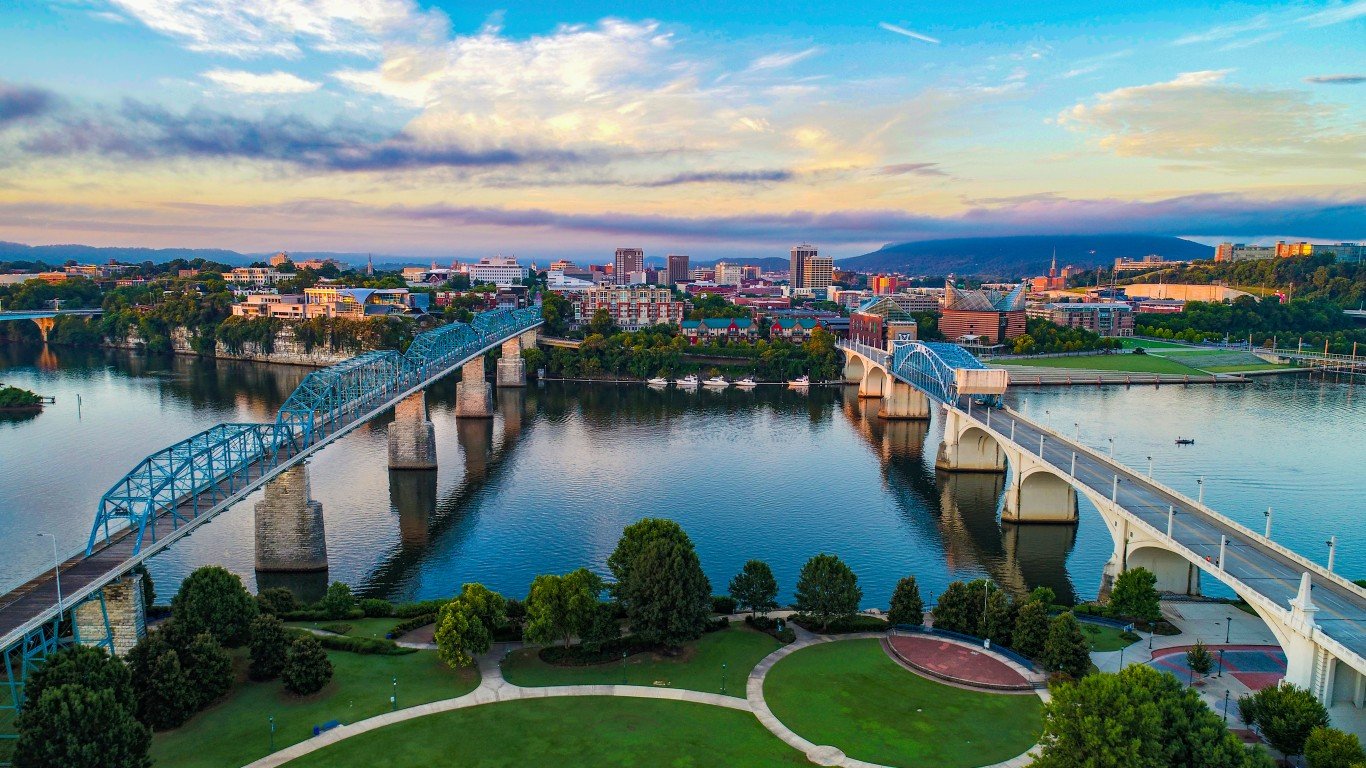
A meaningful alternative sits in Chattanooga, Tennessee. The state’s cost-of-living index comes in at 91.9, which is well below Florida’s 103.4, and Tennessee’s purchasing-power-adjusted real income of $72,154 actually edges out Florida’s $70,919, despite Florida having higher nominal earnings. Tennessee ranks 8th on the 2025 State Tax Competitiveness Index and ties for the best individual income tax rank in the country because the state imposes no tax on wages, pensions, IRA withdrawals, or Social Security.
When you line up the retirement criteria side by side, Chattanooga holds its own against a place like Sarasota. Erlanger Health System provides a Level I trauma center and a broad multispecialty medical network. Downtown offers a walkable riverfront, the Bluff View arts district, and the Tennessee Aquarium, which deliver real cultural depth, and the city sits within an easy drive of both Nashville and Atlanta. Housing is priced well within the national context set by the Case-Shiller reading, and since this is a non-coastal, non-hurricane market, insurance policies carry no named-storm deductible or NFIP flood-zone add-ons.
What the Math Looks Like
The BLS Consumer Expenditure Survey pegs average annual household spending at $78,535 for 2024, a reasonable starting point for a comfortable retirement budget. Applied against Tennessee’s 91.9 cost index versus Florida’s 103.4, the same lifestyle asks less of the portfolio in Chattanooga. The gap widens once Florida’s coastal insurance stack is priced in. Social Security benefits carry a tracking 3.1% COLA for 2027, which helps both sides but does more work against a lower nominal budget. The existing-home-sales pace of 4.06M annualized in July 2026 sits in the soft range, giving patient buyers negotiating room in secondary markets like Chattanooga that they will not find in coastal Florida.
A traditional couple aiming to close the gap between annual spending and Social Security at a standard withdrawal rate can see what the target portfolio looks like directly.
[calculator type=”withdrawal-rate” portfolio=”1500000″ annual_spending=”78535″ withdrawal_rate=”4″]
Most Sarasota-versus-elsewhere comparisons miss how the named-storm deductible interacts with a fixed retirement withdrawal plan. A percentage-of-dwelling deductible turns a single storm year into a liquidity event that a 4% withdrawal budget was never designed to absorb, forcing either a sequence-of-returns hit at the wrong moment or a dedicated cash reserve that lowers the portfolio’s effective withdrawal rate (the early-retirement version of this problem is the whole subject of a free guide we put together on defending the first five years). Chattanooga does not eliminate weather risk, but it removes that specific deductible structure from the balance sheet.
Chattanooga gives up saltwater, a mature snowbird ecosystem, and the specific Gulf-sunset lifestyle Sarasota sells. Winters are cooler, summers are humid rather than breezy, and the beach is a day’s drive. When those are non-negotiable, the answer is Sarasota. When they are not, Chattanooga delivers a comparable cultural and medical footprint on a materially lower cost base, in a state that does not tax the withdrawals funding any of it.
Contact [email protected] for any questions or corrections.
David Beren has been a Flywheel Publishing contributor since 2022. Writing for 24/7 Wall St. since 2023, David loves to write about topics of all shapes and sizes. As a technology expert, David focuses heavily on consumer electronics brands, automobiles, and general technology. He has previously written for LifeWire, formerly About.com. As a part-time freelance writer, David’s “day job” has been working on and leading social media for multiple Fortune 100 brands. David loves the flexibility of this field and its ability to reach customers exactly where they like to spend their time. Additionally, David previously published his own blog, TmoNews.com, which reached 3 million readers in its first year. In addition to freelance and social media work, David loves to spend time with his family and children and relive the glory days of video game consoles by playing any retro game console he can get his hands on.