The Backdoor Roth: The Legal Workaround High Earners Use to Build a Tax-Free Pile
The tax code bars high earners from contributing directly to a Roth IRA, but a legal workaround built into the IRS's own forms lets them get money in anyway. The catch is a single overlooked account balance that can silently…

This post may contain links from our sponsors and affiliates, and Flywheel Publishing may receive compensation for actions taken through them.
Consider a 58-year-old single filer earning $260,000 who wants to save in a Roth IRA for 2026. The tax code says she can’t contribute a dollar directly because her income is too high. Within a week, though, she can own a Roth funded with $7,500, legally, using a form the IRS issues for the purpose.
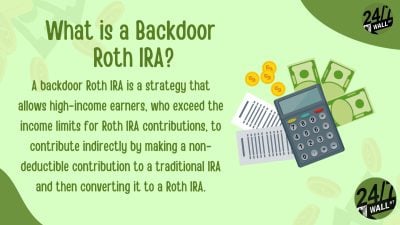
The strategy is called the backdoor Roth. It works by linking two code sections together: one lets anyone with earned income make a nondeductible traditional IRA contribution, and the other lets anyone convert a traditional IRA to a Roth, no matter how much they earn.
Why High Earners Get Locked Out of the Roth Front Door
Section 408A(c)(3) reduces direct Roth contributions as modified adjusted gross income (MAGI) rises. For tax year 2025, single filers were phased out between $150,000 and $165,000 (2026 is $153,000 – $168,000) and joint filers between $236,000 and $246,000 (2026 is $242,000 – $252,000). The 2026 ranges are slightly higher. For 2026, the IRA contribution limit is $7,500, and savers 50 and older get a catch-up on top of that.
Conversions are a different story. Congress removed the income cap on conversions starting in 2010, and the code still posts a leftover from that change: a clause that let 2010 converters spread the taxable income ratably over the 2-taxable-year period beginning with the first taxable year beginning in 2011.
How the Backdoor Roth Works in Three Steps
- Open a traditional IRA and contribute without deducting it. Section 408(o) allows designated nondeductible contributions to a traditional IRA. The money goes in after tax, which creates “basis.”
- Turn around and convert to a Roth right away. Converting soon after contributing leaves little or no growth to tax.
- At tax time, you will receive Form 1099-R and you will File Form 8606 . The Form 1040 instructions send anyone who converted part or all of a traditional IRA to Form 8606, which records your basis so the IRS doesn’t tax the same dollars twice.
If she has no other pre-tax IRA money, the conversion costs her close to nothing in tax. From there, the money grows tax-free for good.
Pro-Rata Rule Can Turn a Free Conversion Into a $2,220 Bill
The pro-rata rule is where people get caught. Section 408(d)(2) says all individual retirement plans shall be treated as 1 contract, valued as of the close of the calendar year. You can’t convert only the after-tax dollars.
Say she also has $92,500 in a rollover IRA from an old 401(k). Her combined IRA balance is $100,000, and her basis makes up just 7.5% of it. Convert $7,500, and only $562.50 comes out tax-free. The other $6,937.50 counts as ordinary income.
Her top dollars already land in the 32% bracket, which starts above $201,775 for single filers in 2026. That makes the extra tax $2,220.
| Scenario (2026, single, 32% bracket) | Clean Backdoor | With $92,500 Rollover IRA |
|---|---|---|
| Amount converted | $7,500 | $7,500 |
| Tax-free portion | $7,500 | $562.50 |
| Taxable portion | $0 | $6,937.50 |
| Federal tax on conversion | About $0 | $2,220 |
Medicare enrollees can feel it a second time. Taxable conversion income increases MAGI, and Medicare sets premiums using income from two years earlier. A single filer within about $6,900 of the $205,000 line could see the Part B premium jump from $527.50 to $649.20 a month, based on 2026 levels.
Simple Fixes That Keep the Backdoor Tax-Free
- Roll pre-tax IRAs into a workplace plan. 401(k) balances don’t count in the pro-rata math. If your plan takes roll-ins, move the money before December 31 of the year you convert, since the IRA balance is measured at year-end.
- Run it separately for each spouse. The rule applies person by person, so your spouse’s rollover IRA doesn’t contaminate your conversion.
- Get it right the first time. Since 2018, a Roth conversion can’t be undone through recharacterization.
- Watch the five-year clock if you’re under 59½. Each conversion starts its own five-year period for the 10% early-withdrawal penalty.
What $7,500 a Year Becomes When Growth Is Never Taxed
Assume she repeats the backdoor every year for 15 years and earns 6% a year. Her $112,500 in contributions grows to about $174,570. Once she meets the qualified-distribution rules, that roughly $62,070 in growth comes out federally tax-free. Roth IRAs also don’t force required minimum distributions on the original owner, so the account can keep growing for heirs. State treatment usually follows federal rules, but check your state.
On the scale from routine to aggressive, the backdoor is routine. It’s legal, widely used, and built into the IRS’s own forms. The risk sits in the execution: an forgotten rollover IRA or a missing Form 8606. Before you convert, it’s worth having a CPA or fiduciary advisor check your year-end IRA balances.
Contact [email protected] for any questions or corrections.
Vilma Rios is a tax professional and tax content contributor with more than 15 years of experience in tax and accounting. She specializes in federal tax research, tax education, and translating complex tax rules into clear, practical information for individuals, families, and small-business owners.
Vilma is a Content Tax Contributor II with the National Association of Tax Professionals (NATP), where she contributes to tax education and professional content. She has also presented tax information through webinars, including Spanish-language tax education, and has appeared on Telemundo 47 discussing tax topics and helping viewers understand important tax-filing requirements.
Her experience also includes tax and accounting work, tax research, IRS-related matters, and public tax education. While in college, Vilma volunteered in an IRS-sponsored tax assistance program and was recognized for her community service by local and state officials.
Known as “Your Tax Geek,” Vilma is passionate about making taxes easier to understand and helping people navigate an increasingly complex tax system.