She Does a Backdoor Roth Every Year. Her $250,000 Rollover IRA Makes Most of It Taxable, and Form 8606 Is Where She Finds Out
A backdoor Roth conversion looks like a clean tax move until a forgotten rollover IRA quietly rewrites the math, and most savers don't see the damage until Form 8606 forces the calculation months later.


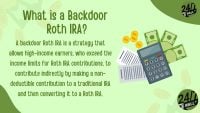
A backdoor Roth looks simple on paper: put after-tax money into a traditional IRA, then convert it to a Roth IRA. If you also hold a pre-tax rollover IRA from an old 401(k), the math rarely works out that cleanly. You find out on Form 8606, usually months after the money has moved.
Every IRA She Owns Counts as One Account
The rule sits in IRC Section 408(d)(2). To figure the taxable part of any IRA distribution, “all individual retirement plans shall be treated as 1 contract,” all distributions in a year count as one distribution, and value is measured “as of the close of the calendar year”. Treasury Regulation 1.408A-4 states that a converted amount is “treated as a distribution from the traditional IRA”. It is taxed under Section 408(d)(1) and (2), so the only part that escapes income is the part treated as a return of basis. Under Section 408A(d)(3), the conversion is included in gross income, but the Section 72(t) early-withdrawal tax “shall not apply”.
Publication 590-B spells out which accounts go into the calculation: the value of all traditional (including SEP and SIMPLE) IRAs. It makes no difference which account you convert from or which firm holds it.
Hypothetical Saver Converts $5,000 and Owes Tax on $4,900
Laura is a hypothetical single saver whose income is too high for direct Roth contributions. In tax year 2026 she puts $5,000 into a traditional IRA as a nondeductible contribution (a round number chosen for example) and converts it soon after. She has no basis from earlier years. She also owns a fully pre-tax rollover IRA worth $250,000 on December 31. Here is her Form 8606:
- Line 1, nondeductible contribution: $5,000. Line 2, basis from prior years: $0. Line 3, total basis: $5,000.
- Line 6, year-end value of all traditional, SEP and SIMPLE IRAs: $250,000. The converted money is already gone by December 31, so only the rollover IRA counts.
- Line 8, amount converted: $5,000.
- Line 9, lines 6 + 7 + 8: $250,000 + $0 + $5,000 = $255,000.
- Line 10, line 3 ÷ line 9: $5,000 ÷ $255,000 = 0.0196, entered as 0.020 because the IRS requires for a decimal rounded to at least three places.
- Line 11, tax-free part of the conversion: $5,000 × 0.020 = $100.
- Line 14, basis carried forward: $5,000 − $100 = $4,900.
- Line 18, taxable conversion: $5,000 − $100 = $4,900.
That makes 98% of her conversion taxable, even though every dollar she contributed had already been taxed. The basis she couldn’t use carries forward. Next year, line 2 starts at $4,900, and another $5,000 contribution brings line 3 to $9,900. Each year her basis grows in an account she can’t separate out, and most of what she converts is taxed as if it came from the rollover money. Keep filing the form. Publication 554 warns that skipping Form 8606 for nondeductible contributions can bring a $50 penalty, and without proof of basis, later withdrawals may be taxed in full.
Rolling Pre-Tax Money Into a 401(k) Brings Line 6 to Zero
The usual fix is to move the pre-tax IRA balance into a current employer plan that takes roll-ins. Publication 590-A allows this: only the pre-tax part of an IRA can go into an employer plan, and a special rule treats the rollover as including only otherwise taxable amounts as long as what remains behind is at least equal to your basis. If Laura finishes the roll-in by December 31, 2026, line 6 becomes $0, line 9 equals $5,000, line 10 is 1.000, and line 18 drops to $0.
Section 408(d)(2)(C) measures value at the end of the calendar year, so a roll-in completed in January is too late for the prior year’s conversion.
What the Fix Costs
- Plan approval: Plans may, but aren’t required to, accept such rollovers.
- Investments and fees: Your choices are limited to the plan’s menu, and its costs may be higher or lower than what you pay in the IRA.
- Access: Withdrawal options follow the plan’s rules, which can be narrower than an IRA’s.
- Paperwork: If you roll IRA money into an employer plan, the IRS says to attach a statement explaining what you did.
- SEP and SIMPLE IRAs: If you are self-employed, new contributions to these accounts add back to line 6.
Who Should Skip This Strategy
If you plan to convert the whole $250,000 eventually, the pro-rata rule matters less, and the main consideration becomes how much ordinary income to take on each year (the quiet years between your last paycheck and your first RMD are usually the cheapest, which is the whole subject of our free Roth conversion guide). Converted amounts count as income for all purposes, including the formula that determines how much of your Social Security is taxed. For Medicare enrollees, the 2026 Part B surcharge (IRMAA) starts at income above $109,000 for single filers and $218,000 for joint filers. Monthly premiums run from $202.90 up to $689.90, and the surcharge is usually based on income from an earlier tax year.
The backdoor Roth also fits these savers poorly:
- Savers with no employer plan, or a plan that won’t take roll-ins
- Savers who value the IRA’s investment choices more than a small annual Roth deposit
- Retirees close to drawing down, who have only a few years left for Roth growth
For everyone else, check one figure before converting: what will all your traditional, SEP and SIMPLE IRAs be worth on December 31? If that number is large, you have three choices: move the pre-tax money into an employer plan before year-end, takes that most of each conversion will be taxed, or stop doing the backdoor. Form 8606 tracks your basis either way, so keep every year’s copy.
Contact [email protected] for any questions or corrections.
Jake has been been working in financial media for almost 15 years. He focuses on all things personal finance for 24/7 Wall St. with high hopes to educate and entertain. Most recently, Jake spent 12 years working various roles at The Motley Fool. He started copy editing fool.com content, worked on premium and marketing campaigns, and helped launch The Ascent, a personal finance brand.
His work has been featured on platforms like MSN, Yahoo Finance, USA Today, and more. He's written about credit cards, social security, ETFs, savings accounts, and just about anything else you can imagine when thinking about money. Jake love to cook, play golf, and tell people he's never had a cavity. (It's true!)