78% of Retirees Feel Confident About Retirement. Only 67% of Workers Say the Same, and the Ones Already There Worry Less
Retirees sleep easier about money than the workers still racing toward retirement, and the reason has less to do with savings balances than with one thing workers simply cannot have yet.

This post may contain links from our sponsors and affiliates, and Flywheel Publishing may receive compensation for actions taken through them.

Americans have varying levels of confidence about retirement, with those who have already retired generally feeling better about their financial future than those still working. In the Employee Benefit Research Institute’s 2025 Retirement Confidence Survey, 67% of workers said they’re confident they’ll have enough money to live comfortably in retirement. Among retirees, that share was 78%, up from 74% in 2024.
Workers may be unsure whether their savings will last, while retirees can see how their finances have turned out. The survey asked 1,042 workers and 1,005 retirees the same questions, so their different answers may reflect where each group sits on the retirement timeline.
What Retirees Know That Workers Are Still Estimating
A worker has to guess at a lot: future income, future prices, how long they’ll work, and what Social Security will pay. A retiree has already found out most of those answers. That may help explain why confidence numbers differ. Once the monthly deposits are landing and the bills are coming in, a lot of the guesswork goes away.
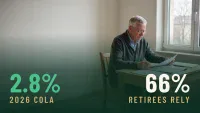
Social Security plays a big part in this. EBRI found that 94% of retirees said they receive Social Security, and 66% called it a major income source. Among workers, only 36% expect it to be a major source. After the 2026 cost-of-living adjustment, a typical retiree’s benefit is about $2,071 a month. Retirees count on that check, while fewer workers expect it to be a major source.
Medicare gives retirees another known number. Part B’s standard premium (the monthly charge for doctor visits and outpatient care) is $202.90 in 2026, and the annual deductible is $283. Spending also tends to change once work ends, as commuting and work-related costs drop off and retirees build their budgets around actual bills.
Where Workers’ Worries Pile Up
Workers carry concerns that retirees have mostly worked through. In the survey, 70% of workers worried about having to cut back because of inflation, and 56% said health care costs are cutting into how much they can save.
Short-term cushions have also gotten smaller. A 2024 FINRA Foundation study found that 46% of adults have three months of expenses set aside for emergencies, down from 53% in 2021. The EBRI survey found that only about four in 10 workers have calculated how much they might need for health care or long-term care in retirement, and not having a number can make it harder to feel confident.
Retirees still have their own worries. In the EBRI survey, 79% of workers and 71% of retirees were concerned about government changes to the retirement system; among those concerned, 80% of retirees and 60% of workers worried the changes could reduce their Social Security benefit. The thing is, retirees also rely more on Social Security, while the 2026 Trustees Report projects that the combined Social Security trust funds will run short in 2034, after which incoming payroll taxes would cover about 83% of scheduled benefits.
Habits That Tend to Close the Confidence Gap
Workers’ uncertainty tends to sit in a few places, each tied to a figure that can be checked before retirement:
- Retirement math. Comparing current savings, expected spending, and expected income turns a vague worry into a specific shortfall or surplus.
- The Social Security statement. A free online account at the Social Security Administration shows estimated benefits at different claiming ages.
- An emergency cushion. A cash reserve keeps a surprise bill from turning into a withdrawal from retirement accounts.
- Health care costs. Medicare premiums are published every year, and higher-income retirees pay surcharges on top of the standard amount.
Why Confidence Can Run Ahead of Readiness
Confidence and preparation can differ. EBRI found that 38% of retirees said their health care expenses were higher than they expected. Some confident retirees could still face pressure from living longer than planned or from needing long-term care, which Medicare largely doesn’t cover. In Northwestern Mutual’s 2025 study, 51% of adults thought it was at least somewhat likely they’d outlive their savings.
Prices are another factor in retirement costs. The 2027 cost-of-living adjustment for Social Security is 3.6%, and the Labor Department’s research inflation index for Americans 62 and older reached a series high in September 2026.
How much each group knows may help explain the confidence gap between workers and retirees. Retirees have real numbers to work with, while workers are often still estimating. Retirees generally have an actual Social Security benefit, a known monthly budget, and current savings figures, while workers often rely on estimates for each.
Contact [email protected] for any questions or corrections.
David Beren has been a Flywheel Publishing contributor since 2022. Writing for 24/7 Wall St. since 2023, David loves to write about topics of all shapes and sizes. As a technology expert, David focuses heavily on consumer electronics brands, automobiles, and general technology. He has previously written for LifeWire, formerly About.com. As a part-time freelance writer, David’s “day job” has been working on and leading social media for multiple Fortune 100 brands. David loves the flexibility of this field and its ability to reach customers exactly where they like to spend their time. Additionally, David previously published his own blog, TmoNews.com, which reached 3 million readers in its first year. In addition to freelance and social media work, David loves to spend time with his family and children and relive the glory days of video game consoles by playing any retro game console he can get his hands on.