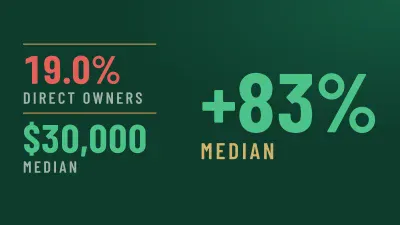
Fewer Families Own Stocks Directly, 19.0% in 2025, but Their Typical Holding Jumped 83% to $30,000
The Fed's newest wealth survey shows two stock trends pulling in opposite directions, and the gap between them reveals who really owns Wall Street. For retirees holding individual shares, the hidden risks may matter more than the headline numbers.

This post may contain links from our sponsors and affiliates, and Flywheel Publishing may receive compensation for actions taken through them.
Two numbers in the latest Survey of Consumer Finances from the Federal Reserve are moving in opposite directions. Fewer families own individual stocks than three years ago, but the families that still own them hold much more. Here is what the survey found, why both trends can be true at once, and what it might mean for people who are close to retirement or already there.
Fewer Owners but Bigger Positions in the Fed’s Latest Count
According to the Fed’s survey, the share of families directly holding stocks fell from 21.0% in 2022 to 19.0% in 2025. On its own, that fall could suggest fewer families choosing to hold individual shares.
The value of holdings moved in the other direction. Among families who still held shares, the median value rose from $16,400 to $30,000, an increase of 83%. Both figures are in 2025 dollars, so inflation is already taken out.
The survey uses “directly held” as a fairly narrow term. The Fed counts publicly traded shares a family owns outright and excludes stocks held through a managed investment account, mutual fund, or retirement account. So someone whose 401(k) is full of stock funds, but who owns no individual shares, isn’t counted here. Stocks held through pooled investment funds are counted separately.
Half the group sits above the middle holder, and half below. The mean, or simple average, gets pulled up by a handful of outsized portfolios. In 2025, the mean direct stock holding among owners was $524,300, compared with the $30,000 median. That gap means most of the dollars sit in a fairly small number of big portfolios.
Why Both Trends Can Happen Together
The survey offers part of the explanation. Direct ownership jumped 6 percentage points between 2019 and 2022, the largest change between surveys on record. The Fed says some of that jump looks temporary, but the 2025 rate is still well above 2019’s 15.2%. It also says the median’s rebound almost erased the drop in median holdings from 2019 to 2022.
Rising stock prices are another factor. The Fed notes that the real value of publicly traded equity holdings, including those held through funds and retirement accounts, rose for every income group, in line with gains in public equity markets. The SPDR S&P 500 ETF Trust (NYSEARCA:SPY), which tracks the S&P 500, gained about 43% from January 3, 2022, through December 31, 2025. When prices rise, families who kept their shares see the value grow without buying anything new.
The makeup of the families who left also matters. Broader stock ownership, which includes funds and retirement accounts, slipped from 58% to 56%, and the Fed says families in the bottom half of the income distribution accounted for nearly all of that fall. If the families who dropped out tended to have smaller accounts, the median among those who stayed would rise even if nobody’s holdings changed. That’s one possible reason, but the survey doesn’t measure it directly.
The Fed’s Distributional Financial Accounts show how concentrated ownership is. In the second quarter of 2026, the top 1% by wealth held 50.9% of household corporate equities and mutual funds. The bottom 50% held 0.6%.
What Concentrated Holdings Can Mean for Retirees
A portfolio of individual stocks often ends up in just a few companies. That can happen with employer stock collected over a career, or with a single position that grew while the rest stayed flat. One company’s bad stretch can cut a much bigger piece out of that kind of account than it would out of a fund holding hundreds of names.
Overall stock exposure can also be easy to underestimate near retirement. The survey tracks individual shares, funds, and retirement accounts as separate categories. A household with a brokerage account of individual stocks plus a 401(k) in stock funds may hold more stock overall than either account suggests.
Taxes also matter as shares held for years in a taxable account usually carry unrealized gains, and selling them brings capital gains tax on the difference between the sale price and the cost basis. Shares bought at different times and prices count as separate tax lots, and which lots get sold changes the tax bill (lot selection is one of nine IRS rules we mapped in a free tax trap guide for retirees). That cost keeps some concentrated positions concentrated longer than their owners planned.
What the Fed’s Data Leaves Open for Stock Owners
The Fed’s figures describe what happened through 2025. They don’t predict whether direct ownership will keep falling or whether the median will keep rising. The data describes a smaller group of direct owners whose holdings grew, mostly through price gains, while top-end concentration stayed high. One related measure for any portfolio is how much of it is held in a handful of stocks.
Contact [email protected] for any questions or corrections.
David Beren has been a Flywheel Publishing contributor since 2022. Writing for 24/7 Wall St. since 2023, David loves to write about topics of all shapes and sizes. As a technology expert, David focuses heavily on consumer electronics brands, automobiles, and general technology. He has previously written for LifeWire, formerly About.com. As a part-time freelance writer, David’s “day job” has been working on and leading social media for multiple Fortune 100 brands. David loves the flexibility of this field and its ability to reach customers exactly where they like to spend their time. Additionally, David previously published his own blog, TmoNews.com, which reached 3 million readers in its first year. In addition to freelance and social media work, David loves to spend time with his family and children and relive the glory days of video game consoles by playing any retro game console he can get his hands on.