More Than 15% of American Families Own a Private Business. In the Top 10% by Income It’s 40%, and in the Bottom Half It’s 8%

This post may contain links from our sponsors and affiliates, and Flywheel Publishing may receive compensation for actions taken through them.
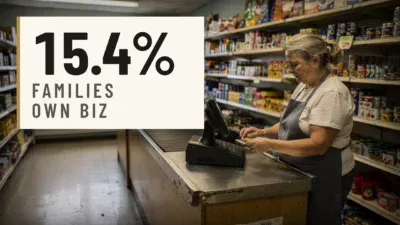
Many Americans work for themselves, whether through a landscaping company, a small shop, or a share of a family farm. According to the Federal Reserve’s 2025[1] Survey of Consumer Finances, more than 15% of American families own a privately held business.
Among families in the top 10% by income, that share is 40%. In the bottom half, it’s 8%. This article looks at who builds wealth through ownership, how things shifted since 2022, and why a business can serve as a retirement account for some owners.
What Counts as a Private Business
The Fed uses a wide definition. Private business equity in the survey includes sole proprietorships, partnerships, S corporations and other corporations that aren’t publicly traded, limited liability companies, and other private ventures.
If a family lives on a farm or ranch used at least partly for agriculture, that portion counts too, net of related debts. Partial stakes count, and so do business investments that aren’t traded on an exchange (Federal Reserve, Changes in U.S. Family Finances from 2022 to 2025).
One group is left out of the count. About 5% of surveyed families have a head of household who’s self-employed but doesn’t report a business interest, and the Fed doesn’t treat them as owners. A freelancer who simply invoices clients can fall outside the ownership figure.
How Ownership Breaks Down by Income
Business ownership climbs with income, and the spread between the top and bottom is wide. Here’s how the 2025 survey sorts families:
Across all families, the ownership rate is 15.4%. It rises to 40% in the top 10% by income and falls to 8% in the bottom 50%.
Private business ownership is much less common than stock ownership at every income level. In the same survey, 31% of families in the bottom half held publicly traded stock, directly or through retirement accounts, compared with 97% of families in the top decile.
A 401(k) can be opened with a small paycheck deduction, while starting or buying a business usually takes savings, credit, or both.
More Owners, Lower Values
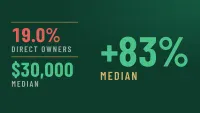
Ownership edged up between surveys. The share of families with a private business was 15.4% in 2025, up almost 1 percentage point from 2022. The Fed says that increase came entirely from families in the bottom 90% of income, while ownership in the top decile declined.
Values moved in a different direction. Among owners in the bottom half, the real mean business value fell around $59,000, an 18% fall after inflation. Owners in the upper-middle group saw a drop of about $128,000, or 22%.
Top-decile owners posted a real mean increase of around $98,000, a gain of about 2%.
The gap between the average and the typical business is wide. The median value among owners fell 23% to $75,400, while the mean dropped 12% to $1,566,600. The median is the middle owner in line. If ten owners each run a small business and one more owns a very large company, the median stays near the value of the small businesses, while the mean rises far above it.
The Fed attributes the difference to the small fraction of private businesses with very high valuations.
Where Business Wealth Sits
The Fed’s Distributional Financial Accounts track the dollar value of private, unincorporated business assets by income group. As of the second quarter of 2026[2], households in the top 1% by income held 38.8% of those assets, and households between the 80th and 99th income percentiles held 40.8%.
Back in 1989[2], the top 1% held 28.3%. Lower-income families have added business ownership, while most of the dollar value remains with high earners.
Why a Business Can Double as a Retirement Plan
For some owners, the business is a large share of their net worth. A landscaping company or small shop can bring in money that might otherwise go into a 401(k) or an IRA, and the owner’s retirement plan is to sell it. A sale can turn years of work into a lump sum that pays for retirement.
That approach depends on what a buyer will pay when the time comes. Between the 2022 and 2025 surveys, real business values fell for owners in the bottom 90% of income, the same group that drove the rise in ownership.
A business that was worth less in 2025 than in 2022 after inflation leaves a smaller sum at retirement if most of an owner’s wealth sits in that one asset.
Contact [email protected] for any questions or corrections.
David Beren has been a Flywheel Publishing contributor since 2022. Writing for 24/7 Wall St. since 2023, David loves to write about topics of all shapes and sizes. As a technology expert, David focuses heavily on consumer electronics brands, automobiles, and general technology. He has previously written for LifeWire, formerly About.com. As a part-time freelance writer, David’s “day job” has been working on and leading social media for multiple Fortune 100 brands. David loves the flexibility of this field and its ability to reach customers exactly where they like to spend their time. Additionally, David previously published his own blog, TmoNews.com, which reached 3 million readers in its first year. In addition to freelance and social media work, David loves to spend time with his family and children and relive the glory days of video game consoles by playing any retro game console he can get his hands on.