Sitting on a $1.22 Million 401(k)? The Roth Conversion Math That Turns Future RMDs Into $5,592 a Month Tax-Free

This post may contain links from our sponsors and affiliates, and Flywheel Publishing may receive compensation for actions taken through them.

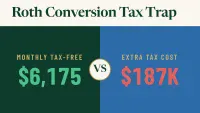
A $1.22 million 401(k) looks like freedom until you run the required withdrawal math. If you leave it alone, the IRS pulls money out on its own schedule, and every dollar gets taxed as ordinary income. If you convert it to Roth during a few low-income years instead, that same balance earning a 5.5% planning yield pays $5,592 a month, or $67,104 a year, tax-free. Below is how the workplace-plan version works and which holdings produce that income.
Two Ways to Get Your 401(k) Into a Roth
The first option is an in-plan Roth rollover. If your plan allows it, you move pre-tax money into a Roth account inside the same plan. The converted amount counts as income that year. A direct transfer skips the 20% mandatory withholding, and the IRS says in-plan conversions can’t be undone.
The second option opens once you leave the job. You do a direct rollover to an IRA account, meaning the plan sends the money straight to the new custodian, and then you convert it there. If the distribution is paid to you, the plan generally withholds 20%, while a check payable to the receiving custodian for your benefit can still qualify as a direct rollover without that holding. Our coverage of rollover mistakes walks through that trap.
Convert in Slices Before Withdrawals Begin
If you were born in 1960 or later, required withdrawals start at age 75. The IRS factor at that age is 24.6, so a $1.22 million balance forces out about $49,600 in the first year. And once those withdrawals start, you can’t roll over the required amount into a Roth.
For 2026, married couples filing jointly get a $32,200 standard deduction, and the 22% bracket runs up to $211,400 of taxable income. Medicare surcharges kick in once joint income tops $218,000[1], and Social Security bases them on your tax return from two years earlier. So a big conversion at 63 raises your premiums at 65.
Without other income, two married people could convert about $218,000 a year. That works out to $185,800 of taxable income and roughly $30,300 owed to the IRS, all in the 22% bracket. Pay that bill from a brokerage account so every converted dollar stays invested. At that pace, the whole balance moves over in about six years.
A separate five-year period starts with each conversion. If you’re under 59½ and pull converted money out before that period runs out, a 10% additional tax can apply.
What $67,104 a Year Costs at Each Yield
- Conservative (3% to 4%): $67,104 divided by 0.035 equals about $1.92 million. That’s more than the account holds, but this tier’s income grows.
- Moderate (5% to 7%): $67,104 divided by 0.06 equals about $1.12 million. This plan sits right here.
- Aggressive (8% to 14%): $67,104 divided by 0.10 equals about $671,000. You need the least money, but payout cuts and a shrinking principal are common.
Six Holdings Behind the Paycheck
At current prices, the weighted mix yields about 6.0%, slightly above the 5.5% planning figure, giving the plan a buffer. If your 401(k) offers only a fund menu, holding these may require a brokerage window or an IRA.
Covered Calls on Dividend Aristocrats
FT Vest S&P 500 Dividend Aristocrats Target Income ETF (CBOE:KNG) makes up 20%. It owns the Aristocrats and sells call options on them for extra cash, which drives its yield to about 8.0%. Risk: those options cap your gains in a strong rally.
Growth Engine With a Thin Yield
A 10% slice buys ProShares S&P 500 Dividend Aristocrats ETF, holding companies with 25+ straight years of dividend raises. Yielding about 2.9%, it adds little income today.
Apartment Rent Checks
Mid-America Apartment Communities (NYSE:MAA) holds 20%. This apartment real estate investment trust (REIT) just paid its 131st[2] straight quarterly dividend and yields about 5.2%. Risk: rents on new leases fell 6% last quarter.
Venture Lending for Top-Tier Income
Lending to tech and life sciences firms, Hercules Capital (NYSE:HTGC) takes 15% and yields about 11.8%. Earnings covered the base payout 118%[3], but management says a full-point cut in the prime rate would reduce annual income by about 7 cents a share.
Data Centers Powering a Utility
American Electric Power (NASDAQ:AEP | AEP Price Prediction) gets 15% and yields about 3.0%. It’s guiding to 9% to 11%[4] annual earnings growth from 2027 through 2031, backed by a $100 billion spending plan. Risk: regulators have to approve the rate increases that pay for it.
Bond Ballast for Almost Nothing
The 20% bond allocation, iShares Core U.S. Aggregate Bond ETF (NYSEARCA:AGG), owns investment-grade bonds, charges 0.03%[5] a year, and yields about 4.3%. But its price sits about 2% below where it was five years ago.
Why Slower Income Often Wins
Say $67,104 comes from a 3.5% yield that grows 8% a year. In nine years, it becomes about $134,000. A 12% stock with no growth keeps sending $67,104, and inflation eats away at it every year. You can see this in real payouts: AEP’s quarterly dividend rose from 67 cents in 2019 to 97 cents, while Hercules went from 48 cents in 2024 to 47 cents.
Three Moves to Make This Year
- Ask your plan administrator whether the plan allows in-plan Roth rollovers and whether it has a brokerage window.
- Map your income year by year from your last paycheck to 75, and size each conversion to stay under $218,000 of joint income.
- Set aside the tax money in a taxable account now. A full slice costs about $30,300.
The years between your last paycheck and your first required withdrawal offer the lowest tax rate you’ll ever see again, and we break down that window in detail in a free Roth guide.
Contact [email protected] for any questions or corrections.
David Beren has been a Flywheel Publishing contributor since 2022. Writing for 24/7 Wall St. since 2023, David loves to write about topics of all shapes and sizes. As a technology expert, David focuses heavily on consumer electronics brands, automobiles, and general technology. He has previously written for LifeWire, formerly About.com. As a part-time freelance writer, David’s “day job” has been working on and leading social media for multiple Fortune 100 brands. David loves the flexibility of this field and its ability to reach customers exactly where they like to spend their time. Additionally, David previously published his own blog, TmoNews.com, which reached 3 million readers in its first year. In addition to freelance and social media work, David loves to spend time with his family and children and relive the glory days of video game consoles by playing any retro game console he can get his hands on.