Sitting on a $1.45 Million IRA at 61? The Roth Conversion Math That Turns Future RMDs Into $7,250 a Month Tax-Free

This post may contain links from our sponsors and affiliates, and Flywheel Publishing may receive compensation for actions taken through them.

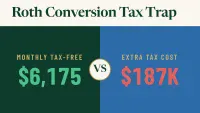
A 61-year-old holding $1.45 million in traditional IRA assets faces a future tax bill. Every dollar gets taxed on the way out. Eventually, the IRS forces withdrawals called required minimum distributions, or RMDs. Those born in 1960 or later see them start at 75. At today’s balance, the first one would be about $58,943.
A Roth conversion moves money from the traditional IRA into a Roth IRA, and you pay the income tax now. While you’re alive, Roth IRAs have no RMDs, and qualified withdrawals after age 59½[1] come out tax-free. Convert all of it, earn a 6% yield, and the account pays $7,250 a month. That’s $87,000 a year with no tax bill.
What $87,000 a Year Costs at Three Yields
The formula: income divided by yield equals the money you need.
- 3.5% (dividend growth and broad stock funds): $87,000 divided by 0.035 equals about $2.49 million. The payouts grow, but the IRA falls short.
- 6% (REITs, emerging market bonds, covered call funds): $87,000 divided by 0.06 equals $1.45 million. That matches the balance exactly.
- 10% (business development companies, leveraged closed-end funds): $87,000 divided by 0.10 equals $870,000. It takes less money, but payouts are cut, and the principal shrinks over time.
Over decades, lower yields can come out ahead when the payout itself grows. A 10% check that never rises loses buying power every year.
Six Holdings Built to Pay 6%
In this hypothetical example, at current prices and payouts, the mix yields about 6.2%, close to the 6% plan.
Foreign Dividends With Option Income: 20%
Amplify CWP International Enhanced Dividend Income ETF (NYSEARCA:IDVO) owns foreign dividend payers like TSMC and ASML[2]. It also sells covered calls, which give up some upside in exchange for extra cash. It pays monthly and yields about 6.1%. Those calls limit your gains in a strong rally, though.
15% in Steady U.S. Dividend Stocks
VictoryShares US EQ Income Enhanced Volatility Weighted ETF holds U.S. dividend stocks and leans toward the less volatile ones. It yields about 3.0% on trailing payouts. The monthly checks vary a lot, from about $0.20 in October to $0.12 in November.
Storage Rent Gets 10%
Public Storage (NYSE:PSA) runs 4,764 self-storage facilities. The quarterly payout is $3 a share, a yield of about 3.6%. It recently raised its 2026 guidance for core funds from operations (a REIT’s version of earnings) to $16.90-$17.10[3] a share. On the downside, acquisitions pushed net debt to EBITDA (debt measured against operating cash earnings) up to 3.4x from 3.0x[3].
20% Goes to High-Yield Private Loans
Sixth Street Specialty Lending (NYSE:TSLX) operates as a business development company, lending to midsize companies mostly through first-lien loans, which get repaid first. It yields about 9.5%. The risk: lower interest rates already cut the base dividend from $0.46 to $0.42, and net asset value went down to $16 from $17[4] over the past year.
Pipeline Cash Flow Earns 15%
Kayne Anderson Energy Infrastructure Fund (NYSE:KYN) is a closed-end fund built around pipelines and other energy infrastructure. Over the past year, its monthly payout rose from $0.08 to $0.095, for a yield of about 8.2%. Energy downturns hit this part of the market hard.
Emerging Market Government Bonds: 20%
iShares J.P. Morgan USD Emerging Markets Bond ETF (NASDAQ:EMB) owns dollar bonds issued by governments such as Ecuador, Oman and Romania[5]. It yields about 5.3%. Some of the borrowers are shaky, though, including Ghana, Angola, and defaulted Lebanese debt[5].
Convert in Slices Before RMDs Start
In 2026, the 22% bracket for joint filers tops out at $211,400 of taxable income, and the standard deduction is $32,200. A couple with no other income could convert $243,600 and stay in that bracket. The federal tax would be $35,932.
Pay that tax from a regular taxable account so the whole slice continues growing tax-free. At that rate, it takes about six years of slices to convert today’s balance, well before RMDs begin.
Medicare Checks Your Tax Return From Two Years Earlier
Higher earners pay a Medicare premium surcharge called IRMAA, and it’s based on your tax return from two years prior. A conversion at 63 shows up at 65. For 2026 premiums, joint modified adjusted gross income above $218,000 and up to $274,000 generally raises Part B from $202.90 to $284.10 a month, based on 2024 income; higher income triggers higher premiums. Starting at 63, many couples shrink their slices to stay under that line.
Start the Five-Year Clock Now
Roth earnings are tax-free once your first Roth has been open for five tax years[1]. On top of that, each conversion gets its own five-year period for the 10% early-withdrawal penalty, which mostly matters before 59½. A small conversion this year starts the main timer.
Quiet Years Are the Cheapest Years to Convert
Pull last year’s tax return. For joint filers, the gap between this year’s projected taxable income before the conversion and $211,400 is the room remaining in the 2026 22% bracket. Those quiet years between your last paycheck and your first RMD may be the lowest tax rate you ever see again, and we sized up the window in a free guide here.
Contact [email protected] for any questions or corrections.
David Beren has been a Flywheel Publishing contributor since 2022. Writing for 24/7 Wall St. since 2023, David loves to write about topics of all shapes and sizes. As a technology expert, David focuses heavily on consumer electronics brands, automobiles, and general technology. He has previously written for LifeWire, formerly About.com. As a part-time freelance writer, David’s “day job” has been working on and leading social media for multiple Fortune 100 brands. David loves the flexibility of this field and its ability to reach customers exactly where they like to spend their time. Additionally, David previously published his own blog, TmoNews.com, which reached 3 million readers in its first year. In addition to freelance and social media work, David loves to spend time with his family and children and relive the glory days of video game consoles by playing any retro game console he can get his hands on.