How Much Do You Really Need Invested to Replace a $210,000 Salary With Dividends?

This post may contain links from our sponsors and affiliates, and Flywheel Publishing may receive compensation for actions taken through them.
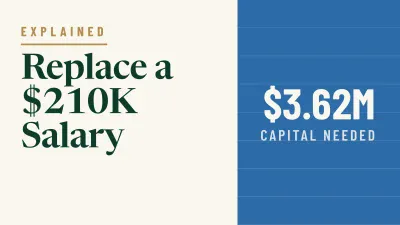
Before taxes, a $210,000 salary comes to $17,500 a month. Replacing that paycheck with dividends requires a specific pile of capital, and the size of that pile swings by millions depending on the yield you target. Below is the math at three yield levels, plus a six-holding portfolio built to hit the target.
Three Yield Levels, Three Very Different Price Tags
The equation never changes: income target divided by yield equals capital required.
- Conservative, around 3.5%: $210,000 divided by 0.035 equals $6,000,000. Dividend growth stocks and broad market funds live here. The capital requirement is highest here, but payouts tend to rise, and principal tends to grow.
- Moderate, around 5.8%: $210,000 divided by 0.058 equals $3,620,690. REITs, international dividend funds, equity income closed-end funds, and Treasuries fill this range. Income growth slows.
- Aggressive, around 10%: $210,000 divided by 0.10 equals $2,100,000. This is where BDCs, mortgage REITs, and junk bond funds sit. Distribution cuts and shrinking principal come with the territory.
A Six-Holding Mix Built for 6%
This portfolio combines all three levels into a yield of approximately 6%.
iShares International Select Dividend ETF (CBOE:IDV) takes a 20% slot. It owns high-dividend stocks outside the U.S., charges 0.5%[1] a year, and yields about 5.0%. Payouts are uneven: the June check was $1.10 a share, while March brought $0.20.
Eaton Vance Tax-Advantaged Dividend Income Fund (NYSE:EVT) gets 15%. This closed-end fund holds dividend stocks and preferreds, aiming for qualified dividends taxed at lower rates. It just raised its monthly payout by about 15%, pushing the yield near 8.4%.
Another 15% goes to CareTrust REIT (NYSE:CTRE), which leases skilled nursing and senior housing properties and collected 100% of contractual rent. The $0.39 quarterly dividend, up from $0.335 a year earlier, takes roughly 72%[2] of normalized funds from operations (FFO), the REIT version of cash earnings. Yield: about 4.2%.
Blackstone Secured Lending Fund (NYSE:BXSL | BXSL Price Prediction) supplies the aggressive 15%. This BDC lends to private middle-market companies, with 96% in first-lien loans. It also shows the aggressive tier’s risk in real time. Third-quarter earnings covered only 88%[3] of the dividend, so the board cut the payout by about 22% to $0.60 starting with the March 2027 record date. Net asset value per share slipped to $25[3] from $27. Even at the reduced rate, it yields about 10.1%.
U.S. Bancorp (NYSE:USB) makes up 15%. Third-quarter net income rose 10%[4], and the quarterly dividend climbed to $0.54 from $0.52. The yield sits near 3.6% because shares gained 33% over the past year.
For the final 20%, the portfolio uses the iShares 20+ Year Treasury Bond ETF. The fund pays out monthly from long Treasuries, yielding about 5.2% with no credit risk. Its price moves with interest rates, though: the fund is down 35% over five years as the 10-year Treasury yield climbed to 5.1%[5].
Why a Lower Yield Can Pay More by Year Nine
Put $6,000,000 into 3.5% payers that raise dividends 8% a year, and your income roughly doubles to about $420,000 in nine years. Put $2,100,000 into 10% payers with flat payouts, and you still collect $210,000, or less after a cut like Blackstone’s. Inflation shrinks that fixed check every year.
The middle mix splits the difference. U.S. Bancorp and CareTrust have raised payouts steadily, while Treasury coupons and BDC distributions do not grow.
Who Fits This Mix and What Moves the Number
This portfolio suits someone holding roughly $3.51 million who needs full income now and accepts slower income growth. The capital figure rises if yields fall, if more distributions get cut, or if taxes take a bigger bite. It drops if you need less than $210,000 or layer in Social Security or a pension (the mix, payment calendar, and withdrawal order are laid out in a free guide on turning a lump sum into a paycheck).
Three Moves Before You Commit
- Price your actual spending. A $210,000 earner often lives on far less once payroll taxes and retirement contributions disappear.
- Rerun the combined yield using each holding’s forward payout, including Blackstone’s reduced dividend, instead of trailing figures.
- Place holdings by tax treatment. REIT, BDC, and Treasury income is taxed as ordinary income, while Treasury interest is federally taxable but exempt from state income tax. U.S. Bancorp dividends generally qualify for lower rates, while Eaton Vance distributions can include qualified dividends, capital gains, and return of capital.
Contact [email protected] for any questions or corrections.
David Beren has been a Flywheel Publishing contributor since 2022. Writing for 24/7 Wall St. since 2023, David loves to write about topics of all shapes and sizes. As a technology expert, David focuses heavily on consumer electronics brands, automobiles, and general technology. He has previously written for LifeWire, formerly About.com. As a part-time freelance writer, David’s “day job” has been working on and leading social media for multiple Fortune 100 brands. David loves the flexibility of this field and its ability to reach customers exactly where they like to spend their time. Additionally, David previously published his own blog, TmoNews.com, which reached 3 million readers in its first year. In addition to freelance and social media work, David loves to spend time with his family and children and relive the glory days of video game consoles by playing any retro game console he can get his hands on.