He Turned 73 This Year and Skipped His First RMD When the Market Was Tanking. The IRS Charges a 25% Excise Tax on Whatever He Should Have Withdrawn, Selloff or Rally

This post may contain links from our sponsors and affiliates, and Flywheel Publishing may receive compensation for actions taken through them.

He was born in 1953, turned 73 this year and has about $1.2 million in his 401(k).
The S&P 500 has fallen for four straight sessions as of November 17, so he has left his first required minimum distribution (RMD) alone and plans to sell after a bounce. The IRS ignores the market. His required amount was fixed before 2026 began, and any shortfall draws a 25% excise tax.
His 2026 Withdrawal Was Locked In Last December
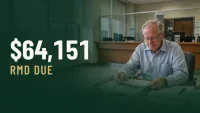
The RMD equals the prior year-end balance divided by the IRS Uniform Lifetime Table divisor. At 73, that divisor is 26.5. On a $1.2 million balance, his 2026 RMD comes to about $45,283.
That figure holds whether the account drops 15% in a selloff or gains 15% in a rally. A downturn only makes the withdrawal a bigger share of what’s left. Federal law sets the tax at 25% of the amount by which the minimum required distribution exceeds what was actually distributed[1]. If he skips the full amount, he owes about $11,321, and that comes on top of ordinary income tax on the withdrawal itself.
April 1 Is Technically His Deadline, and Using It Can Cost Him
The first RMD gets a grace period. A 2026 first-year RMD can wait until April 1, 2027, so technically he hasn’t missed anything yet. But his 2027 RMD is still due by December 31 of that year. Waiting means both withdrawals land in the same tax year.
Here’s an example. Say he collects $36,000 a year in Social Security, up to 85% of it becomes taxable as income rises, and his 2027 RMD is about the same size as this year’s. His 2027 income would come to roughly $121,166.
That places him past the start of the 24% bracket, which begins at $105,700 for single filers in 2026. It also puts him over the $109,000[2] single threshold for IRMAA, the income-based Medicare surcharge. Medicare uses income from two years earlier, so his 2027 income sets his 2029 premiums.
At 2026 rates, the first IRMAA tier increases his monthly Part B premium from $202.90[2] to $284.10 and adds $14.50 to Part D.
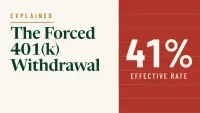
That works out to about $1,148 a year in extra premiums. Once Social Security taxation and IRMAA both kick in, each additional dollar he withdraws can face a far higher effective tax rate than his bracket alone suggests.
Missing April 1 Still Leaves Two Ways to Cut the Penalty
If April 1, 2027 passes with no withdrawal, the 25% tax applies. Section 4974(e) lowers the rate to 10% if he withdraws the shortfall and files a return reporting the tax within the correction window. That window closes at the earliest of a deficiency notice, an IRS assessment, or the last day of the second taxable year that begins after the end of the taxable year in which the additional tax is imposed. On his RMD, the 10% rate means about $4,528.
He can also ask for a full waiver on Form 5329. To qualify, he has to show the shortfall came from reasonable error and that he is fixing it. He shouldn’t count on a full pass. IRS relief notices in recent years have waived RMD penalties but only in certain cases involving inheritances and the SECURE Act’s 10-year rule, not for an investor who missed an RMD. He still has the April 1 grace period working in his favor.
One 401(k) Rule That Catches IRA Owners
Under IRS rules, 401(k) RMDs must be taken separately from each of those plan accounts. Taking $45,283 from an IRA does not meet what he owes from the 401(k). Qualified charitable distributions, which are capped at $111,000 per person in 2026, are available only from IRAs.
Three Moves to Make Before December 31
- Take the 2026 RMD this year. If you don’t want to sell after a fall, ask the plan whether it allows an in-kind distribution, which moves shares into a taxable brokerage account without selling them. The fair market value still counts toward the RMD, and your money stays invested.
- Project 2027 income both ways. Estimate 2027 income with one RMD and with two. If two RMDs would push you past $109,000[2] single or $218,000 joint, waiting until April costs more than it saves.
- Roll the remaining balance to an IRA after this year’s RMD is out. The RMD itself is not eligible for rollover, but the rest of the account is. Once it’s in an IRA, future RMDs are easier to manage, and QCDs can cover them while keeping that income off your IRMAA calculation.
Contact [email protected] for any questions or corrections.
Gerelyn Terzo is the author of dividend investing handbook "Dividend Investing Strategies: How to Have Your Cake & Eat It Too." A veteran financial journalist, she covers agri-finance for outlets like Global AgInvesting and the broader stock market and personal finance for 24/7 Wall Street. She began at CNBC and later helped launch Fox Business in New York. Gerelyn currently resides in Woodland Park, Colorado and dabbles in nature photography as a hobby.