‘You Absolutely Hate Your Money’: Clark Howard to Chase and Wells Fargo Savers

This post may contain links from our sponsors and affiliates, and Flywheel Publishing may receive compensation for actions taken through them.
Clark Howard was blunt on his November 16 show. If your savings sit at JPMorgan Chase (NYSE:JPM | JPM Price Prediction), Bank of America (NYSE:BAC), Citigroup (NYSE:C) or Wells Fargo (NYSE:WFC), the syndicated consumer money host told listeners, “you hate your money. You absolutely hate your money.”
He also gave the reason. “The biggest banks are going to pay you 1/100th of 1% on your savings,” he said, while “the US Treasury will pay you 5.51% on your savings.”
On $10,000, that works out to about $1 a year versus roughly $551. That gap is what you give up by leaving cash where it sits.
Howard Is Right About the Banks, and Treasury’s Numbers Back Him
My conclusion: Howard’s attack on big-bank savings rates holds up. His I bond pitch also works, but only for money you can lock away for at least a year. If you put your emergency cash into I bonds, you can’t get it back when an emergency hits.
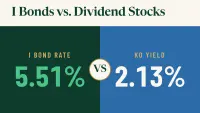
TreasuryDirect confirms a 5.51%[1] rate on I bonds issued from November 1, 2026 to April 30, 2027. That rate combines a 1.4% fixed rate with a 2% semiannual inflation rate.
The fixed rate matters most, because Treasury says it never changes[1]. Bonds bought from July through October locked in just 0.9% fixed. Buy today and you lock in 1.4% above inflation for up to 30 years[1].
On $10,000, that extra half point adds about $50 a year on top of inflation.
The alternatives pay less. The FDIC’s national average 12-month CD yields 1.8%[2], and the 52-week Treasury bill recently yielded 4.55%. The I bond pays about 3 times the average CD.
Here is an example one-year comparison on $10,000. It assumes the I bond rate holds for the full year and ignores compounding:
| Where the cash sits | Rate | Estimated one-year interest |
|---|---|---|
| Big-bank savings | 0.01% | $1 |
| Average 1-year CD | 1.8%[2] | $181 |
| I bond, cashed at 12 months | 5.51%[1] | About $413 after the penalty |
Even after giving up roughly $138 in lost interest, the I bond still pays more than the average CD. The interest also escapes state and local income tax[1], and you can put off federal tax until you cash the bond in.
When You Need the Cash Decides Whether This Helps or Hurts
Treasury lets you cash in an I bond only after 12 months[1]. If you cash it in before five years, you lose the last 3 months of interest[1]. Howard said the same thing on air: “You have to own them for a minimum of a year.”
Say your transmission fails in month seven. Your I bond money is frozen, so the repair goes on a credit card that charges far more than the bond earns. Cash you might need belongs in an online savings account. Howard said those accounts can pay “as much as 400 times” what the megabanks pay.
Money you won’t touch for five years is a different story. There is no penalty, and you earn inflation plus 1.4%.
Remember that the 2% inflation piece looks back and resets every six months.
In the year through September, consumer prices rose about 3.7%, roughly double the Fed’s 2% goal. If inflation cools, the rate falls.
If the inflation piece drops to zero, you earn only the 1.4% fixed rate, which is less than today’s average CD. Howard has said he would consider cashing in I bonds in a very low inflation cycle.
His 30-year warning comes with a catch. “From that point forward, I earn nothing. Nothing. Not a penny,” he said. TreasuryDirect pays electronic bonds automatically[1] when they mature, so that risk mostly applies to old paper bonds.
Moves to Make Before December 31
- Check what you earn now. Open your bank app and find the APY on your savings account. If it starts with 0.0, you are earning almost nothing while prices rise about 3.7% a year.
- Split your cash into two buckets. Keep enough to cover a job loss or a major repair in an online savings account you can reach within a day. Everything else becomes your long-term bucket.
- Consider I bonds for the long-term bucket. Each Social Security number can buy $10,000[3] in electronic I bonds per calendar year through TreasuryDirect. Each spouse has a separate limit, and children have their own. Because the limit resets in January, buying in late December and again in early January uses two years of limits within a few weeks.
- Set reminders for May and November. The rate resets twice a year. After your bonds pass the five-year mark, compare the new rate with online savings yields. If the inflation piece has fallen, you can move the money without a penalty.
Treasury sets a new rate in May, and nothing guarantees the 1.4% fixed rate lasts that reset.
Contact [email protected] for any questions or corrections.
Jake has been been working in financial media for almost 15 years. He focuses on all things personal finance for 24/7 Wall St. with high hopes to educate and entertain. Most recently, Jake spent 12 years working various roles at The Motley Fool. He started copy editing fool.com content, worked on premium and marketing campaigns, and helped launch The Ascent, a personal finance brand.
His work has been featured on platforms like MSN, Yahoo Finance, USA Today, and more. He's written about credit cards, social security, ETFs, savings accounts, and just about anything else you can imagine when thinking about money. Jake love to cook, play golf, and tell people he's never had a cavity. (It's true!)