The RMD Mistake That Turns a $1.31 Million IRA’s $6,408 Monthly Paycheck Into a Bigger Tax Bill

This post may contain links from our sponsors and affiliates, and Flywheel Publishing may receive compensation for actions taken through them.
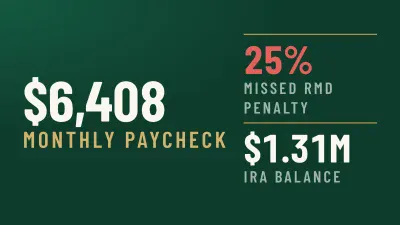
You turn 73 this year, and your IRA holds $1.31 million, and the portfolio you built pays about $6,408 a month. Your first required minimum distribution can wait until next April, but waiting often ends with a bigger tax bill. Below you’ll find the paycheck math, the job each holding does, and the timing fix.
How $1.31 Million Becomes a $6,408 Monthly Paycheck
This portfolio puts 20% in First Trust BuyWrite Income ETF (NASDAQ:FTHI), 15% each in four income names and 10% each in two credit funds. The blended yield comes to 5.9%.
| Holding | Yield | Role | Catch |
|---|---|---|---|
| FTHI | 9.8% | Option premium pays monthly cash | Short S&P 500 calls cap gains in sharp rallies |
| Invesco S&P Ultra Dividend Revenue ETF (NYSEARCA:RDIV) | 3.4% | High-dividend stocks | Payouts shift each quarter |
| Regency Centers (NASDAQ:REG) | 4.3% | Grocery-anchored centers, 97%[1] leased | A $65.1M[1] impairment hit GAAP earnings |
| Gladstone Investment (NASDAQ:GAIN) | 7.1% | BDC paying $0.08 monthly | NAV rose 1.2%[2] sequentially |
| Pembina Pipeline (NYSE:PBA) | 4.3% | Fee-based Canadian midstream | Canadian withholding can trim dividends |
| Vanguard Short-Term Corporate Bond ETF (NASDAQ:VCSH) | 4.7% | Steady ballast, 0.03%[3] expense ratio | Income drops when short rates fall |
| Janus Henderson B-BBB CLO ETF (NYSEARCA:JBBB) | 6.1% | Floating-rate CLO tranches | Monthly payouts swing with rates and credit |
What $76,896 a Year Costs at Three Yield Levels
Conservative (3% to 4%). This tier holds dividend-growth funds and broad-market stocks. At 3.5%, $76,896 divided by 0.035 equals about $2.2 million. At that yield, the same $1.31 million pays only about $3,821 a month. You need the most capital, but you face the least risk of income disruption.
Moderate (5% to 7%). This tier holds covered calls, REITs, preferreds, and high-dividend funds. At about 5.9%, $76,896 divided by that yield equals roughly $1.31 million, which describes this portfolio. In exchange for the higher income, dividend growth slows, and covered calls cap your upside.
Aggressive portfolios yielding 8% to 14% hold leveraged covered calls, BDCs, mortgage REITs, and high-yield bonds. At 10%, $76,896 divided by 0.10 equals $768,960. Distributions get cut, and principal often erodes.
Why a Lower Yield Can Pay More by Year Ten
A 3.5% yield that grows 8% a year doubles your income in about nine years. Regency raised its quarterly dividend from $0.67 in 2024 to $0.80 now. Gladstone’s regular $0.08 monthly payout hasn’t moved since 2023, so inflation shrinks what it buys a little more every year.
Delaying Your First RMD Stacks Two Withdrawals Into One Tax Year
If you were born in 1953, your first RMD year is 2026. You can wait until April 1, 2027, but your 2027 RMD is still due by December 31. If your IRA held $1.31 million at the end of 2025, the age-73 divisor of 26.5 puts your first RMD at about $49,434. If you wait, 2027 carries two RMDs totaling roughly $99,000. The exact figure shifts with your year-end balance.
Retirees already drawing the full paycheck in 2026 automatically satisfy the RMD. The trap catches people who live on cash or a final salary in year one and leave the IRA alone.
The double year raises taxable income. For 2026, single filers pay 24% on taxable income over $105,700. The extra income can also make more of your Social Security taxable and raise your Medicare premiums through IRMAA two years later. A single filer whose income tops $109,000[4] pays $284.10 a month for Part B instead of $202.90. For joint filers, IRMAA starts above $218,000[4]. Missing an RMD entirely costs 25% of the shortfall, or 10% if you correct it in time.
Shrinking that balance before the first required withdrawal is the whole point of planning early. We walked through how to defuse the first-year tax bomb in a free guide here.
Three Moves Before December 31
- Take your first RMD in the year it’s due. The exception is a year when your income is unusually high, such as a final year of salary.
- Project your 2027 taxable income against the $109.125 bracket line. Medicare will use your 2027 income to set 2029 premiums, using thresholds not yet announced.
- Ask your custodian how it handles Canadian withholding on Pembina dividends in your IRA.
The portfolio can deliver its $6,408 a month either way. When you take your first RMD, it determines how much you keep.
Contact [email protected] for any questions or corrections.
David Beren has been a Flywheel Publishing contributor since 2022. Writing for 24/7 Wall St. since 2023, David loves to write about topics of all shapes and sizes. As a technology expert, David focuses heavily on consumer electronics brands, automobiles, and general technology. He has previously written for LifeWire, formerly About.com. As a part-time freelance writer, David’s “day job” has been working on and leading social media for multiple Fortune 100 brands. David loves the flexibility of this field and its ability to reach customers exactly where they like to spend their time. Additionally, David previously published his own blog, TmoNews.com, which reached 3 million readers in its first year. In addition to freelance and social media work, David loves to spend time with his family and children and relive the glory days of video game consoles by playing any retro game console he can get his hands on.