What Size Portfolio Replaces a $130,000 Salary With Dividends at 67?

This post may contain links from our sponsors and affiliates, and Flywheel Publishing may receive compensation for actions taken through them.
You’re 67, at full retirement age, and still earning $130,000 a year. You’re probably wondering whether your savings can finally take over. Walking away from a steady paycheck feels like stepping off a ledge, and that fear makes sense. The math shows how far the drop really is.
One equation runs it all: your income target divided by the yield equals the portfolio you need. Your target works out to about $10,833 a month.
Three Yield Levels, Three Very Different Price Tags
| Tier | Yield | Math | Portfolio Needed |
|---|---|---|---|
| Conservative | 3.5% | $130,000 divided by 0.035 | About $3,714,000 |
| Moderate | 7% | $130,000 divided by 0.07 | About $1,857,000 |
| Aggressive | 12% | $130,000 divided by 0.12 | About $1,083,000 |
The conservative tier covers dividend growth funds, utilities, and oil majors. It takes the most capital, but payouts tend to rise, and principal tends to grow. The moderate tier covers REITs, high-yield telecom stocks and covered call funds. Dividend growth slows there, and some of those strategies cap your upside. The aggressive tier covers business development companies, mortgage REITs, and leveraged option funds, where distribution cuts and principal erosion are common. Before you trust any double-digit yield, check its payout history and its five-year share price.
A Six-Holding Mix Yielding About 4.5%
Here’s one blend built on current yields. Each holding has a job, and each one comes with a catch.
- Schwab U.S. Dividend Equity ETF (NYSEARCA:SCHD): 30% weight, 3.0% yield. It’s the diversified anchor, with Merck, Abbott, and Amgen[1] among its largest positions. The catch: its yield sits below the conservative tier, so every dollar of income takes more capital.
- JPMorgan Equity Premium Income ETF (NYSEARCA:JEPI): 15% weight, 7.3% yield. It pays monthly income from selling call options. The tradeoff is giving up gains in strong rallies, and the monthly payout changes, so you can’t budget around a fixed check.
- Realty Income (NYSE:O): 15% weight, 5.4% yield. It collects rent from 15,536 properties at 99% occupancy and just announced its 116th consecutive quarterly dividend increase. The catch: most of its dividends hit your tax bill at ordinary income rates.
- Exxon Mobil (NYSE:XOM | XOM Price Prediction): 10% weight, 2.7% yield. It’s your inflation hedge, with 44 consecutive years[2] of dividend raises and $19.1 billion of third-quarter free cash flow. The catch: oil prices drive its earnings.
- Southern Company (NYSE:SO): 15% weight, 3.2% yield. This regulated utility’s retail electricity sales rose 8% on data center demand. The catch: its raises come in small steps, and rising interest expense weighs on earnings.
- Verizon (NYSE:VZ): 15% weight, 6.0% yield. It generated $7.8 billion[3] of third-quarter free cash flow to back the dividend. The catch: revenue grew only about 1%[3].
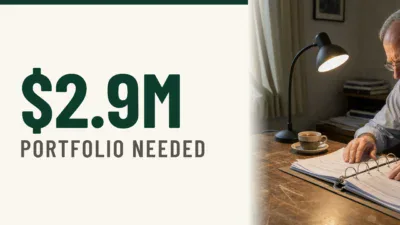
Together, the mix yields about 4.5%. Divide $130,000 by that combined yield, and you need roughly $2.9 million.
Social Security Shrinks the Target
In 2027, the maximum benefit for someone retiring at full retirement age is $4,188 a month, or $50,256 a year. That leaves $79,744 for the portfolio to cover, which drops the capital you need to about $1.8 million. The average retired worker’s estimated benefit of $2,170 cuts the need to about $2.3 million.
Why Lower Yields Often Win
When dividends cover your bills, you never have to sell shares in a crash to pay for groceries. Dividend growth compounds on top of that. If a 3.5% yield grows 8% a year, your $130,000 of income becomes about $260,000 in nine years. A flat 12% yield still pays $130,000 nine years later, while inflation eats into every dollar. The nearly 4% COLA for 2027 shows how fast prices are still climbing.
Taxes and Medicare Take a Cut
In a regular brokerage account, your dividends are taxable. In 2026, qualified dividends are taxed at 0% up to $98,900 of taxable income for joint filers and $49,450 for single filers, with higher income subject to 15% or 20% rates. Single filers start paying 15% on taxable income above $49,450. Higher income can also increase your Medicare bill. A single filer with modified adjusted gross income above $1120,000 and up to $141,000 pays about $293 a month for Part B in 2027, compared with the standard $209.
Three Moves to Make Before You Give Notice
- Pull your Social Security statement and subtract your projected benefit from $130,000. The difference is what your portfolio must cover.
- Add up your actual spending over the last 12 months. Payroll taxes of nearly 8%, commuting, and retirement contributions go away once you stop working, so you may need less than your salary.
- Decide which account keeps each investment. Placing Realty Income and the JPMorgan fund in an IRA shelters their ordinary income from tax. For anyone born in 1959, required minimum distributions don’t start until age 73, in 2032.
The more of your income that comes from 3% to 4% yields that keep growing, with Social Security filling the gap, the less likely you’ll ever have to sell at the wrong time. A free guide here lays out the mix, the payout calendar, and the withdrawal order for turning a lump sum into something that acts like a paycheck.
Contact [email protected] for any questions or corrections.
David Beren has been a Flywheel Publishing contributor since 2022. Writing for 24/7 Wall St. since 2023, David loves to write about topics of all shapes and sizes. As a technology expert, David focuses heavily on consumer electronics brands, automobiles, and general technology. He has previously written for LifeWire, formerly About.com. As a part-time freelance writer, David’s “day job” has been working on and leading social media for multiple Fortune 100 brands. David loves the flexibility of this field and its ability to reach customers exactly where they like to spend their time. Additionally, David previously published his own blog, TmoNews.com, which reached 3 million readers in its first year. In addition to freelance and social media work, David loves to spend time with his family and children and relive the glory days of video game consoles by playing any retro game console he can get his hands on.