Rochester, Minnesota, Is Home to the Mayo Clinic. What It Takes to Retire There at 67 on $1.1 Million

This post may contain links from our sponsors and affiliates, and Flywheel Publishing may receive compensation for actions taken through them.
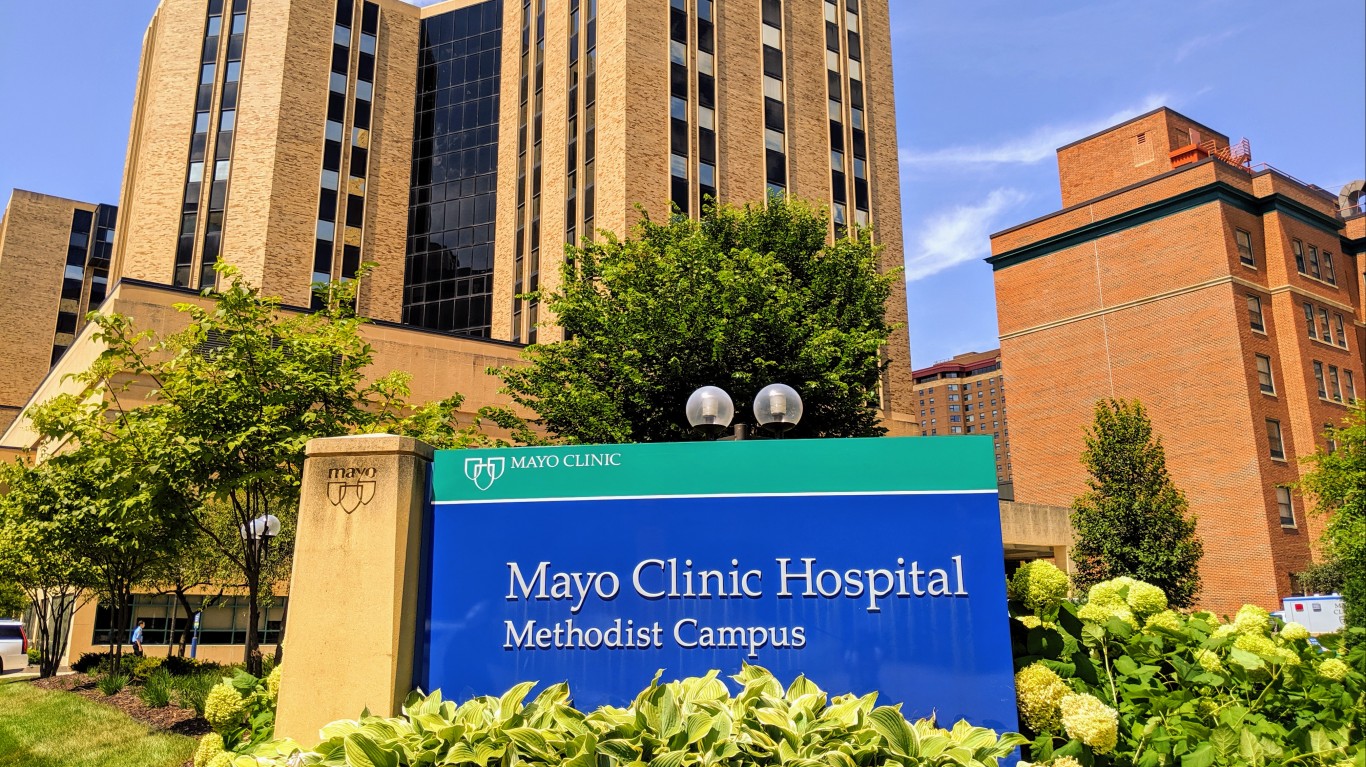
Rochester, home of the Mayo Clinic, attracts retirees willing to trade warm winters for a second opinion a short drive away rather than a cross-country flight. Is $1.1 million enough to retire there at 67?
For a married couple with no mortgage left to pay and average Social Security, it can be enough, even though the margins are thin, and the biggest catch involves the hospital that gets people to Rochester in the first place.
How $1.1 Million and Social Security Become a Rochester Paycheck
Let’s imagine a married couple, both 67, filing jointly. The whole $1.1 million sits in traditional IRAs and 401(k)s. Both spouses claim Social Security at full retirement age and collect the SSA’s estimated average for an aged couple: $3,208 a month, or $38,496 a year. A 4% first-year withdrawal, assuming a 25- to 30-year horizon starting at 67, produces $44,000.
On the federal return, that withdrawal makes about $22,400 of the Social Security taxable. After the $32,200 joint standard deduction, two $1,650 age-65 add-ons and the $6,000 senior deduction for each spouse, the federal bill comes to roughly $1,900.
Minnesota is easier on this couple than its reputation suggests. Retirement distributions are taxable in Minnesota. But the state’s simplified method lets joint filers with AGI below $108,320 in 2026 subtract all of their taxable Social Security, and that threshold is indexed to inflation. Take the $30,600 state standard deduction off the IRA income, apply the 5.35% bottom rate for 2026, and the state tax is about $717. That’s before Minnesota’s extra age-65 amount, which would trim it further.
Medicare Part B costs $202.90[1] a month per person, about $4,870 for the two of them. Their income sits well below the $218,000[1] joint IRMAA threshold. That leaves roughly $75,000 to spend. For comparison, the average U.S. household spent $81,905 in 2025, and that figure includes working households and households paying mortgages.
What $75,000 Has to Cover Through a Minnesota Winter
Housing determines whether this budget works. In the Rochester metro, the FHFA home price index rose 2.2%[2] over the past year and 28.01% over five years. Buying at 67 means paying today’s prices, and one carrying a mortgage would likely need more than $1.1 million. The $75,000 still has to cover property taxes, homeowners insurance, a long heating season, snow removal, food, Part D, the $283[1] Part B deductible, replacement cars, gifts, and an emergency reserve. Pricing each of those accurately requires a real county tax statement and a real insurance quote.
Mayo Access Depends on Which Medicare You Choose
Access to Mayo depends on the type of Medicare coverage a retiree holds. Mayo says it accepts Original Medicare, and adds: “We do not accept noncontracted Medicare Advantage Plans.” Local reporting ahead of 2026 open enrollment said Mayo would be out of network for certain Medicare Advantage plans.
A cheap Advantage plan could leave a retiree a few miles from the clinic and still outside its network. One path that keeps Mayo access is Original Medicare plus a Medigap policy and a Part D plan. That costs more each month, but it shields the couple from costs like the $1,736[1] Part A hospital deductible. Budgeting for that premium from the $75,000 up front avoids finding the gap after a diagnosis (we listed the Medigap, IRMAA, and Part D surprises retirees run into in a free Medicare guide here).
A Property Tax Ceiling Newcomers Have to Wait For
Minnesota’s senior property tax deferral caps what a qualifying homeowner pays at three percent[3] of household income, as long as that income stays at or below $96,000[4]. At this couple’s income, the cap works out to about $2,475 a year. The rest is deferred with interest until the home is sold.
A homeowner must have owned and lived in the home for at least five years[4] before applying, so a couple who moves at 67 can’t use it until their early 70s. Required distributions shouldn’t push them over the income limit on their own. At 73, the IRS divisor of 26.5 implies about $41,500 on a $1.1 million balance, which is less than the planned $44,000.
What Makes the Plan Hold
The plan works when the house is paid off, withdrawals stay near 4%, and the portfolio keeps pace with inflation after each withdrawal. Every year the couple delays Social Security past 67, up to age 70, raises the benefit by 8% of the full retirement age amount. The medical advantage in Rochester applies only when coverage includes Mayo. With Original Medicare and the Medigap premium built into the budget from day one, $1.1 million can likely support a couple there.
Contact [email protected] for any questions or corrections.
David Beren has been a Flywheel Publishing contributor since 2022. Writing for 24/7 Wall St. since 2023, David loves to write about topics of all shapes and sizes. As a technology expert, David focuses heavily on consumer electronics brands, automobiles, and general technology. He has previously written for LifeWire, formerly About.com. As a part-time freelance writer, David’s “day job” has been working on and leading social media for multiple Fortune 100 brands. David loves the flexibility of this field and its ability to reach customers exactly where they like to spend their time. Additionally, David previously published his own blog, TmoNews.com, which reached 3 million readers in its first year. In addition to freelance and social media work, David loves to spend time with his family and children and relive the glory days of video game consoles by playing any retro game console he can get his hands on.