Forget the U.K. eVTOL Hype, Here’s Why Joby Aviation Will Really Soar
Out Over Its Skis Shares of Joby Aviation (NYSE:JOBY | JOBY Price Prediction) rocketed more than 13% on Friday, capping a blistering week that saw the stock climb double so far this year amid surging investor enthusiasm for electric vertical…


Out Over Its Skis
Shares of Joby Aviation (NYSE:JOBY | JOBY Price Prediction) rocketed more than 13% on Friday, capping a blistering week that saw the stock climb double so far this year amid surging investor enthusiasm for electric vertical takeoff and landing (eVTOL) innovation.
Friday’s catalyst was the U.K.’s Civil Aviation Authority (CAA) unveiling its ambitious roadmap for integrating eVTOL travel into the nation’s skies by 2028, complete with phased regulatory milestones, environmental reporting enhancements, and nods to emerging tech like battery-electric aircraft. It’s a visionary blueprint that paints a future of seamless urban air mobility, slashing commute times and emissions in one fell swoop.
Joby’s been ahead of the curve, applying for U.K. certification in 2022 and partnering with Virgin Atlantic in March, via Delta Air Lines (NYSE:DAL), to launch air taxis connecting Heathrow and Manchester to city centers. These services promise quick trips, like eight-minute hops to Canary Wharf, bookable via Virgin’s app.
Yet, the roadmap lacks teeth — there are no binding regulations, and no revenue impact exists yet. It’s a vision, not a catalyst. Joby’s real ascent comes from its technological edge, strategic alliances, and looming commercial launches, not U.K. hype. Here’s why Joby’s really poised to dominate the skies.
Joby’s S4 Redefines the Skies
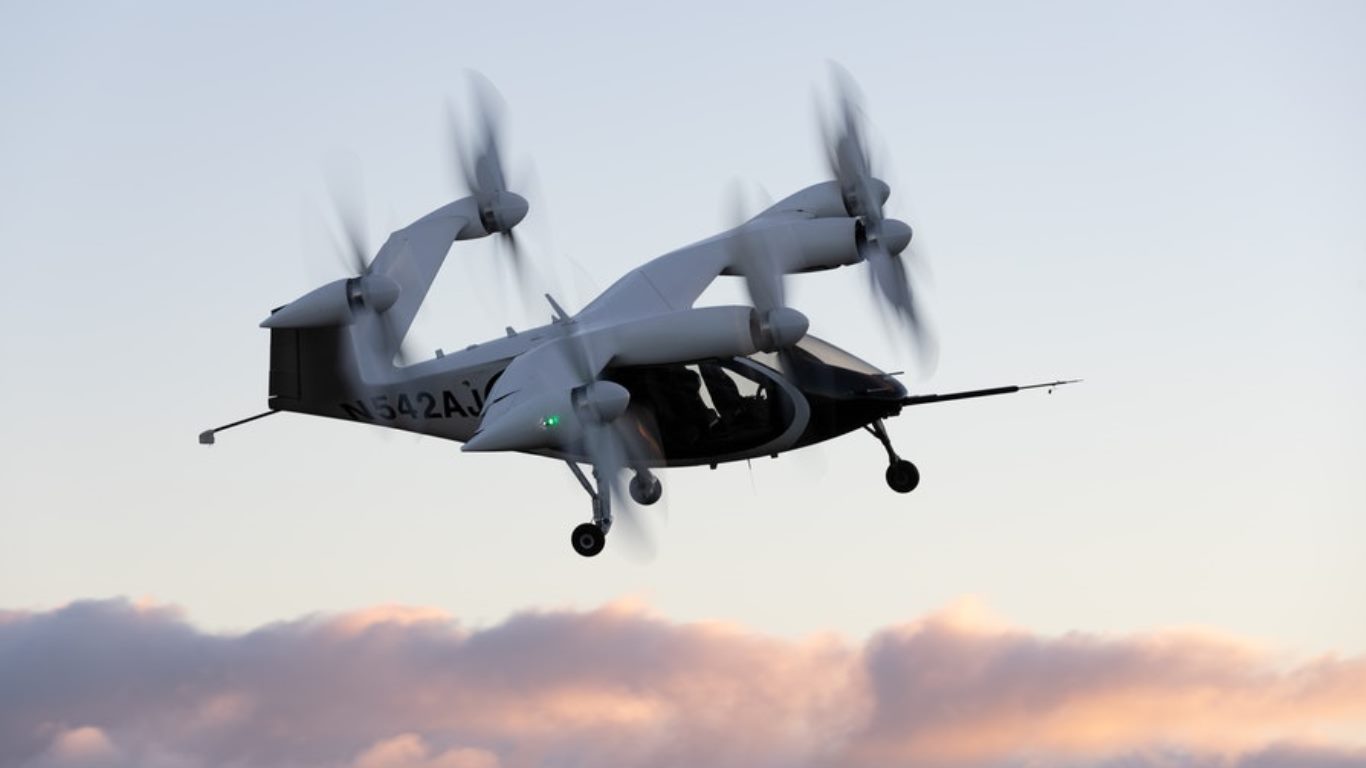
At the heart of Joby’s dominance is its S4 eVTOL — a sleek, piloted beast packing a 150-mile range, 200 mph top speed, and whisper-quiet acoustics that make helicopters sound like jackhammers.
Founded in 2009, Joby has logged over 30,000 test miles, including a groundbreaking 561-mile hydrogen-electric flight in 2024, proving its mettle in real-world endurance. Unlike rivals scrambling with prototypes, Joby’s vertically integrated model — from proprietary batteries to ElevateOS software — slashes costs and accelerates scalability.
With Joby reporting 70% completion of Stage 4 certification tasks as of the second quarter, it is lapping the field. Analysts peg the eVTOL market exploding to $1 trillion by 2040, and Joby’s head start positions it to snag a fat slice of urban air mobility’s projected 16.7% CAGR through 2032. This isn’t hype either. It is engineering supremacy primed for liftoff.
Blue-Chip Backing Accelerates Takeoff
Joby isn’t flying solo — it’s got a squadron of titans in formation. Toyota (NYSE:TM) has pumped nearly $900 million since 2018, including a fresh $250 million tranche in 2025, lending manufacturing wizardry to ramp production. Delta’s equity stake fuels seamless integration into airline ecosystems, while the March Virgin Atlantic tie-up locks in exclusive U.K. dominance.
Uber Technologies (NYSE:UBER) powers the app-based booking platform, blending eVTOLs with ground rides for frictionless ridesharing. Overseas, exclusive deals with Dubai’s government, Japan’s ANA Holdings, and Saudi Arabia’s Jameel secure over 300 aircraft deployments. Add the U.S. Air Force’s first delivery milestone and L3Harris Technologies (NYSE:LHX) defense hybrids set for fall 2025 tests, and Joby’s network isn’t just supportive — it’s a revenue rocket, diversifying beyond civilians into military might.
Cash-Rich and Burn-Savvy
Don’t let the pre-revenue jitters fool you — Joby’s war chest is battle-tested. The second quarter closed with $991 million in cash and equivalents, shrugging off a $325 million net loss (skewed by non-cash warrants) to fund a disciplined $500 million to $540 million burn rate. There is no crippling debt, minimal dilution risk, and Toyota’s $500 million commitment ensures a runway through commercialization in 2027..
The Blade Air Mobility passenger service acquisition was a stealth coup, injecting immediate operations (and revenue) in New York and Europe while its certification is brewing. Analysts forecast revenues leaping from peanuts in 2025 to over $100 million in 2026 and ballooning to $500 million by 2027 via aircraft sales, maintenance, and rides. High-margin services will flip the script from red ink to profitability quickly, turning this cash hoard into a compounding machine.
Two-Year Launch Horizon Ignites the Bull Case
Forget roadmaps — Joby’s calendar is etched in stone. Commercial passenger service hits Dubai in early 2026, with a U.S. rollout to follow after it gets an almost-assured FAA greenlight.
California’s Marina facility already churns out 24 aircraft yearly, while its trophy Ohio plant eyes 500 units annually by 2027. Six S4s are in final assembly, meaning test flights are routine, not rare. These aren’t pipe dreams, but rather milestones backed by 1,700 engineers and a global footprint.
As urbanization chokes roads and climate mandates focus on zero-emission skies, Joby’s 2025 debut could accelerate a valuation rerating, turning early investors into millionaires as air taxis become as ubiquitous as Ubers. JOBY stock’s 215% 12-month surge is just the warm-up before the real melt up begins.
Contact [email protected] for any questions or corrections.
After two decades of patrolling the dark corners of suburbia as a police officer, Rich Duprey hung up his badge and gun to begin writing full time about stocks and investing. For the past 20 years, he’s been cruising the markets looking for companies to lock up as long-term holdings in a portfolio while writing extensively on the broad sectors of consumer goods, technology, and industrials. Because his experience isn’t from the typical financial analyst track, Rich is able to break down complex topics into understandable and useful action points for the average investor. His writings have appeared on The Motley Fool, InvestorPlace, Yahoo! Finance, Money Morning, and, of course, 24/7 Wall St. He has been featured in both U.S. and international publications, including MarketWatch, Financial Times, Forbes, Fast Company, and USA Today.