Netflix Doubled Your Money in 12 Months After Years of Lagging the Market
Netflix (NASDAQ: NFLX | NFLX Price Prediction) went from mailing DVDs in red envelopes to dominating global streaming. That transformation created one of the most compelling investment stories of the past decade, but the path wasn’t smooth. The company weathered…

Netflix (NASDAQ: NFLX | NFLX Price Prediction) went from mailing DVDs in red envelopes to dominating global streaming. That transformation created one of the most compelling investment stories of the past decade, but the path wasn’t smooth. The company weathered subscriber losses in 2022, fierce competition from Disney+ and HBO Max, and persistent questions about whether it could sustain growth after saturating major markets.
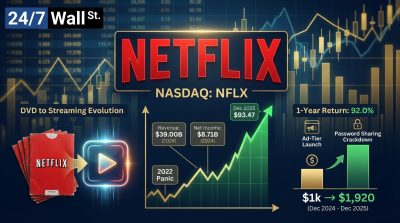
The answer came through strategic pivots. Netflix doubled down on international expansion, launched an ad-supported tier in late 2022, and cracked down on password sharing in 2023. These moves reignited subscriber growth and drove revenue acceleration. By 2024, the company reported $39.00 billion in revenue and $8.71 billion in net income. The most recent quarter (Q3 2025) delivered $11.51 billion in revenue, up 17% year over year, with a 28% operating margin despite a $619 million Brazilian tax dispute.
The stock reflected this evolution. After touching lows around $48 in late 2019 and early 2020, shares climbed steadily through the pandemic and beyond, recently trading near $93.47 in early December 2025.
Your $1,000 Turned Into $1,920 in One Year
Here’s what a $1,000 investment would look like across different time horizons:
1-Year Return (December 2024 to December 2025)
- Initial Investment: $1,000
- Current Value: $1,920
- Total Return: 92.0%
- S&P 500 (same period): Approximately $1,250 (25% estimated)
5-Year Return (December 2020 to December 2025)
- Initial Investment: $1,000
- Current Value: $1,927
- Total Return: 92.7%
- Annualized Return: 14.0%
- S&P 500 (same period): Approximately $1,850 (85% estimated)
10-Year Return (December 2015 to December 2025)
- Initial Investment: $1,000
- Current Value: $1,927
- Total Return: 92.7%
- Annualized Return: 6.8%
- S&P 500 (same period): Approximately $3,200 (220% estimated)
The 10-year picture reveals Netflix underperformed the broader market, largely due to the brutal 2022 drawdown when the stock lost over half its value. Investors who held through that period needed conviction. The recent surge, particularly in 2024 and 2025, came from operational execution: net income jumped 61% in 2023 to $5.41 billion as the company scaled subscribers while optimizing content spending.
Timing mattered significantly. Those who bought in 2022 during the panic saw far better returns than decade-long holders.
Market Outlook and Analyst Perspectives
Analysts remain largely bullish on Netflix, with 34 buy ratings versus just 2 sells. The forward P/E of 32.68 suggests expectations for earnings acceleration compared to the current P/E of 41.77. The company’s return on equity of 42.9% demonstrates strong operational efficiency.
However, the stock’s beta of 1.71 indicates high volatility, meaning shares can move sharply in either direction. The recent Q3 2025 earnings miss—reporting $0.59 versus $0.70 expected—has raised questions about potential margin pressure ahead, particularly given the $619 million Brazilian tax dispute that impacted operating margins.
Key factors analysts are monitoring include whether the company can maintain its 17% revenue growth trajectory and how successfully the ad-supported business scales. The valuation leaves limited room for disappointment, with the current multiple pricing in continued strong execution.
Contact [email protected] for any questions or corrections.
I've been writing about stocks and personal finance for 20+ years. I believe all great companies are tech companies in the long run, and I invest accordingly.