Disney’s Entertainment Model Stumbles as Amazon Doubles Down on AI Infrastructure Spending
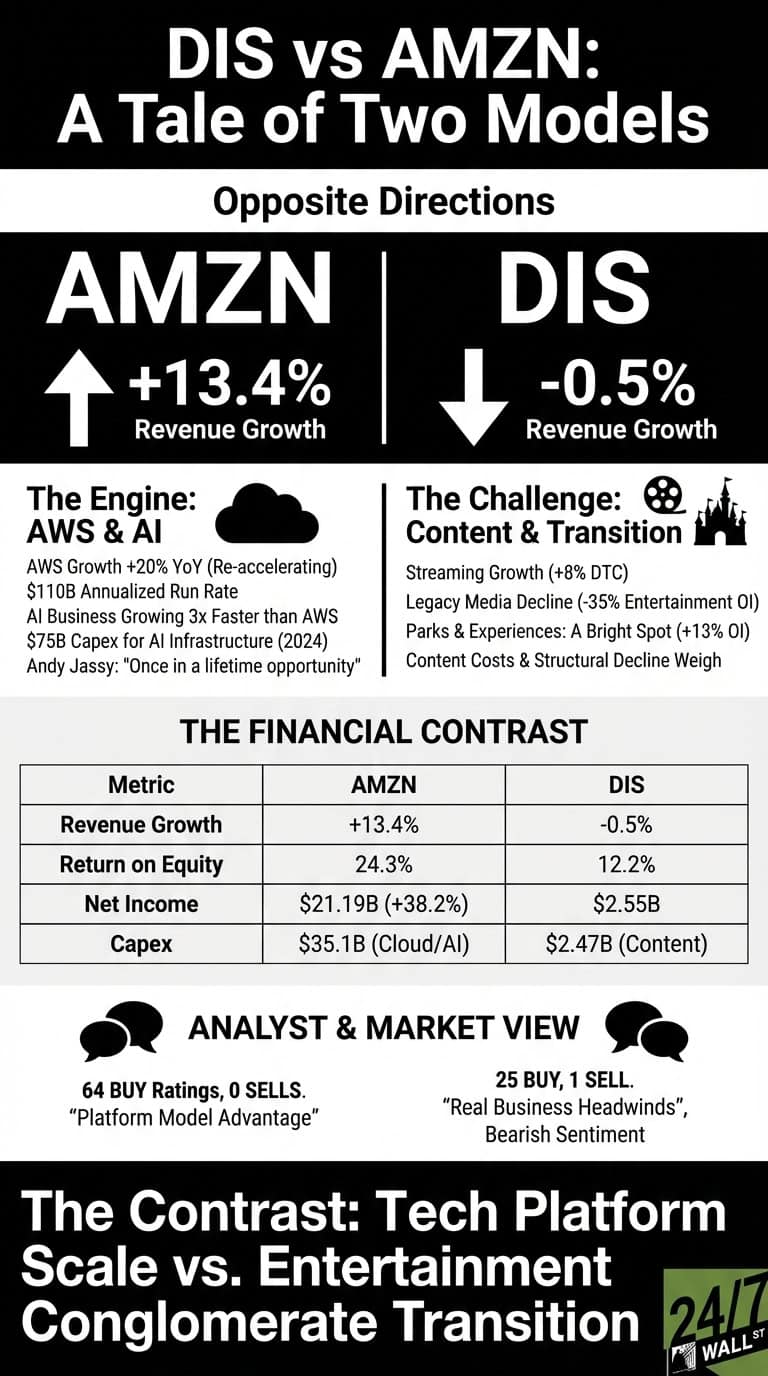
Amazon (NASDAQ: AMZN | AMZN Price Prediction) and Disney (NYSE: DIS) just reported earnings revealing two companies moving in opposite directions. Amazon delivered 13.4% revenue growth and accelerating cloud momentum. Disney posted flat revenue, down 0.5% year-over-year, as streaming gains…


Amazon (NASDAQ: AMZN | AMZN Price Prediction) and Disney (NYSE: DIS) just reported earnings revealing two companies moving in opposite directions. Amazon delivered 13.4% revenue growth and accelerating cloud momentum. Disney posted flat revenue, down 0.5% year-over-year, as streaming gains failed to offset legacy media weakness.
Is it odd that I’m comparing what are now two drastically different companies in drastically different industries? Somewhat, but I believe what we can learn by looking at the two will inform my and your future investment decisions.
The contrast clarifies what separates a tech platform built for scale from an entertainment conglomerate navigating a painful transition.
Cloud Infrastructure Drives Amazon. Content Costs Weigh on Disney.
Amazon Web Services grew 20% year-over-year to reach a $110 billion annualized run rate, re-accelerating to a pace not seen since 2022. CEO Andy Jassy noted that AWS’s AI business alone is “growing more than three times faster at this stage of its evolution as AWS itself grew.” The company’s Trainium2 AI chip saw adoption surge 150% quarter-over-quarter.
Disney’s direct-to-consumer segment grew 8%, driven by Disney+ and Hulu subscriber additions. But that gain couldn’t offset a 35% drop in Entertainment operating income, pulled down by weaker content sales and licensing revenue. Parks and experiences remained a bright spot, with operating income up 13%, but the segment can’t carry the entire company while linear networks continue their structural decline.
| Business Driver | Amazon | Disney |
| Main Growth Engine | AWS cloud + AI infrastructure | Parks + streaming subscriptions |
| Revenue Growth (YoY) | +13.4% | -0.5% |
| Return on Equity | 24.3% | 12.2% |
| Operating Margin | 11.1% | 11.9% |
Amazon generated $21.19 billion in net income, up 38.2% year-over-year. Disney earned $2.55 billion, a recovery from weak prior-year comparisons but still reflecting the challenge of monetizing content in a fragmented media landscape.
Capital Allocation Reveals Different Priorities
Amazon spent $35.1 billion on capital expenditures in Q3, up 55% year-over-year, with the majority directed toward AWS data centers and AI infrastructure. Jassy told investors the company expects to spend approximately $75 billion in 2024 and “more than that in 2025,” calling generative AI “a really unusually large maybe once in a lifetime type of opportunity.”
Disney allocated $2.47 billion to capex and committed $24 billion to content investment across entertainment and sports. The company doubled its share repurchase target to $7 billion and pays a $1.50 annual dividend. CEO Bob Iger emphasized the “multiplier effect” of successful content across streaming, parks, cruise ships, and consumer products.
Amazon’s return on equity sits at 24.3%, nearly double Disney’s 12.2%. That gap reflects superior capital efficiency in a business model built on recurring cloud revenue, logistics scale, and advertising growth, versus Disney’s reliance on cyclical content performance and capital-intensive theme parks.
Analyst Conviction Favors the Platform Model
Wall Street analysts assigned 64 buy or strong buy ratings to Amazon, with zero sells. Disney received 25 buy ratings and one sell. Retail sentiment on Reddit turned bearish for Disney following its mixed earnings report, with one widely discussed post titled “Disney stock falls 8% as media giant posts mixed results” drawing 985 upvotes.
Disney trades at a forward price-to-earnings ratio of 17.61, well below Amazon’s 27.62, but the discount reflects real business headwinds rather than opportunity. Revenue is flat. Legacy media is declining. Streaming profitability remains unproven at scale.
Amazon’s Fundamental Advantages
Amazon’s fundamentals show advantages because the business model compounds in ways Disney’s cannot. AWS operates at 38% operating margins and is accelerating. Retail benefits from logistics scale that competitors struggle to match. Advertising revenue hit $14.3 billion in the quarter, up 18.8%, leveraging Amazon’s unique position from top-of-funnel awareness to point of purchase.
Disney may deliver a turnaround, but it requires flawless content execution, continued parks strength, and a streaming model that can offset linear decline. Amazon’s diversification across cloud, retail, and advertising provides multiple paths to growth without depending on any single hit.
Contact [email protected] for any questions or corrections.
I've been writing about stocks and personal finance for 20+ years. I believe all great companies are tech companies in the long run, and I invest accordingly.