




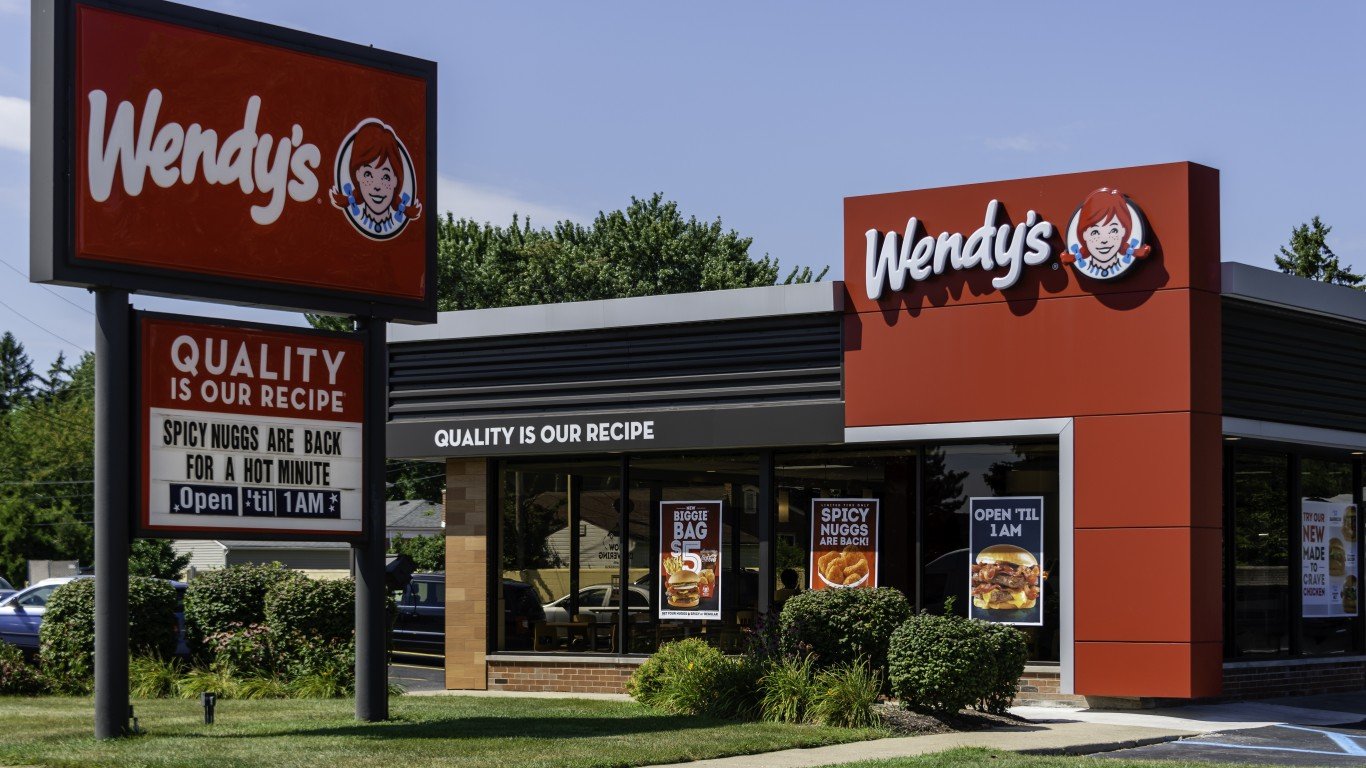
Wendy’s (NASDAQ: WEN) delivered a mixed fourth quarter as the fast-food chain navigates mounting cost pressures and accelerating traffic declines. The company reported revenue of $543.0 million, narrowly topping the $541.3 million consensus estimate, while adjusted earnings per share of $0.16 beat expectations of $0.15. But beneath the headline beat lies a troubling reality: U.S. same-restaurant sales plunged 11.3% as consumers pulled back on restaurant spending, and operating margins contracted 380 basis points to 12.7%.
The results cap a difficult 2025 for Wendy’s, with full-year revenue down 3.1% to $2.18 billion and net income falling 15.1% to $165.1 million. Shares have been battered, dropping 45.77% over the past year to $7.27 as investors question whether management’s turnaround plan can reverse the brand’s momentum loss.
Margin Compression Accelerates Despite Revenue Beat
Wendy’s fourth quarter illustrated the fundamental challenge facing value-oriented restaurant chains: driving traffic without destroying profitability. While the company’s $543.0 million in revenue represented only a 5.5% year-over-year decline, the 11.3% drop in U.S. same-restaurant sales signals that fewer customers are walking through the door. This traffic collapse forced franchisees and company-operated locations to lean heavily on pricing, which proved insufficient to offset rising costs.
Company-operated restaurant margins fell to 12.7%, down from 16.5% in the prior-year quarter, as labor inflation and commodity pressures overwhelmed operational improvements. Adjusted EBITDA declined 17.6% to $113.3 million, while operating income dropped 33.3% to $64.0 million. The margin deterioration stands in stark contrast to category leader McDonald’s (NYSE: MCD), which maintains operating margins of 46.9% through superior scale and pricing power.
Value Menu Strategy Faces Critical Test in 2026
Management is betting heavily on an expanded value platform to stabilize traffic. CEO Ken Cook emphasized that the company is “executing with urgency” on Project Fresh, the turnaround initiative designed to sharpen operations and rebuild customer frequency. The centerpiece is a revamped Biggie value menu launching in 2026, which management believes will recapture price-sensitive customers who have traded down to competitors or reduced restaurant visits altogether.
But the 2026 guidance reveals management’s limited confidence in a quick recovery. The company projects global systemwide sales to remain approximately flat, with adjusted EBITDA of $460 million to $480 million and adjusted EPS of $0.56 to $0.60. That earnings outlook represents a significant step down from 2025’s $0.88 per share, suggesting management expects margin pressure to persist even as value offerings attempt to stabilize traffic.
The broader consumer spending environment offers little relief. Retail sales were flat in December 2025 after climbing steadily through November, signaling that consumers are growing more cautious. While year-over-year retail sales growth of 3.3% indicates the economy is not in recession, the deceleration suggests that restaurant chains face sustained pressure from customers managing tighter budgets.
International Growth Provides Lone Bright Spot
While U.S. operations struggled, Wendy’s international segment delivered solid performance. International systemwide sales grew 6.2% in the fourth quarter and 8.1% for the full year, driven by expansion in markets where the brand faces less entrenched competition. The company opened 157 net new restaurants globally in 2025, with 121 of those outside the United States.
This international momentum provides a growth avenue independent of the challenging U.S. market, but it remains a fraction of total system sales. The real test for Wendy’s will be whether management can stabilize its core U.S. business, which accounts for the majority of revenue and profitability.
Valuation Reflects Deep Skepticism
The market’s verdict on Wendy’s turnaround prospects is unambiguous. At 7.73 times trailing earnings, the stock trades at a steep discount to McDonald’s 27.56 multiple and even value-focused peer Restaurant Brands International’s (NYSE: QSR) 25.23 multiple. Analyst sentiment is decidedly cautious, with 20 Hold ratings, four Sell ratings, and only five Buy or Strong Buy ratings. The consensus price target of $9.38 implies just 29% upside from current levels.
The company’s 8.4% profit margin and 17.2% operating margin lag well behind McDonald’s 32% profit margin, underscoring the structural disadvantage Wendy’s faces in generating returns. While the 7.7% dividend yield may appeal to income investors, the sustainability of that payout is questionable given declining earnings and free cash flow guidance of $190 million to $205 million for 2026, down from $205.4 million in 2025.
Capital Allocation Priorities Shareholder Returns Despite Pressure
Despite margin compression and declining cash flow, Wendy’s maintained aggressive shareholder returns in 2025. The company returned $329.6 million to shareholders, up $48 million year-over-year, through dividends and share repurchases. The board declared a quarterly dividend of $0.14 per share, with a record date of March 2, 2026, and payment date of March 16, 2026.
The company has approximately $35 million remaining under its share repurchase authorization through February 2027. While returning capital to shareholders signals management confidence, the timing raises questions about whether those funds would be better deployed in operational improvements or marketing to drive traffic recovery.
Balance Sheet Deterioration Raises Concerns
Wendy’s financial position weakened materially during 2025. Cash declined 33.2% to $300.8 million, while shareholders’ equity fell 54.7% to $117.4 million. The company’s price-to-book ratio of 12.65 reflects the thin equity cushion relative to market capitalization, a function of the highly leveraged franchise model that generates strong returns in good times but offers little margin for error during downturns.
What Needs to Happen for the Stock to Work
Wendy’s faces a narrow path to rehabilitating investor confidence. The company must demonstrate that its value menu can stabilize U.S. traffic without further eroding margins, a difficult balance that has eluded management for multiple quarters. Success requires not just attracting price-sensitive customers, but converting them into repeat visitors who gradually trade up to higher-margin menu items.
Operationally, the company needs to close the margin gap with peers through better labor management and supply chain efficiency. The 380-basis-point margin contraction in the fourth quarter cannot continue if the business is to generate acceptable returns. International expansion provides a secondary growth driver, but at current scale it cannot offset U.S. weakness.
For investors, the question is whether Wendy’s at $7.27 represents a value opportunity or a value trap. The depressed multiple and high dividend yield will attract contrarian investors, but the deteriorating fundamentals and cautious guidance suggest the turnaround remains in early innings. The next several quarters will determine whether management’s value menu bet pays off or whether further margin compression lies ahead.












 Top Gaining Stocks
 Top Losing Stocks