




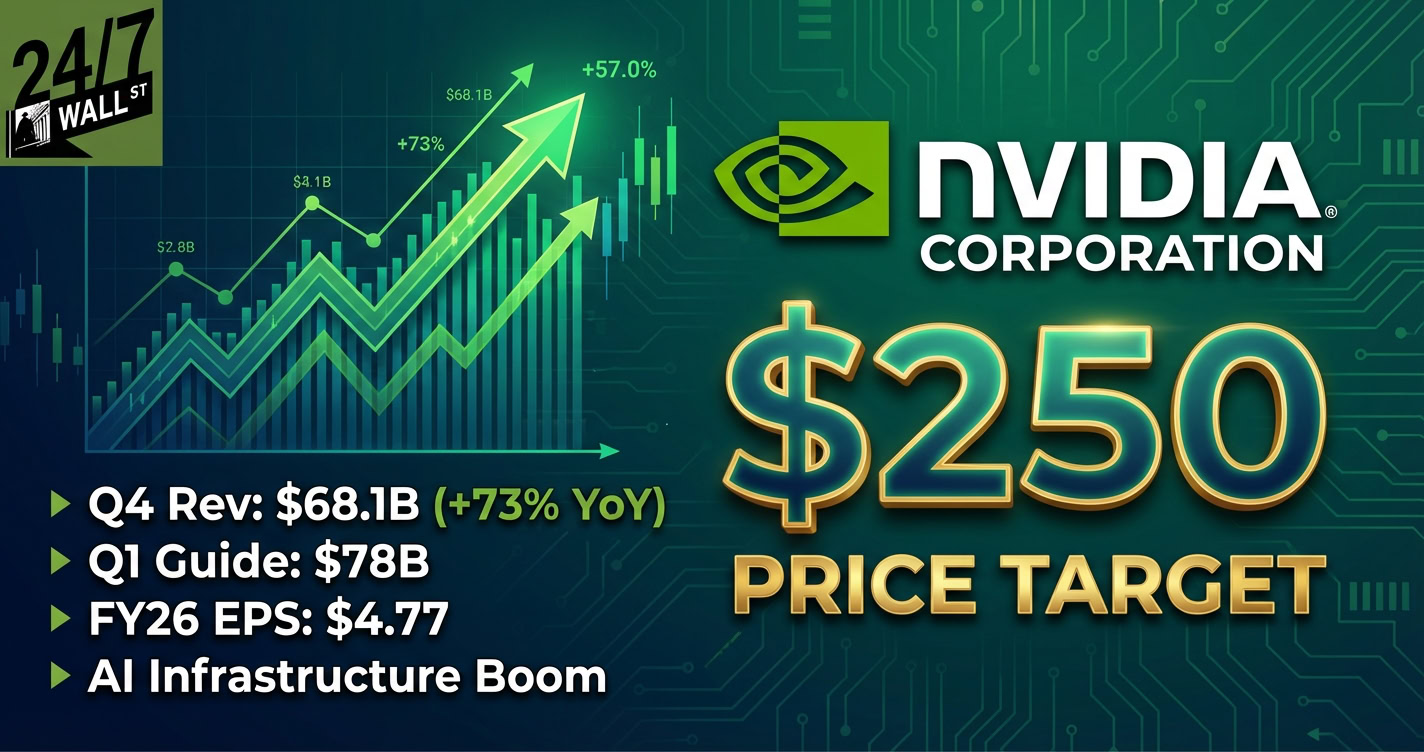
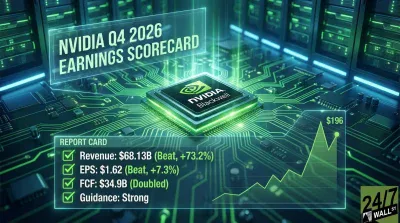
NVIDIA (NASDAQ:NVDA | NVDA Price Prediction) reported fiscal Q4 2026 earnings yesterday that reset the bar for what this company can generate. Revenue hit $68.1 billion, up 73% year-over-year, while Q1 FY2027 guidance came in at $78 billion, well ahead of expectations that had centered around roughly $72 billion. With shares surprisingly pulling back today, the path to $250 remains within scope.
The Revenue Engine Is Still Accelerating
Data Center revenue reached $62.3 billion in Q4, up 75% year-over-year, and now represents approximately 91.5% of total revenue. Within that segment, networking revenue hit roughly $11 billion, up more than 3.5x year-over-year, driven by NVLink, Spectrum-X Ethernet, and InfiniBand demand tied to next-generation AI systems.
The Q1 guidance of $78 billion implies roughly 77% year-over-year growth at the midpoint versus Q1 FY2026 revenue of $44.1 billion. Annualized, that pace would approach a $312 billion run rate, although investors should recognize that simply annualizing a peak AI infrastructure quarter is not the same as forecasting a steady-state revenue base.
NVIDIA remains at the center of surging AI infrastructure spend. Management highlighted that Meta is deploying millions of Blackwell and Rubin GPUs across a multiyear buildout. The company also noted that inventory and supply commitments now extend into calendar 2027, underscoring the scale and duration of current demand. While that does not equate to guaranteed backlog revenue, it does provide unusual visibility for a hardware-driven business operating at this scale.
The Valuation Math at $250
NVIDIA posted full-year FY2026 EPS of $4.77. Q4 alone contributed $1.62 in normalized EPS, which annualizes to roughly $6.48 before factoring in any additional forward growth. At $250, that implies a run-rate P/E of approximately 39x.
However, using consensus FY2027 EPS estimates of about $7.86, the multiple at $250 would be closer to 32x forward earnings. For a company growing revenue north of 70% year-over-year, with non-GAAP gross margins around 75%, that valuation sits within the range investors have historically been willing to pay for category-defining growth platforms.
In other words, $250 does not require heroic assumptions. It requires continued execution, sustained hyperscaler spending, and incremental estimate revisions as guidance continues to outpace expectations.
What Still Needs to Go Right
China remains a wildcard. The Q1 FY2027 guide explicitly excludes Data Center compute revenue from China, making any resumption of shipments a potential upside lever. At the same time, export policy uncertainty cuts both ways, meaning China should be viewed as optionality rather than guaranteed incremental revenue.
The Rubin platform also represents a key swing factor. Management indicated Rubin can deliver up to 10x lower inference token cost versus Blackwell, a step-change that could expand total AI demand. Lower cost per token can drive higher usage and broader enterprise adoption, but sustaining pricing power and margins as performance improves will be critical.
CEO Jensen Huang framed the moment clearly: enterprise adoption of AI agents is accelerating, and customers are racing to build what he describes as AI factories. If that trajectory holds through FY2027, a $250 share price would reflect continued earnings expansion rather than speculative multiple expansion, particularly if consensus estimates continue to move higher following each guidance beat.









 Top Gaining Stocks
 Top Losing Stocks