Uber Stock Price Prediction: Can It Surpass $100 in 2026?
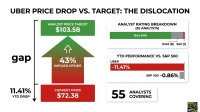
Ride hailing company Uber Technologies (NYSE:UBER | UBER Price Prediction) is trading at $72.34 as of writing, down 11.47% year-to-date and sitting well below its 52-week high of $101.99. Our 24/7 Wall St. Price Target is $125.24, implying upside of…

Ride hailing company Uber Technologies (NYSE:UBER | UBER Price Prediction) is trading at $72.34 as of writing, down 11.47% year-to-date and sitting well below its 52-week high of $101.99. Our 24/7 Wall St. Price Target is $125.24, implying upside of approximately 73% over the next 12 months. The 24/7 Wall St. Price Target carries a 90% confidence level.
| Metric | Value |
|---|---|
| Current Price | $72.34 |
| 24/7 Wall St. Price Target | $125.24 |
| Upside | ~73% |
| Confidence Level Basis | Proprietary 247Factor Model |
| Confidence Level | 90% |
Our price target of $125.24 clears the $100 threshold comfortably. Reaching $100 requires roughly 38% appreciation from current levels, a bar our model treats as a base-case milestone. The analyst consensus target of $103.68 corroborates that view.
Testing the YTD Pullback
Uber shares have declined 11.47% year-to-date, touching a recent low of $70.53 in February 2026 after Q4 2025 earnings disappointed on the EPS line. Non-GAAP EPS of $0.71 missed the $0.77 estimate by 8.83%, while a $1.6 billion equity investment revaluation headwind crushed reported net income to $296 million.
The operating business was accelerating beneath those headlines: free cash flow hit a record $2.8 billion in Q4, up 64.6% year-over-year, and revenue of $14.3 billion grew 20.1% year-over-year.

The Case for $125 and Beyond
The bull thesis centers on autonomous vehicles and margin expansion. CEO Dara Khosrowshahi told investors on the Q4 call: “We enter 2026 with a rapidly growing topline, significant cash flow, and a clear path to becoming the largest facilitator of AV trips in the world.” Uber currently has 20-plus autonomous vehicle partners globally and expects to operate in 15 cities by year-end. A deal to invest up to $1.25 billion in Rivian (NASDAQ: RIVN) to launch 50,000 robotaxis has already lifted retail investor sentiment.
The core business is accelerating. Delivery revenue grew 30% year-over-year in Q4 2025 with adjusted EBITDA up 40%. Full-year 2025 free cash flow reached $9.7 billion, up 41.6%. Uber repurchased $6.5 billion of shares in full-year 2025 under a $20 billion authorization.
Of 56 analysts covering the stock, 47 rate it Buy or Strong Buy, just 1 rates it a Sell, with the bull case pointing to $138.55.
What Could Go Wrong
Worker classification regulation remains an unresolved overhang globally, and insurance reserves grew from $2.7 billion to $3.3 billion year-over-year, a cost pressure management says is easing but has not fully resolved. Long-term debt rose from $8.3 billion to $10.5 billion, partly funding AV infrastructure. The Freight segment remains at flat growth and near-breakeven profitability.
Full-year 2025 GAAP EPS of $2.45 missed the $5.37 estimate by a wide margin, though that gap is almost entirely explained by non-cash equity revaluations. The bear scenario prices the stock at $104.04, still above $100, suggesting limited downside to the key threshold even in a pessimistic scenario.
Key Catalysts and Risks to Watch
The Q1 2026 guidance midpoint calls for 37% year-over-year EPS growth, a meaningful catalyst if delivered. Our price target carries a 90% confidence level. The case strengthens if Q1 2026 results confirm EPS growth and AV city deployments stay on schedule; it weakens if insurance costs re-accelerate or the Rivian deal faces regulatory delay.

Uber Price Prediction 2026-2030
| Year | 24/7 Wall St. Price Target |
|---|---|
| 2026 | $110.14 |
| 2027 | $125.24 |
| 2028 | $165.00 |
| 2029 | $220.00 |
| 2030 | $322.47 |
Intermediate years assume continued 18-20% revenue growth, expanding EBITDA margins, and meaningful AV monetization beginning in 2028. The 2030 figure reflects the 5-year base case, implying a 34.84% annualized return. Significant upside or downside could result from the pace of autonomous vehicle commercialization and any resolution of global worker classification regulations.
Contact [email protected] for any questions or corrections.
Vandita Jadeja is a financial publisher with over a decade of experience writing about financial topics, including investment, savings, retirement, insurance and banking. Vandita is a Chartered Accountant who loves to debunk financial concepts for readers.
Her work has appeared on sites that include The Motley Fool, InvestorPlace, and Benzinga. She covers investing and focuses on stock picks and price prediction for 24/7 Wall St.
When not looking for the next stock investment opportunity, she can be found traveling, reading, chasing sunsets and enjoying her iced latte.