Nvidia Hits $5.5 Trillion — It’s Now Worth More Than the GDP of Every Country but the U.S. and China
The stock market has produced some astonishing winners over the years, but what’s happening with Nvidia (NASDAQ:NVDA | NVDA Price Prediction) feels different. Five years ago, Nvidia was still largely viewed as a high-end gaming graphics card maker with growing…

This post may contain links from our sponsors and affiliates, and Flywheel Publishing may receive compensation for actions taken through them.
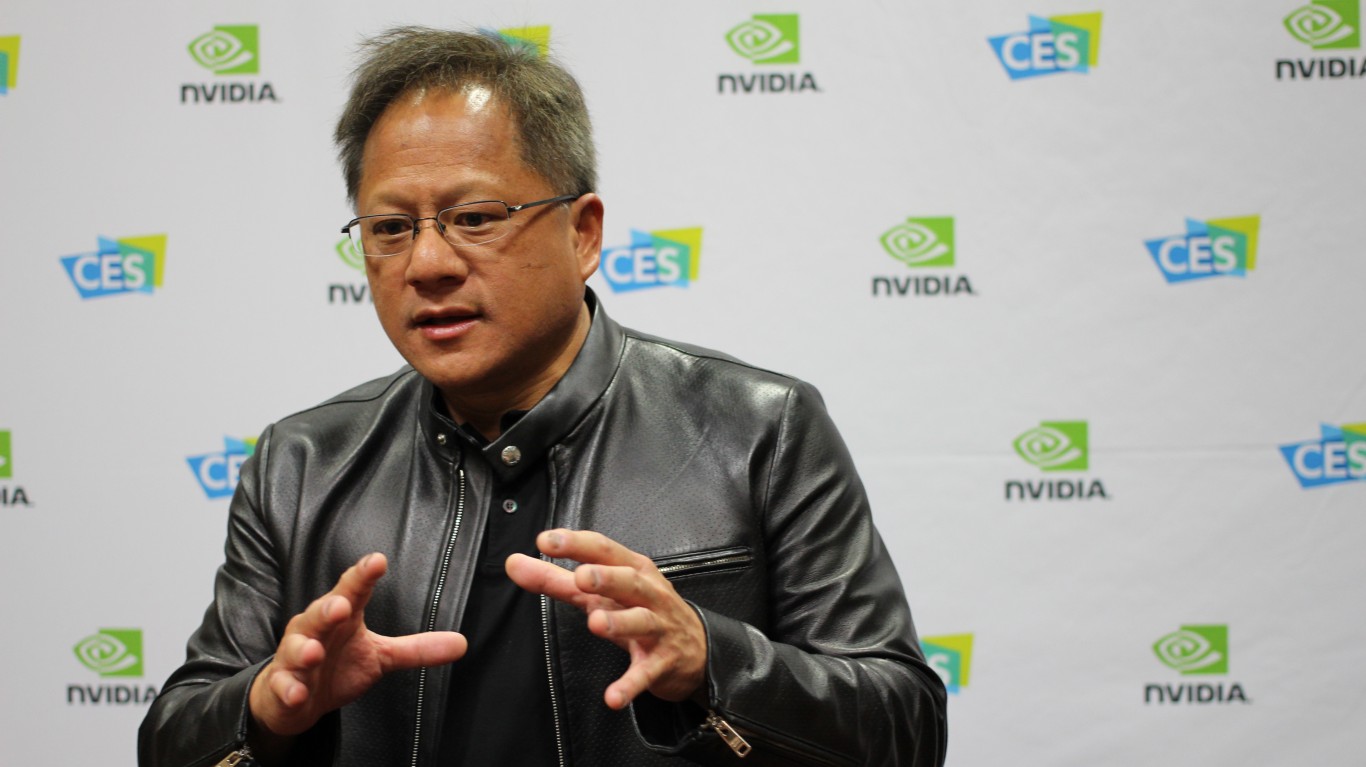
The stock market has produced some astonishing winners over the years, but what’s happening with Nvidia (NASDAQ:NVDA | NVDA Price Prediction) feels different. Five years ago, Nvidia was still largely viewed as a high-end gaming graphics card maker with growing data center ambitions. Today, it sits at the center of the artificial intelligence economy — and increasingly, at the center of global finance itself.
That transformation has been breathtakingly fast. Nvidia’s market capitalization hovered around $345 billion in 2021 and revenue was falling as its gaming revenue collapsed. Yet a harbinger of what was to come, data center revenue was accelerating.
Now the stock has crossed the $5.5 trillion threshold, which remarkably means it is worth more than the entire annual economic output of every nation on Earth except the U.S. and China. That raises a fascinating question for investors: how exactly does one company become larger than virtually all industrialized economies in just half a decade?
Nvidia’s Rise Is Unlike Anything Wall Street Has Seen
Nvidia has added more than $5 trillion in market value in just five years — a gain approaching 1,500%.
Here’s what the numbers tell us:
| Company | Approx. Market Value |
| Nvidia | $5.5 trillion |
| Alphabet (NASDAQ:GOOG) | $4.76 trillion |
| Apple (NASDAQ:AAPL) | $4.35 trillion |
| Microsoft (NASDAQ:MSFT) | $2.99 trillion |
| Amazon (NASDAQ:AMZN) | $2.5 trillion |
That growth did not happen because Nvidia stumbled into a lucky product cycle. The company became the foundational infrastructure provider for generative AI. Its GPUs power the training and inference workloads behind large language models, enterprise AI systems, robotics, autonomous vehicles, and increasingly, national AI infrastructure projects.
That’s a fancy way of saying Nvidia became the company selling picks and shovels during the AI gold rush.
Its latest earnings reports showed revenue growth rates many mature companies can only dream about. In its most recent fiscal year, Nvidia generated nearly $216 billion in revenue and $96.6 billion in free cash flow. Wall Street expects it to produce over $400 billion in FCF over the next two years. Few companies in history have scaled cash generation that quickly.
Nvidia Is Now Bigger Than Entire Economies
The comparison between stock market value and national GDP is imperfect. One measures the value investors place on future cash flows, while the other measures annual economic output. They are not interchangeable.
Still, it illustrates just how enormous Nvidia has become. Here’s where Nvidia stacks up against major economies based on World Bank and IMF estimates:
| Country | Nominal 2025 GDP |
| U.S. | $30.77 trillion |
| China | $19.6 trillion |
| Nvidia | $5.5 trillion |
| Germany | $5.01 trillion |
| Japan | $4.34 trillion |
| United Kingdom | $4.00 trillion |
| India | $3.92 trillion |
| France | $3.36 trillion |
Regardless of how you look at it, Nvidia now occupies rare air. Its valuation also makes it the world’s second-largest asset behind gold, which sits around $32.6 trillion based on estimates from the World Gold Council and global reserve calculations, but ahead of silver at $4.9 trillion.
Surprisingly, Nvidia achieved most of this growth without full access to one of the world’s largest AI markets — China.
China Could Become Nvidia’s Next Growth Engine
U.S. export restrictions have limited Nvidia’s ability to sell its most advanced AI chips into China. That has forced the company to develop downgraded products tailored to regulatory requirements while domestic Chinese competitors attempt to fill the gap.
Yet Nvidia has continued growing at a remarkable pace anyway. That’s what makes the latest geopolitical developments so important. CEO Jensen Huang is accompanying President Donald Trump on a China-related trip alongside other technology executives. Investors are watching closely for signs of a potential trade or export framework that could reopen portions of the Chinese AI market to Nvidia hardware.
If Nvidia regains a meaningful China growth tailwind, the company’s revenue runway could extend even further. China represented roughly 20% to 25% of Nvidia’s data center opportunity before restrictions tightened.
That said, investors should keep expectations grounded. Nvidia already trades at valuations that assume years of continued AI dominance. Competition is increasing from custom AI chips built by hyperscalers including Amazon, Microsoft, and Alphabet. Semiconductor cycles also have a long history of cooling off after periods of rapid expansion.
Key Takeaway
In short, Nvidia’s rise from a $345 billion gaming-chip specialist to a $5.5 trillion AI titan may go down as one of the defining corporate transformations of modern markets.
The GDP comparisons may be imperfect, but the message is clear: Nvidia has become more than just a semiconductor company. It is now a core pillar of the AI economy and, increasingly, global capital markets themselves.
For sharp investors, the real question is no longer whether Nvidia changed the world. It already has. The question now is whether the company can keep expanding fast enough to justify a valuation larger than nearly every nation on Earth.
When all is said and done, that is both the opportunity — and the risk — sitting in front of shareholders today.
Contact [email protected] for any questions or corrections.
After two decades of patrolling the dark corners of suburbia as a police officer, Rich Duprey hung up his badge and gun to begin writing full time about stocks and investing. For the past 20 years, he’s been cruising the markets looking for companies to lock up as long-term holdings in a portfolio while writing extensively on the broad sectors of consumer goods, technology, and industrials. Because his experience isn’t from the typical financial analyst track, Rich is able to break down complex topics into understandable and useful action points for the average investor. His writings have appeared on The Motley Fool, InvestorPlace, Yahoo! Finance, Money Morning, and, of course, 24/7 Wall St. He has been featured in both U.S. and international publications, including MarketWatch, Financial Times, Forbes, Fast Company, and USA Today.