Jeff Bezos Says Bottom 50% of Americans Should Pay No Tax. The Real Culprit Is Federal Spending
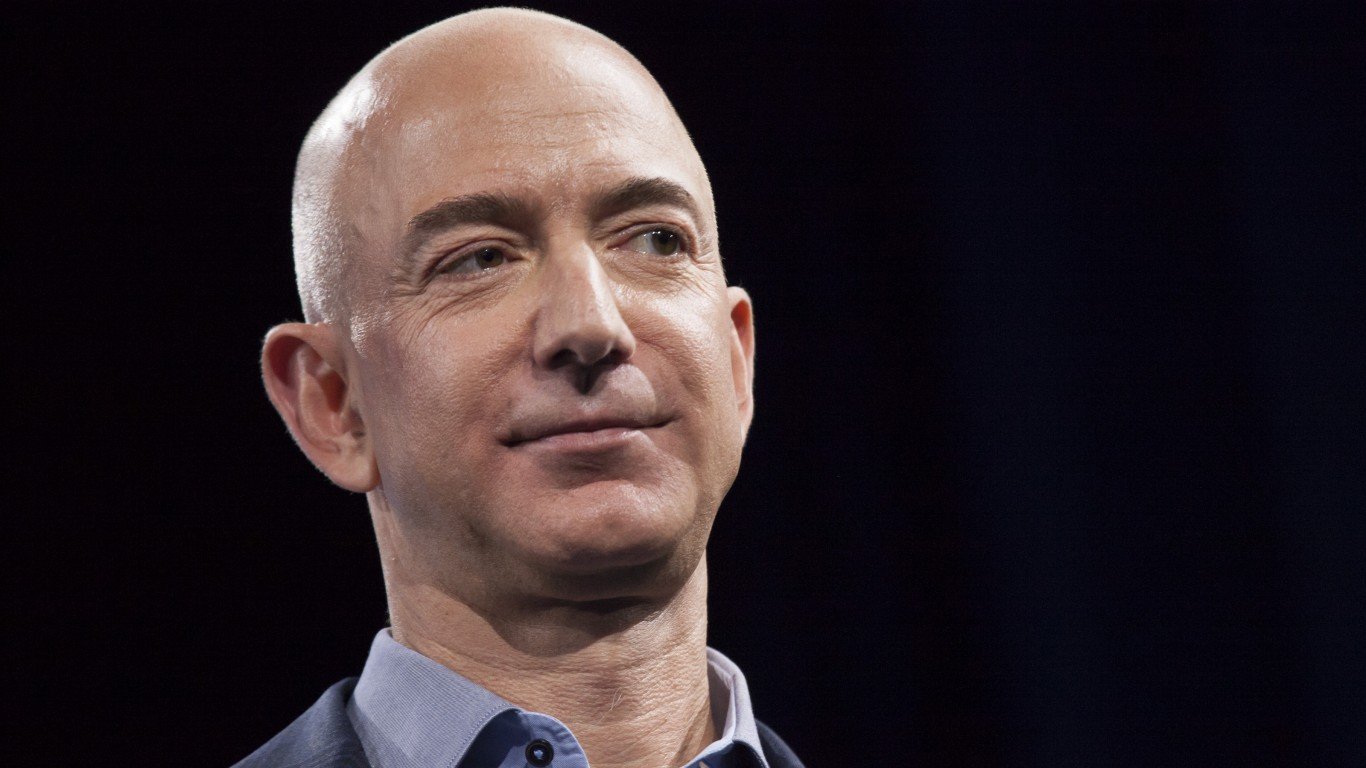
On a recent episode of The Pomp Podcast featuring guest Jordi Visser, host Anthony Pompliano surfaced a notable statement from Amazon (NASDAQ:AMZN | AMZN Price Prediction) founder Jeff Bezos: the bottom 50% of Americans should pay no federal tax. Pompliano…

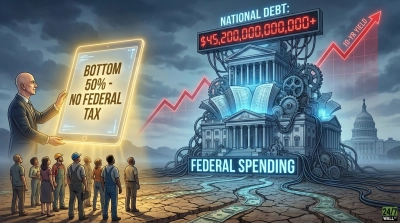
On a recent episode of The Pomp Podcast featuring guest Jordi Visser, host Anthony Pompliano surfaced a notable statement from Amazon (NASDAQ:AMZN | AMZN Price Prediction) founder Jeff Bezos: the bottom 50% of Americans should pay no federal tax. Pompliano paired that proposal with a data point and a pivot. The data point: that bottom-half cohort currently contributes about 3% of the federal budget. The pivot: the conversation, in Pompliano’s reading, centers on federal spending discipline.
For a retirement-focused audience watching Social Security, Medicare, and Treasury yields, this debate matters. Here is how the segment framed it.
The Bezos Proposal
Bezos’s headline argument, as relayed by Pompliano, is that working-class Americans are sending too much to Washington relative to what they keep. Pompliano illustrated the burden with a household example: “If you make $70,000, if you’re sending $10,000 or $12,000 to Washington, one, that’s an incredible amount of of your, of the money that you need to live.”
For context on that earner profile, IRS brackets for 2026 under the One, Big, Beautiful Bill set a 22% marginal rate on single-filer incomes over $50,400, with a standard deduction of $16,100 for single filers. Per-capita disposable personal income in the U.S. reached $68,617 in the first quarter of 2026, which puts the $70,000 worker squarely in the income band Bezos is pointing to. Meanwhile, the personal savings rate has slipped to 4.0% in Q1 2026, down from 6.2% in early 2024, which speaks to the household cash-flow pressure the example invokes.
The 3% figure from Pompliano is the data anchor making the proposal financially defensible at the headline level. He did not compute what the federal revenue impact would be, and neither will we.
The Wealthy-Voices Trend
The second thread in the segment was cultural. Pompliano’s observation: “Wealthy people really didn’t talk that much about taxes, but they seem to become more outspoken.” He pointed to Bezos’s proposal and referenced JPMorgan Chase (NYSE:JPM) chief Jamie Dimon as part of a broader pattern of high-net-worth figures publicly weighing in on federal fiscal policy.
Pompliano framed the moment as an unprecedented “butting of heads” between wealth and Washington. The segment treated this purely as a cultural data point.
The Real Culprit: Federal Spending
Pompliano’s pivot was that the headline tax proposal is a doorway into the spending conversation. His characterization of Washington: “Washington’s not exactly the best, most capital efficient, you know, kind of, uh, uh, allocators.”
The macro backdrop supports why investors are paying attention. The 10-year Treasury yield sat at 4.57% as of May 21, 2026, near the 12-month high of 4.67% reached on May 19, with the yield now in the 98th percentile of its trailing-year range. Government spending contributed 4.4% to real GDP growth in Q1 2026 after a sharp -5.6% contraction in Q4 2025. Core PCE, the Fed’s preferred inflation gauge, ran in the 90.9th percentile of its 12-month range as of March 2026. Federal transfer receipts have climbed to $5,095.8 billion in Q1 2026, with Social Security at $1,631.2 billion and Medicare at $1,301.0 billion.
Pompliano pressed Visser on whether recent efforts like DOGE will succeed or whether “this thing is going to, you know, kind of explode higher, the national debt will continue to go up, government spending is only going to get worse.” The segment posed those questions without resolving them.
For investors, the takeaway is the framework itself. The Bezos proposal, the 3% budget anchor, and the $70K / $10,000-$12,000 household example are the data points worth holding in mind as the spending debate continues to drive yields, transfer-payment math, and the long-run fiscal arithmetic that retirement portfolios depend on.
Contact [email protected] for any questions or corrections.
Thomas Richmond is a financial writer and content strategist with 5+ years of experience covering stocks and financial markets. He has published over 250 articles focused on individual stock analysis, helping investors better understand business fundamentals, stock valuations, and long-term opportunities.
Thomas previously served as a Content Lead at TIKR, a stock research platform, where he helped scale the company’s blog to hundreds of articles per month and contributed to a weekly newsletter reaching more than 100,000 investors.
He specializes in breaking down complex companies into clear, actionable insights for everyday investors, with a focus on fundamentals-driven research.
His work has also been featured on platforms including Seeking Alpha and Sure Dividend.
Outside of work, Thomas enjoys weight lifting and soccer.