Jeff Bezos Says Bottom 50% of Americans Should Pay No Taxes. The Real Culprit Is Federal Spending
During a recent episode of The Pomp Podcast featuring guest Jordi Visser, host Anthony Pompliano highlighted a striking proposal from Amazon (NASDAQ:AMZN | AMZN Price Prediction) founder Jeff Bezos. Bezos believes the bottom 50% of Americans should pay no federal…

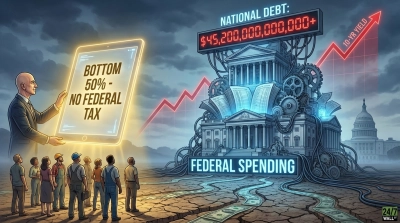
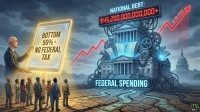
During a recent episode of The Pomp Podcast featuring guest Jordi Visser, host Anthony Pompliano highlighted a striking proposal from Amazon (NASDAQ:AMZN | AMZN Price Prediction) founder Jeff Bezos. Bezos believes the bottom 50% of Americans should pay no federal taxes. According to the discussion, the bottom half of earners currently contribute only 3% of the federal budget, which lends credence to the argument that they shouldn’t pay federal taxes at all.
Bezos’s Proposal Focuses on Household Pressure
Pompliano framed Bezos’s argument around working-class cash flow. “If you make $70,000, if you’re sending $10,000 or $12,000 to Washington, one, that’s an incredible amount of of your, of the money that you need to live,” Pompliano said during the segment.
The example lands at a time when household finances already appear strained. Under 2026 IRS tax brackets tied to the “One, Big, Beautiful Bill,” single filers move into the 22% marginal bracket above $50,400 of income, while the standard deduction sits at $16,100. Meanwhile, U.S. per-capita disposable personal income reached $68,617 in the first quarter of 2026, placing a hypothetical $70,000 worker almost directly in the middle of the income range Bezos appears focused on.
At the same time, the personal savings rate has fallen to 4.0% in Q1 2026, down from 6.2% in early 2024. That decline helps explain why conversations about the tax burden may be resonating more broadly, especially among households facing elevated housing, insurance, healthcare, and food costs.
The key figure supporting Bezos’s proposal is that the bottom half of earners contribute only about 3% of total federal revenue. Pompliano did not break down the precise fiscal impact of eliminating those taxes, but the number served as the foundation for why the proposal could sound plausible at first glance.
Wealthy Americans Are Becoming More Vocal About Fiscal Policy
Pompliano made an observation that wealthy business leaders appear increasingly willing to publicly criticize U.S. fiscal policy. “Wealthy people really didn’t talk that much about taxes, but they seem to become more outspoken,” Pompliano said. He pointed to Bezos’s proposal and referenced JPMorgan Chase’s (NYSE:JPM) CEO Jamie Dimon as part of a broader pattern of high-net-worth figures publicly weighing in on federal fiscal policy. Pompliano framed the moment as an unprecedented “butting of heads” between wealth and Washington.
The Bigger Concern May Be Spending, Not Taxes
Pompliano ultimately steered the discussion toward government spending efficiency rather than the tax proposal itself. “Washington’s not exactly the best, most capital efficient, you know, kind of, uh, uh, allocators,” he said. That concern arrives as bond markets increasingly focus on U.S. fiscal conditions. The 10-year Treasury yield stood at 4.57% as of May 21, 2026, near the highest level of the past twelve months. Core PCE inflation, the Federal Reserve’s preferred inflation gauge, also remains elevated relative to recent history.
Government spending continues to play a growing role in the broader economy. Federal transfer receipts climbed to $5.1 trillion in Q1 2026, including roughly $1.63 trillion tied to Social Security and $1.30 trillion connected to Medicare. Government spending itself contributed 4.4% to real GDP growth during Q1 after contracting sharply in Q4 2025.
The episode discussed that it’s still unclear whether efforts like DOGE would meaningfully slow the trajectory of federal spending. Bezos’s proposal grabs attention because it sounds radical, but the deeper issue underneath the conversation is the long-term fiscal math driving inflation expectations, Treasury yields, entitlement spending, and ultimately investment portfolio outcomes.
Contact [email protected] for any questions or corrections.
Thomas Richmond is a financial writer and content strategist with 5+ years of experience covering stocks and financial markets. He has published over 500 articles focused on individual stock analysis, helping investors better understand business fundamentals, stock valuations, and long-term opportunities.
Thomas previously served as a Content Lead at TIKR, a stock research platform, where he helped scale the company’s blog to hundreds of articles per month and contributed to a weekly newsletter reaching more than 100,000 investors.
Outside of work, Thomas enjoys weight lifting and soccer.