Taiwan Semiconductor Delivers 2,095% Gain Over 10 Years. Will It Continue To Outperform?
A decade ago, Taiwan Semiconductor Manufacturing (NYSE: TSM | TSM Price Prediction) was respected but boring. It made chips for Apple, Qualcomm, and a long list of fabless designers, and the market valued it like a cyclical industrial. Then the…

This post may contain links from our sponsors and affiliates, and Flywheel Publishing may receive compensation for actions taken through them.

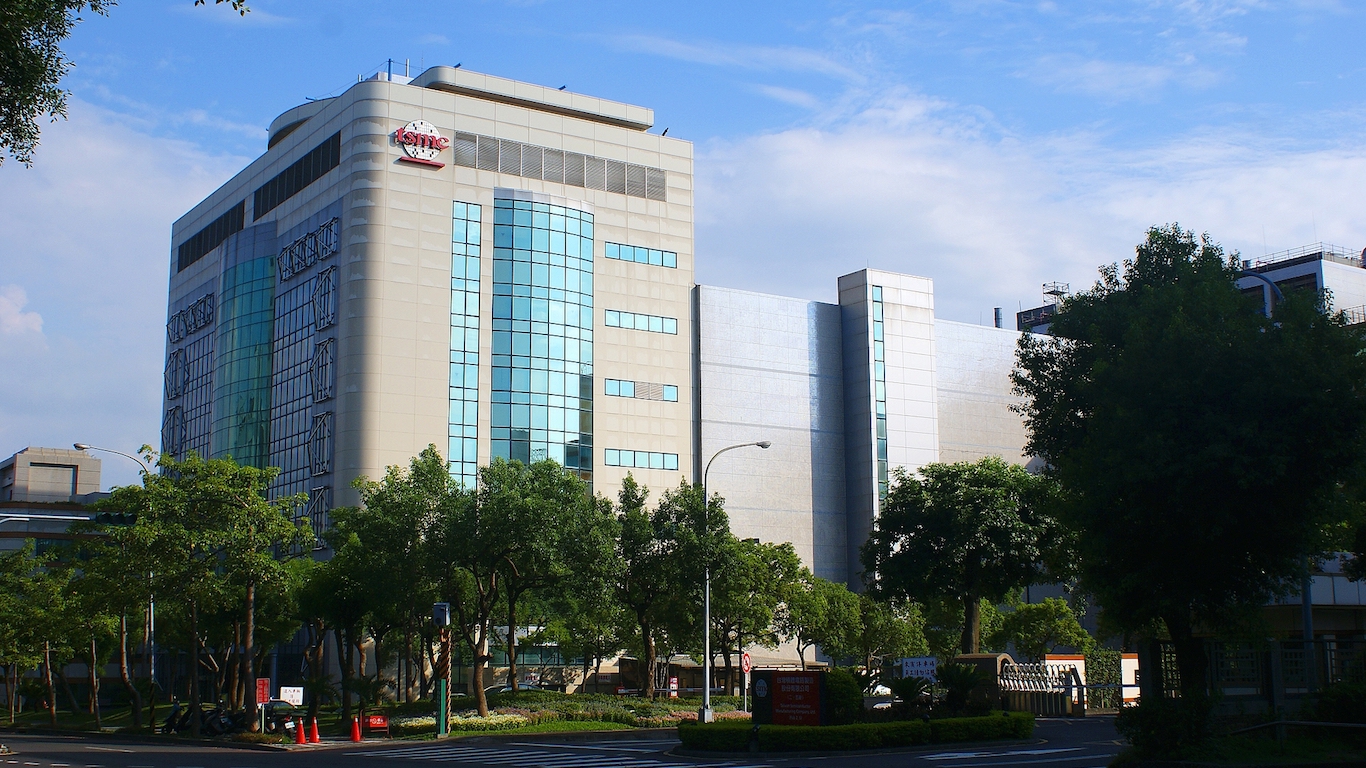
A decade ago, Taiwan Semiconductor Manufacturing (NYSE: TSM | TSM Price Prediction) was respected but boring. It made chips for Apple, Qualcomm, and a long list of fabless designers, and the market valued it like a cyclical industrial. Then the node race got serious. TSMC pulled away from Samsung and Intel at 7nm, then 5nm, then 3nm, and the company became the only place on earth that could reliably manufacture leading-edge silicon at scale.
The AI boom poured gasoline on that lead. Today TSMC controls roughly 72% of the global foundry market and prints chips for NVIDIA, AMD, Apple, and Broadcom on advanced nodes that are running near capacity. Management just approved ~$31.28 billion in capital appropriations for new fabs and up to $20 billion for its Arizona subsidiary to diversify away from Taiwan. Q1 2026 EPS came in at $3.49, beating estimates by 8.39%, and quarterly revenue grew 35.1% year over year.
Your $1,000 Turned Into Nearly $22,000
Here is what $1,000 invested in TSMC would look like across three windows, using split- and dividend-adjusted prices through June 3, 2026.
1-Year Return
- Initial Investment: $1,000
- Current Value: $2,236.50
- Total Return: 123.65%
- S&P 500 (same period): $1,265.30 (26.53%)
5-Year Return
- Initial Investment: $1,000
- Current Value: $3,969.20
- Total Return: 296.92%
- S&P 500 (same period): $1,784.80 (78.48%)
10-Year Return
- Initial Investment: $1,000
- Current Value: $21,954.70
- Total Return: 2,095.47%
- S&P 500 (same period): $3,586.80 (258.68%)
The 10-year number is the headline, but the path was bumpy. Anyone who bought in 2016 sat through the 2018 trade war selloff, the 2022 China-Taiwan invasion scare that briefly cut the stock in half, and a sluggish 2023. The reward for holding through that noise is a stock that has outpaced the S&P 500 by a wide margin over the decade and again over the past year.
The Bull Case, With Conditions
Putting $1,000 into TSMC today rests on two beliefs: AI capex stays elevated through 2027, and Washington and Beijing keep the Taiwan situation in the gray zone. The setup is genuinely attractive. The stock trades at 28x forward earnings with a PEG of 1.4, analysts model 22.5% annual earnings growth, and Q1 2026 EPS more than doubled from $1.48 in Q2 2024.
I’d avoid it if I could not stomach geopolitical tail risk. One Taiwan Strait incident wipes out years of gains in a week, and no Arizona fab fully solves that exposure this decade. The valuation also leaves little room for an AI capex air pocket.
My lean: the setup looks compelling for investors who can size it as a high-conviction position with a real risk budget rather than treat it as a sleep-at-night utility.
Contact [email protected] for any questions or corrections.
Alex Sirois is a financial writer with experience spanning both retail and institutional investing. He has written for InvestorPlace and held roles at BNY Mellon and Bernstein, giving him a perspective that bridges Main Street portfolios and Wall Street analysis.
Alex holds an MBA from George Washington University and has built his career across multiple industries, including e-commerce, education, and translation — a breadth of experience that informs how he breaks down complex financial topics for everyday investors. His writing is conversational, actionable, and grounded in long-term, buy-and-hold investing principles.
At 247 Wall St., Alex focuses on delivering analysis that is both accessible and useful, with a clear emphasis on helping readers make more informed decisions with their money.