




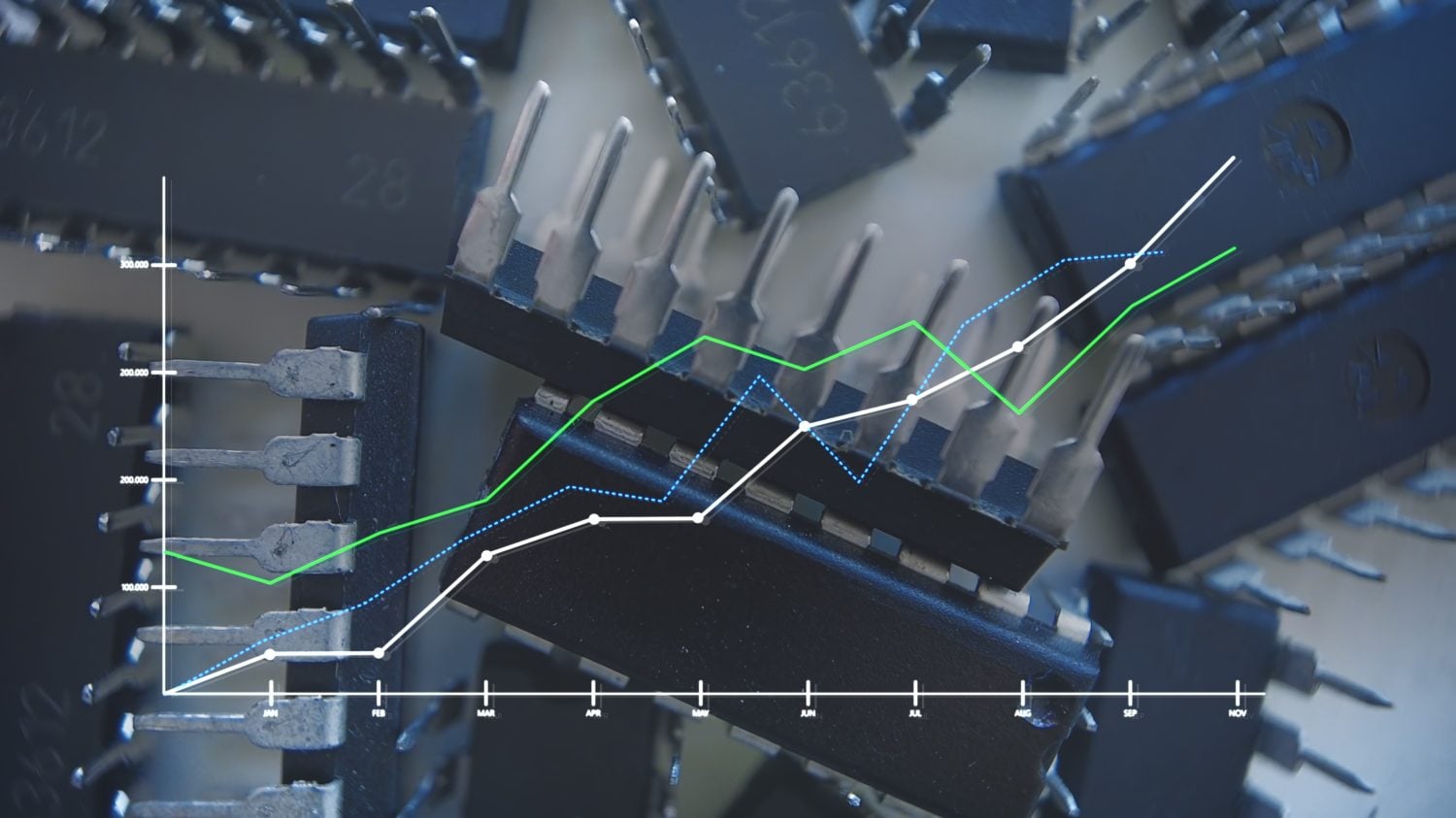
If you put $10,000 into Invesco PHLX Semiconductor ETF (NASDAQ:SOXQ) on the last trading day of 2025, you are sitting on about $19,400 this morning. The same $10,000 in the S&P 500 (via SPY) is worth roughly $11,140. SOXQ is up 94% year to date through June 2, 2026, against 11% for SPY. The headline writers rounded that gap to 7 to 1. The data says it is closer to 8 to 1, and that is before you add a single dividend back in.
This is the kind of run that makes a friend text you a screenshot. The honest question is whether the engine that produced it is still running, idling, or already in reverse.
The arithmetic, on a clean window
SOXQ opened the year at $56 on December 31, 2025 and closed yesterday at $108. The fund is up 30% over the past month alone and 7% in the last week. Over one year it has returned 185%. This is a price-only number, but SOXQ is a low-yield equity ETF tracking the PHLX Semiconductor Index, so the total-return figure is not materially different. The chip names inside are the story.
For context, SPY rose 5.4% over the past month and 1.2% in the past week. The broad market is having a perfectly respectable year. SOXQ is having a different kind of year.
What actually did the work
SOXQ tracks the PHLX Semiconductor Index, which is concentrated in roughly 30 chip names and dominated by a handful of AI-leveraged megacaps. The four holdings doing most of the lifting tell the whole story, and none of them is hiding the ball.
AMD (NASDAQ:AMD | AMD Price Prediction) is the standout. The stock is up 144% year to date, from $214 to $522, with a 45% move in the past month alone. The Q1 print on April 29 delivered a 6% earnings beat and a 19% same-day move, and Lisa Su’s commentary made the thesis explicit. "Data Center now the primary driver of our revenue and earnings growth, and customer engagement around MI450 Series and Helios is strengthening," she said. The Meta partnership for up to 6 GW of Instinct GPUs is the kind of deal that resets a sell-side model overnight.
Broadcom (NASDAQ:AVGO) is up 39% year to date and 14% in the past week alone, set up around tonight’s Q2 print. The March quarter showed $8.4 billion in AI semi revenue, up 106% year over year, with guidance for $10.7 billion in the current quarter. Hock Tan is publicly targeting more than $100 billion in AI sales by 2027. Polymarket gives a 94.9% probability that Broadcom beats tonight and a 98.4% probability that Q2 AI revenue clears $10.5 billion, though only 21.5% probability it tops $12 billion. The expectation bar is now very high.
Taiwan Semiconductor (NYSE:TSM) is up 47.4% YTD. April monthly revenue came in at NT$410.73 billion, up 17.5% year over year, with year-to-date revenue up 29.9% through April. The board approved roughly $31.3 billion in capital appropriations and up to $20 billion of additional capital for TSMC Arizona. That is what conviction in late-decade demand looks like on a balance sheet.
And then there is NVIDIA (NASDAQ:NVDA), the largest holding, the smallest YTD mover of the four at 19%. The Q1 FY27 report on May 20 showed $81.61 billion in revenue, up 85.2% year over year, Data Center revenue of $75.25 billion (up 92%), and Q2 guidance of $91 billion plus or minus 2%, excluding any China DC compute. Jensen Huang called it "the largest infrastructure expansion in human history." Yet NVDA fell 2% the day after the print and 4% over the following week, extending a five-quarter sell-the-news pattern. The dispersion is the news of this rally; NVIDIA did not lead it.
What has to keep going for this to keep going
The mechanism here is simple and concentrated. SOXQ is sector concentration meeting an AI capex cycle that has broadened from hyperscalers into sovereign AI and enterprise, and is now being underwritten by named multibillion-dollar commitments from Meta to AMD, from TSMC to its own fabs, and from Broadcom to a 2027 revenue target it has publicly anchored to.
That is the durable part. The regime-dependent part is valuation and pace. The Polymarket consensus on NVDA for end-of-June clusters around $220, with a 60.5% probability of closing above that level and only a 0.235 probability of finishing the week above $230. The crowd is not expecting another vertical leg from the largest holding. The AVGO market cap markets price essentially zero chance (0.2%) of Broadcom passing into the world’s second-largest company by June 30. Translation: a lot of good news is in, and the marginal buyer is more cautious than the YTD chart suggests.
What you can actually watch
If you want one number per holding to watch instead of a feeling, the list is short. TSMC publishes monthly revenue, and the May print is the next dot on the page that either confirms or breaks the 29.9% YTD trajectory. Broadcom reports tonight, and the prediction-market threshold to beat is whether AI semi revenue can credibly trace a path to $100 billion by 2027 from $10.7 billion in the current quarter. AMD’s MI450 and Helios ramp, and the cadence of Meta’s 6 GW deployment, will tell you whether the second-source AI accelerator thesis is a 2027 story or a 2026 story. NVIDIA’s next guide will tell you whether China DC compute comes back into the number, which is currently excluded.
The broader tell is hyperscaler capex commentary from Microsoft, Alphabet, Meta, and Amazon. SOXQ is, in the end, a leveraged play on that line item in four corporate budgets. As long as those four are still raising, the engine inside this fund is still running. When the first one trims, you will not need to read a research note to know it. The chips will tell you first.
The honest read is this. The conditions that produced an 8-to-1 YTD gap over the S&P are mostly still in place, but at materially higher prices and with the crowd already leaning the same way. The next leg, if there is one, will be earned in increments rather than handed over in a single quarter. That is the indicator to watch, and it is the difference between a rally you chase and a rally you understand.
Contact [email protected] for any questions or corrections.











 Top Gaining Stocks
 Top Losing Stocks