AMD Just Hit 2030’s Earnings Target Two Years Early. Here’s What Happens Next
Bernstein’s Stacy Rasgon spent years as a skeptic on Advanced Micro Devices (NASDAQ:AMD | AMD Price Prediction). On a recent episode of The Real Eisman Playbook, he flipped the script.”I’m looking at 2028 and I’m pretty close to $20 in…

Bernstein’s Stacy Rasgon spent years as a skeptic on Advanced Micro Devices (NASDAQ:AMD | AMD Price Prediction). On a recent episode of The Real Eisman Playbook, he flipped the script.”I’m looking at 2028 and I’m pretty close to $20 in earnings, which was their 2030 target.” Read that again. The 2030 number, pulled forward two years.
Rasgon is not the cheerleader type. So when he upgrades after a run like this and openly admits “better late than never,” it’s worth unpacking what changed in the model and what didn’t.
The CPU Story Is the Real Engine
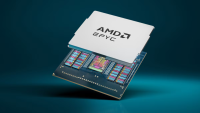
The upgrade hinged on server CPUs. Rasgon said AMD’s server CPU growth needed to be raised from an expected 50% this year to “70%, like maybe more.” AMD has clawed x86 server share from essentially zero to the low-to-mid 40s, with Intel (NASDAQ:INTC) sliding to the 60s. That share grab now has a bigger pie to attack: CEO Lisa Su doubled her 2030 total addressable market estimate for server CPUs from $60 billion to $120 billion.
You can see the math working already. Q1 FY2026 revenue hit $10.253 billion, with Data Center revenue at $5.775 billion, up 57% year over year. Non-GAAP EPS came in at $1.37, beating consensus by roughly 6% per the company’s Q1 FY2026 8-K filing. Free cash flow more than tripled to $2.6 billion.
Lisa Su said on the call: “We delivered an outstanding first quarter, driven by accelerating demand for AI infrastructure, with Data Center now the primary driver of our revenue and earnings growth.” Guidance for Q2 calls for roughly $11.2 billion in revenue, implying ~46% YoY growth.
The GPU Caveat Investors Keep Glossing Over
Eisman pushed on GPUs because, as Rasgon noted, that has been “the story” for the stock. The Bernstein view is more measured here. Rasgon described AMD moving “from being a marginal player to a slightly less marginal player,” from roughly 4% to potentially 10-11% market share in a market growing to $1 trillion+.
To land the marquee deals (OpenAI’s 6 gigawatts and Meta Platforms (NASDAQ:META)’s matching commitment), Rasgon said AMD “basically had to give away chunks of the company” via warrants representing roughly 10% each. His take: “I would rather see them sign big deals without having to sign the warrants, but I understand the warrants.” The reasoning is that “the products as they stand today are not good enough yet,” so AMD traded equity for the scale needed to build out the developer ecosystem around ROCm and MI450.
This is the toll-bridge question for AMD’s accelerator franchise. NVIDIA (NASDAQ:NVDA) still owns the road. AMD is paying to build an on-ramp.
Valuation, Risk, and What I’m Watching
The stock is up 129% year to date and 322% over the trailing year, closing at $490.33. Forward P/E sits at 67, with 36 buy ratings, 5 strong buys, 10 holds, and no sells. The analyst target of $482.69 sits just below the current price, meaning the Street’s median view has already been overtaken by reality.
Risks remain real: export controls cost AMD roughly $440 million in FY2025 on MI308 shipments to China, semiconductor cyclicality always lurks, and the warrant dilution from OpenAI and Meta will show up in the share count over time.
If you believe Rasgon’s $20-by-2028 path, today’s multiple compresses fast. If you believe the GPU thesis hinges on AMD closing the software gap with CUDA, you’re betting on execution that has not happened yet. I own NVIDIA and have watched AMD chase it for years. What’s new is that the CPU side is now a standalone bull case strong enough to hit a 2030 target two years early, with GPUs as optionality on top. That is a meaningfully different story than the one investors were debating in 2024, and it is why Rasgon’s late upgrade still matters.
Contact [email protected] for any questions or corrections.
I've been writing about stocks and personal finance for 20+ years. I believe all great companies are tech companies in the long run, and I invest accordingly.