Palantir vs Oracle: Two AI Plays, One Winner
Palantir (NASDAQ:PLTR | PLTR Price Prediction) and Oracle (NYSE:ORCL) both just put out earnings that read like AI manifestos, but the businesses underneath could not be more different. Palantir closed Q4 2025 as a capital-light software shop riding U.S. commercial…

Palantir (NASDAQ:PLTR | PLTR Price Prediction) and Oracle (NYSE:ORCL) both just put out earnings that read like AI manifestos, but the businesses underneath could not be more different.
Palantir closed Q4 2025 as a capital-light software shop riding U.S. commercial adoption. Oracle finished Q3 FY2026 as a balance-sheet-heavy hyperscaler pouring tens of billions into GPUs and concrete.
AIP Floods One Side. GPU Buildouts Define the Other.
Palantir put up $1.406 billion in revenue, growing 70% year over year, with U.S. commercial revenue exploding 137% to $507 million. That is AIP doing the work, pulling enterprises into bootcamps and turning them into seven-figure customers. Closed total contract value hit a record $4.262 billion, up 138%, which is what a real demand wave looks like.
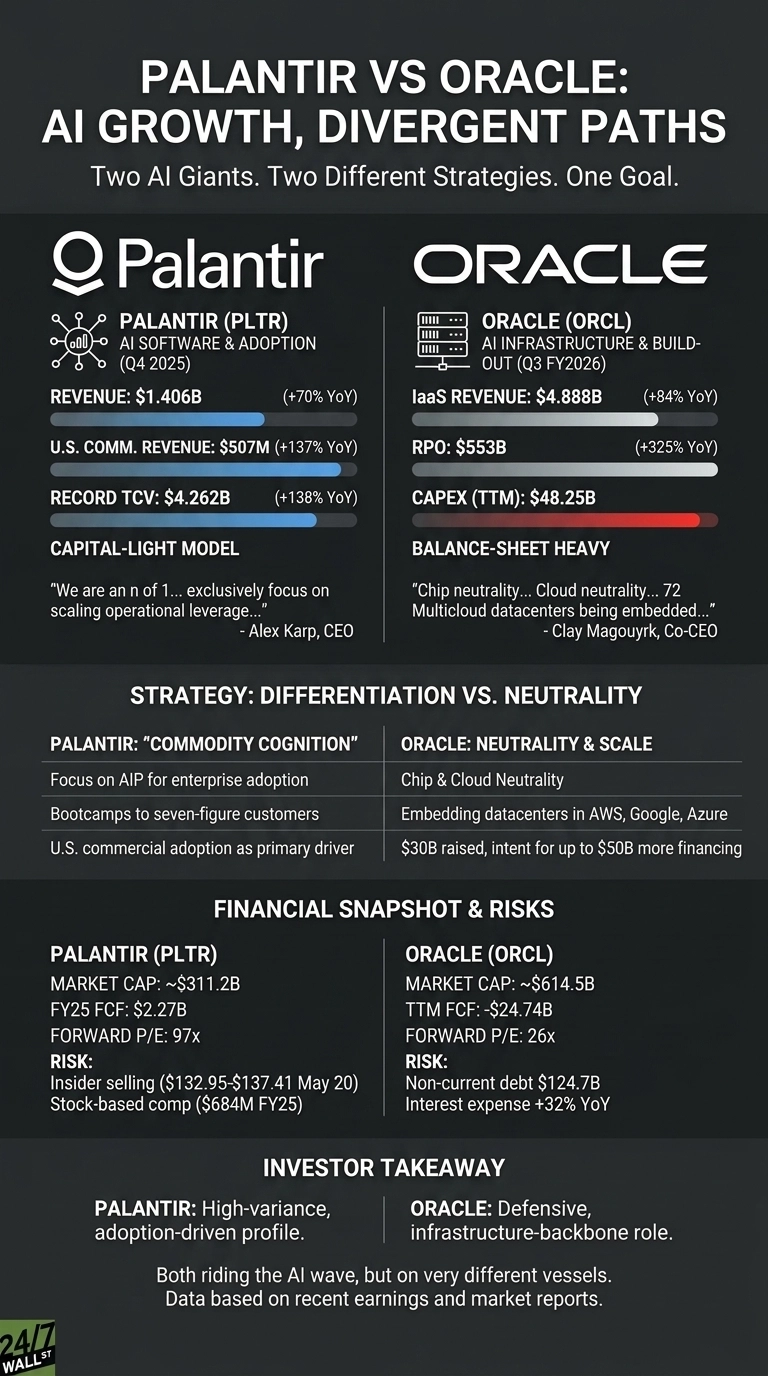
Oracle’s quarter was a different animal. Cloud infrastructure revenue surged 84% to $4.888 billion, and remaining performance obligations rocketed 325% to $553 billion as customers prepaid or supplied their own GPUs. SaaS grew just 13% and core software a sleepy 3%, so the AI story is doing nearly all the heavy lifting.
| Driver | Palantir | Oracle |
| Top growth engine | U.S. commercial AIP | OCI (IaaS) |
| Capital model | Software, asset-light | Debt-funded datacenters |
| FCF posture | $2.27B FY25 FCF | -$24.7B trailing FCF |
Differentiation vs. Neutrality
Alex Karp framed it bluntly: “We are an n of 1, and these numbers prove it. Palantir is alone in choosing to exclusively focus on scaling the operational leverage made possible by the rapid advancements of AI models.” That is a bet on being uniquely indispensable inside the customer’s workflow.
Oracle is going the other way. Co-CEO Clay Magouyrk has pushed chip neutrality and cloud neutrality, with 72 Multicloud datacenters being embedded inside AWS, Google, and Azure.
Larry Ellison’s team raised $30 billion in bonds and convertible preferred and flagged intent for up to $50 billion more in financing. Non-current debt already swelled to $124.7 billion. That is conviction, or a very expensive bet, depending on the day.
The Next Test Is Cash Generation
For Palantir, I will be watching whether U.S. commercial can really clear the $3.144 billion bar implied in 2026 guidance, and whether stock-based comp ($684 million in FY25) stops diluting that pristine FCF story. Insider selling at $132.95 to $137.41 on May 20 is a small caution flag.
For Oracle, the question is whether $50 billion of FY26 capex converts into usable AI revenue fast enough to service that debt. Polymarket traders give an 84% probability Oracle hits the $50 billion capex target, but only 48% for $52.5 billion. The crowd believes in the plan while stopping short of pricing in a blowout.
How the Two Stack Up for Investors
Investors seeking defensive AI exposure with a dividend and a sizable revenue backlog will find Oracle’s profile more conservative. The 26x forward P/E and 26.1% one-year gain reflect a story already partly priced in, but RPO gives visibility most peers cannot match.
Palantir, trading at a 97x forward P/E after a 23.75% year-to-date drawdown, represents the higher-variance profile tied to enterprise AI adoption. One framing puts Oracle in an infrastructure-backbone role and Palantir in a smaller, more volatile sleeve. Should Oracle’s interest expense keep climbing past the 32% YoY pace, that balance would warrant reassessment.
Contact [email protected] for any questions or corrections.
Vandita Jadeja is a financial publisher with over a decade of experience writing about financial topics, including investment, savings, retirement, insurance and banking. Vandita is a Chartered Accountant who loves to debunk financial concepts for readers.
Her work has appeared on sites that include The Motley Fool, InvestorPlace, and Benzinga. She covers investing and focuses on stock picks and price prediction for 24/7 Wall St.
When not looking for the next stock investment opportunity, she can be found traveling, reading, chasing sunsets and enjoying her iced latte.