Prediction: Eli Lilly Will Trade at $1,200 on This Date
Eli Lilly (NYSE:LLY | LLY Price Prediction) just reported a quarter that should have sent bulls into a frenzy. Revenue grew 55.5% year over year to $19.80 billion, Mounjaro alone delivered $8.66 billion, and management raised full-year guidance to $82…

Eli Lilly (NYSE:LLY | LLY Price Prediction) just reported a quarter that should have sent bulls into a frenzy. Revenue grew 55.5% year over year to $19.80 billion, Mounjaro alone delivered $8.66 billion, and management raised full-year guidance to $82 to $85 billion.
Yet shares are up just 2.57% year to date at $1,098.57. That disconnect is the entire setup for my question: can LLY trade at $1,200 by year-end 2026? I think it can, and the math is closer than most realize.
What’s Holding Eli Lilly Back Right Now
The near-term price action has been ugly. LLY is down 5.37% over the past week after touching $1,160.95 on June 11. The one-month picture is better at +7.55%, but the year-to-date number tells the story of a stock stuck in neutral despite booming fundamentals.
The market worries about pricing. Realized prices fell 13% in Q1 as Mounjaro’s addition to China’s NRDL formulary compressed international margins. Lilly also absorbed $584 million in acquired IPR&D charges from its M&A spree.
Add in 11 recent insider transactions skewed toward selling, and you understand the hesitation. With a beta of 0.517, this should be a steady compounder. Right now it is waiting for a catalyst.
Wall Street Sees Roughly 11% Upside. Our Model Sees More
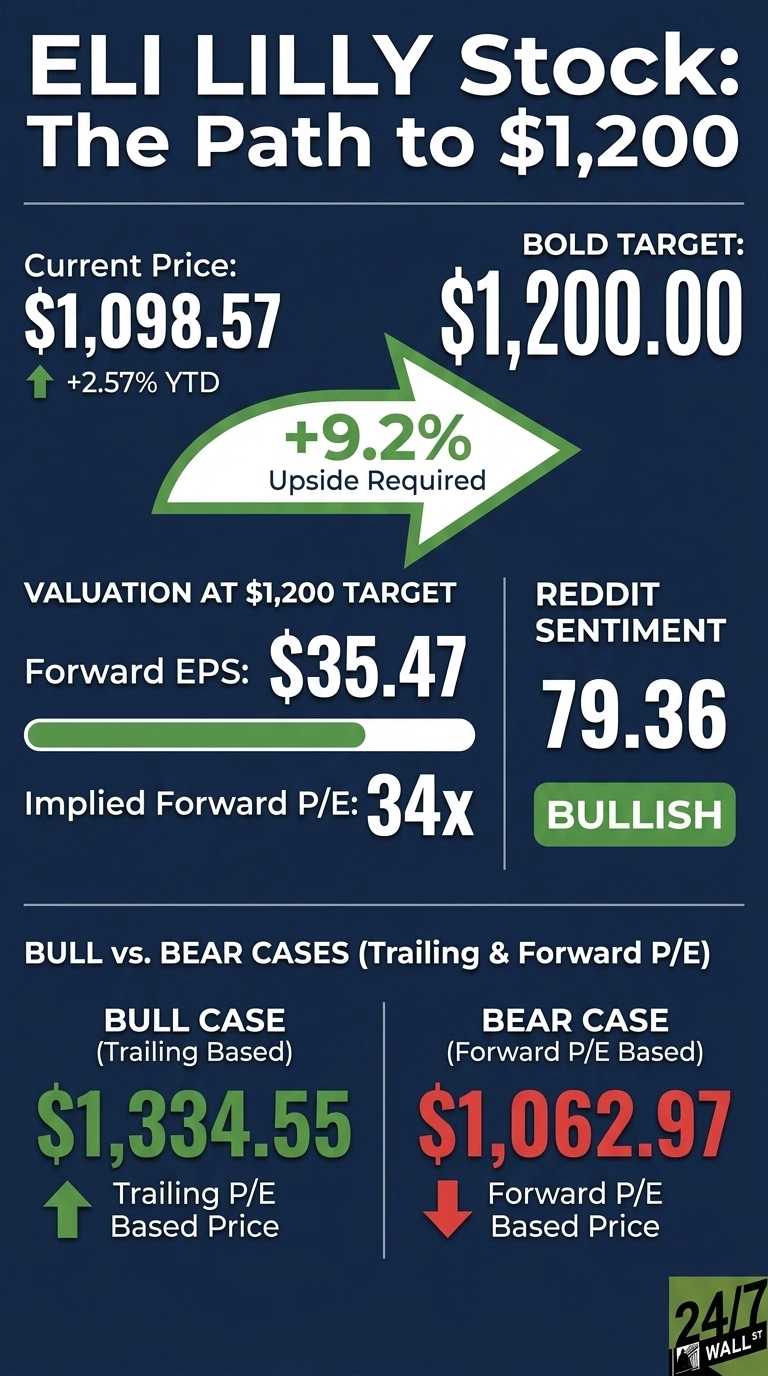
The consensus target sits at $1,215.79, supported by 6 Strong Buy, 18 Buy, 5 Hold, 1 Sell and 1 Strong Sell ratings. That works out to 77% bullish. Our internal model is more aggressive. The base case lands at $1,279.62, implying 16.48% upside, with a bull scenario of $1,334.55 and a bear case of $1,062.97. Confidence on the base case is 90%.
Analysts underweight two things: the speed of the Foundayo (oral GLP-1) ramp and retatrutide’s optionality. Barclays already telegraphed where this could go, maintaining a Buy rating with a $1,400 price target. With earnings growth contributing positively to our 247Factor and bullish consensus at 77%, the $1,200 line looks like a floor.
The Path to $1,200 Per Share
Reaching $1,200 from today’s price of $1,098.57 requires a gain of 9.2%. With forward EPS of $35.47, a price of $1,200 implies a forward P/E of 34x. Our base case of $1,279.62 already implies 37x, meaning $1,200 sits below our base case multiple and demands no incremental rerating. The stock simply needs to grow into the earnings.
CEO David Ricks framed it on the Q1 call: “2026 is off to a strong start, we delivered 56% revenue growth in the first quarter and raised our full-year revenue guidance by $2 billion. A key milestone was the U.S. FDA approval of Foundayo.”
Early launch metrics are striking: 8,000+ prescribers and 20,000+ patients in weeks, with 80% of scripts new-to-class. Retatrutide’s Phase 3 readout showing weight loss of 25 to 37 pounds and the retatrutide late-stage trial results comparable to or exceeding Zepbound fuel the model. The primary risk remains continued price erosion outpacing volume gains.
Where Eli Lilly Trades Today vs Its Earnings Power
At $1,098.57, LLY trades at roughly 31x forward EPS of $35.47. For a business compounding revenue at 28% at the 2026 guidance midpoint with a forward PE of 31x, that looks reasonable. Shares sit 3% below the 52-week high of $1,182.73 and 77.4% above the $619.40 low. The 10-year return of 1,661.56% shows what happens when this company gets a platform right. Today it has two.
Is $1,200 Realistic? Here’s My Take
The $1,200 target requires a 9.2% gain from here, and my model’s base case already overshoots it. I view $1,200 by year-end 2026 as realistic.
Three things need to keep going right: Foundayo’s prescriber base must expand, retatrutide’s June obesity readout must confirm the diabetes data, and Q2 must validate the raised guidance. What derails it is sharper-than-expected pricing reset on Mounjaro and Zepbound in the back half. We’ve outlined the blueprint for how Eli Lilly could reach $1,200 in 2026.
Contact [email protected] for any questions or corrections.
Vandita Jadeja is a financial publisher with over a decade of experience writing about financial topics, including investment, savings, retirement, insurance and banking. Vandita is a Chartered Accountant who loves to debunk financial concepts for readers.
Her work has appeared on sites that include The Motley Fool, InvestorPlace, and Benzinga. She covers investing and focuses on stock picks and price prediction for 24/7 Wall St.
When not looking for the next stock investment opportunity, she can be found traveling, reading, chasing sunsets and enjoying her iced latte.