Here Is the 1 Dirt-Cheap Hardware Juggernaut I Keep Accumulating on Repeat
I keep buying NVIDIA, and the recent pullback handed me another reason to do it again.The story behind that buy button is simple. NVIDIA (NASDAQ:NVDA | NVDA Price Prediction) sells the machinery that every cloud, every frontier model lab, and…

I keep buying NVIDIA, and the recent pullback handed me another reason to do it again.
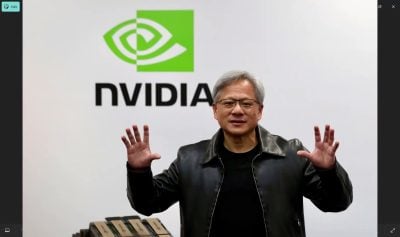
The story behind that buy button is simple. NVIDIA (NASDAQ:NVDA | NVDA Price Prediction) sells the machinery that every cloud, every frontier model lab, and every sovereign AI project needs to run. Jensen Huang called the current moment “the largest infrastructure expansion in human history”, and the income statement is backing the rhetoric. When a company prints earnings this fast while the stock drifts sideways, the multiple compresses on its own. That is the setup I keep showing up for.
The receipts that keep me clicking buy
The Q1 FY2027 report on May 20 showed revenue of $81.61 billion, up 85.2% year over year, with non-GAAP diluted EPS of $1.87 against a $1.77 estimate. Data Center alone did $75.25 billion, up 92%, and networking inside that segment climbed 199%. Management guided Q2 FY27 revenue to $91.0 billion with a 75.0% non-GAAP gross margin, and that guide explicitly excludes any Data Center compute revenue from China. The growth is happening with one engine offline.
The valuation is where the “dirt-cheap” framing earns its place. Fiscal 2026 closed with $215.94 billion in revenue, $120.07 billion in net income, and $96.58 billion in free cash flow. The forward P/E sits at 23, the PEG ratio at 0.63, and the trailing P/E at 31. For a business compounding earnings at the rate the recent quarters describe, that multiple favors the buyer.
Then there is the capital return story. The board approved an additional $80.0 billion buyback authorization, lifted the quarterly dividend from $0.01 to $0.25, and already returned ~$20.0 billion to shareholders in Q1 alone. Full-year FY26 returns hit $41.1 billion. With $48.55 billion in free cash flow in a single quarter, the buybacks come out of operating cash flow.
The risk I refuse to wave away
China export restrictions are real. Q2 guidance carries zero H20 shipments, against a $4.6 billion year-ago contribution. Total supply commitments of $119.0 billion sit on the books, which means if AI capex slows, NVIDIA owns the obligation. Add the heavy TSMC manufacturing dependency, and I respect the downside. The reason I keep buying anyway is that the China hole already lives inside a $91 billion Q2 guide. Structural demand is absorbing the policy shock in real time.
Why the buy button stays active
The price action since the May 20 earnings report makes the case plain. The stock traded at $223.21 the day of the filing and closed at $210.69 on June 18, a 5.61% retreat into the broader macro grind. The analyst consensus target sits at $298.93, and the recent Computex partnerships across SK hynix, Hyundai, Nokia, Siemens, and Palantir extend the runway for the Blackwell and Vera Rubin platforms.
I keep accumulating because earnings are growing faster than the share price, the capital return is now real money, and the moat (CUDA-X, NVLink, Spectrum-X, BlueField) is the operating system of the AI build. The buy button stays active as long as the math keeps working in my favor.
Contact [email protected] for any questions or corrections.
Alex Sirois is a financial writer with experience spanning both retail and institutional investing. He has written for InvestorPlace and held roles at BNY Mellon and Bernstein, giving him a perspective that bridges Main Street portfolios and Wall Street analysis.
Alex holds an MBA from George Washington University and has built his career across multiple industries, including e-commerce, education, and translation — a breadth of experience that informs how he breaks down complex financial topics for everyday investors. His writing is conversational, actionable, and grounded in long-term, buy-and-hold investing principles.
At 247 Wall St., Alex focuses on delivering analysis that is both accessible and useful, with a clear emphasis on helping readers make more informed decisions with their money.