No, IBM Is Not Becoming a Chipmaker — But It Just Revolutionized the Industry Anyway
The semiconductor industry has spent the last decade racing toward a physical wall. Engineers have steadily shrunk transistors to pack more computing power onto ever-smaller chips, but that strategy is running out of room. At today’s leading-edge process nodes, components…

The semiconductor industry has spent the last decade racing toward a physical wall. Engineers have steadily shrunk transistors to pack more computing power onto ever-smaller chips, but that strategy is running out of room.
At today’s leading-edge process nodes, components are measured in just a handful of atoms. Heat, power leakage, and manufacturing complexity have become major obstacles. That is why IBM‘s (NYSE:IBM | IBM Price Prediction) latest could revolutionize the industry. The company just unveiled a sub-1 nanometer chip design that could keep Moore’s Law alive for years to come.
Yet despite the breakthrough, IBM is not getting back into the business of manufacturing chips.
IBM’s Business Isn’t Making Chips — It’s Inventing Them
Many investors hear “new chip” and immediately think of companies like Taiwan Semiconductor Manufacturing (NYSE:TSM), Intel (NASDAQ:INTC), or Nvidia (NASDAQ:NVDA). IBM occupies a very different role.
After selling its commercial semiconductor manufacturing business to GlobalFoundries in 2014, IBM transformed itself into one of the world’s premier semiconductor research organizations. From its Albany, NY, research center, IBM develops next-generation chip architectures and licenses the underlying intellectual property to manufacturing partners.
That model allows IBM to avoid spending tens of billions of dollars building advanced fabrication plants while still influencing the direction of the industry.
The newly unveiled 0.7 nm “nanostack” design follows that playbook. IBM expects partners such as Samsung, Intel, and Japan’s Rapidus to commercialize the technology over roughly the next five years.
But to be clear, this is a research prototype, not a commercial product launch.
How IBM Broke Through Silicon’s Limits
The most important detail is that “0.7 nm” is not a literal measurement of transistor size. Modern process nodes are largely marketing labels that represent advances in chip architecture and density.
Historically, chipmakers improved performance by shrinking transistors horizontally across a flat silicon surface. That approach has largely reached its practical limits because components are already only a few atoms wide. IBM’s answer is what it calls 3D Sequential Integration, or Nanostack.
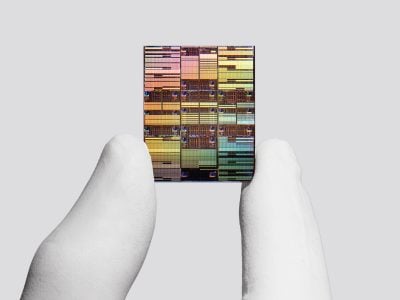
Instead of placing transistors side by side, IBM stacks them vertically. The result is a fingernail-sized chip capable of housing approximately 100 billion transistors — roughly double the density of today’s leading 2 nm designs.
Here’s how IBM could change the game:
| Metric | Current Leading-Edge Chips | IBM 0.7 nm Nanostack |
| Transistor Density | ~50 billion | ~100 billion |
| AI Processing Power | Baseline | Up to 7,000 TOPS |
| Performance Gain | Baseline | Up to 50% higher |
| Power Consumption | Baseline | Up to 70% lower |
Source: IBM Research announcement and technical briefing.
Why Investors Should Pay Attention
This breakthrough matters because it extends the computing roadmap for artificial intelligence.
Training frontier AI models currently requires months of processing time and enormous energy consumption. IBM estimates a specialized AI accelerator built on its 0.7 nm architecture could deliver up to 7,000 trillion operations per second, or TOPS, roughly seven times current AI hardware capabilities.
The architecture also improves SRAM scaling by 40%, allowing processors to keep more data close to the computing cores. That reduces bottlenecks and speeds up AI inference tasks such as text generation, image creation, and reasoning.
Data centers may be the biggest beneficiaries. Operators could choose between:
- Up to 50% more performance at existing power levels.
- Up to 70% lower power consumption while maintaining current performance.
That flexibility could reshape data center economics as electricity becomes one of AI’s largest operating expenses.
Granted, commercialization remains years away. Manufacturing sub-1 nm chips will require the industry’s most advanced High-NA EUV lithography systems from ASML (NASDAQ:ASML), machinery that costs hundreds of millions of dollars per unit. That reality likely strengthens the competitive positions of Taiwan Semiconductor, Samsung, Intel, and government-backed ventures like Rapidus.
Key Takeaway
In short, IBM’s announcement is not the return of a commercial chipmaker. It is the latest example of IBM doing what it has done for decades — inventing the future and letting others manufacture it.
The significance isn’t that IBM built a 0.7 nm prototype. It’s that the company demonstrated a path around the physical limits that threatened to slow artificial intelligence, cloud computing, and high-performance computing.
If IBM’s manufacturing partners can bring this technology to market around 2030, investors may look back on this announcement as the moment the semiconductor industry’s next decade of growth was secured.
Contact [email protected] for any questions or corrections.
After two decades of patrolling the dark corners of suburbia as a police officer, Rich Duprey hung up his badge and gun to begin writing full time about stocks and investing. For the past 20 years, he’s been cruising the markets looking for companies to lock up as long-term holdings in a portfolio while writing extensively on the broad sectors of consumer goods, technology, and industrials. Because his experience isn’t from the typical financial analyst track, Rich is able to break down complex topics into understandable and useful action points for the average investor. His writings have appeared on The Motley Fool, InvestorPlace, Yahoo! Finance, Money Morning, and, of course, 24/7 Wall St. He has been featured in both U.S. and international publications, including MarketWatch, Financial Times, Forbes, Fast Company, and USA Today.