Apple Just Did Something It Wouldn’t Even Do During COVID, and Wall Street Is Freaking Out
Apple (NASDAQ:AAPL | AAPL Price Prediction) rarely raises prices. That has been a working assumption on Wall Street for roughly two decades. The company absorbs component costs, squeezes suppliers, redesigns around the problem, and protects its margin envelope without making customers…

Apple (NASDAQ:AAPL | AAPL Price Prediction) rarely raises prices. That has been a working assumption on Wall Street for roughly two decades. The company absorbs component costs, squeezes suppliers, redesigns around the problem, and protects its margin envelope without making customers pay more for the same box.
So when Apple confirmed Friday that it was raising prices an average of about 20% across Macs, iPads, home devices and the Vision Pro, the reaction was violent. KOSPI fell as much as 9% intraday and was halted for the second time this week, Nasdaq futures dropped 1.2%, and global equities sank to a two-week low. Bloomberg Senior Market Strategist Neil Campling summed up the problem in one line. “Even during COVID Apple did not need to basically raise prices to reflect these shortages.”

What Apple actually did, and why markets recoiled
The magnitude mattered. “We are not talking small price increases, we are talking an average of about 20% increases to these product pricing,” Campling said. Apple is the company that, two months ago, told investors it had just done its best March quarter ever, with revenue of $111.2 billion and iPhone revenue of $56.994 billion, fueled by what Tim Cook called extraordinary iPhone 17 demand. None of that demand picture suggested a company needing to claw back margin from the consumer.
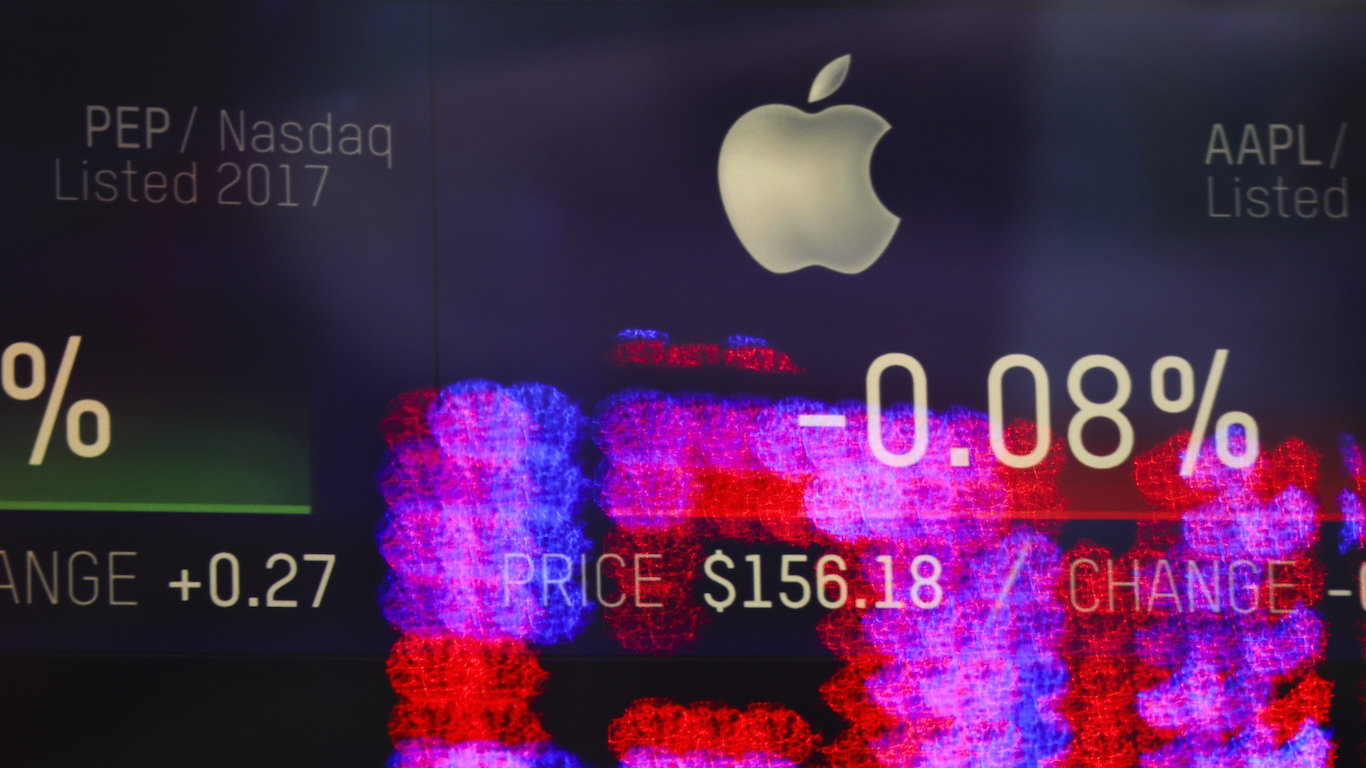
The stock moved accordingly. AAPL fell 6.12% on Thursday, and is now down 6.1% over the past week and 9.3% over the past month, sitting at $279. Polymarket traders assign a 72.5% probability AAPL closes lower again Friday, and only a 7% chance Apple closes above $290 by end of June. A week ago that target was the base case.
The supply chain reads the same memo
Campling’s worry was downstream. “If Apple is struggling, then what is happening with all the other companies who have much less pricing power? That has sent shockwaves through the tech complex.”
Apple builds its silicon at Taiwan Semiconductor Manufacturing (NYSE:TSM), which would normally benefit from higher Apple ASPs. TSM fell 8.6% on the week anyway, because a 20% price hike implies the foundry’s biggest customer is paying more for chips and may sell fewer finished products. The shares are still up 94% over the past year, so this reads as a sentiment crack.
Memory tells a more interesting story. Micron Technology (NASDAQ:MU) reported Wednesday night and posted Q3 FY26 revenue of $41.46 billion, up 345.7% year-over-year, with gross margin of 84.6% and Q4 revenue guidance of $50.0 billion plus or minus $1.0 billion.
CEO Sanjay Mehrotra called the results a reflection of “the strategic value of memory in the AI era.” Micron is the smoking gun on Campling’s component-shortage theory. Memory prices have quadrupled in a year, and that cost is appearing at the consumer end. The stock is up 270% year-to-date. One r/stocks post asked “345% YoY revenue growth from Micron. Is this just the memory cycle or something bigger?”
The OpenAI footnote that made it worse
Friday’s selloff had a second leg. The New York Times reported OpenAI is delaying its IPO to potentially 2027, and SoftBank shares fell 14%, the worst intraday loss since November. Campling’s read was blunt. “You could say the latest update is advantage Anthropic.” That matters for NVIDIA (NASDAQ:NVDA) because the AI capex story rests on a small group of hyperscaler customers writing increasingly large checks.
NVDA posted Q1 FY27 revenue of $81.62 billion last month and Jensen Huang described the AI factory buildout as the largest infrastructure expansion in human history.
Apple is raising prices because chips cost more. Memory suppliers are booking record margins because chips cost more. AI infrastructure spending faces its first real customer-side question. The IPO calendar is suddenly lighter. Winnie Hsu described it as a vicious cycle. Hyperscalers passing chip-cost inflation to consumers hurts demand, which feeds back to chipmakers. Apple just did the first visible piece of that loop. Whether it stays a one-quarter pricing reset or becomes the start of a demand problem is what the next earnings cycle has to answer.
Contact [email protected] for any questions or corrections.
Omor Ibne Ehsan is a writer at 24/7 Wall St. He is a self-taught investor with a focus on growth, cyclical, and dividend equities that have strong fundamentals, value, and long-term potential. He also has an interest in high-risk, high-reward investments such as penny stocks.