Oracle Shares Are Crashing. Here’s Why I’ll Start Buying.
Oracle shares have shed nearly half their value in twelve months while the company quietly piles up a backlog larger than Microsoft's cloud empire. Something in that math does not add up, and the gap may be exactly where the…


Oracle (NYSE:ORCL | ORCL Price Prediction) shareholders have endured a brutal seven months. From a record high above $341 in October, shares have retraced roughly two-thirds. The one-year total return sits at -49.98%, and last month alone wiped out 33.9% of the equity value. That drawdown signals either a broken thesis or an entry point. I believe it is the latter.
Our 24/7 Wall St. price target lands at $195.52, implying 56.51% upside from Monday’s close. Our model rates Oracle a buy with high conviction.
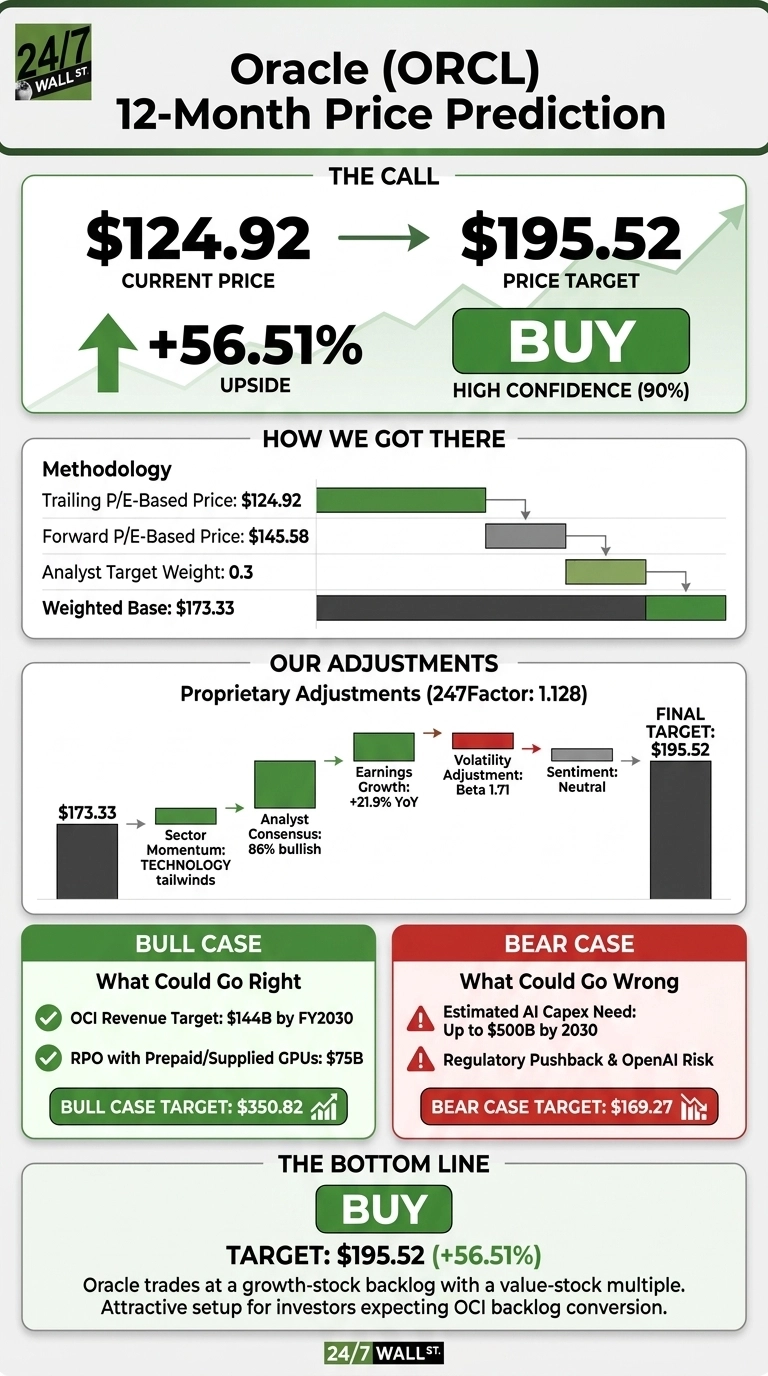
24/7 Wall St. Price Target Summary
| Metric | Value |
|---|---|
| Current Price | $124.92 |
| 24/7 Wall St. Price Target | $195.52 |
| Upside | 56.51% |
| Recommendation | BUY |
| Confidence Level | 90% |
The setup is unusual: a mega-cap cloud franchise with $638 billion in remaining performance obligations trading like distressed debt. The market demands a discount for balance-sheet stress, but the discount has gone too far.
How a $341 Stock Became a $125 Stock
Oracle is -37.12% year-to-date and -7.72% in the past week, closing recently just above the 52-week low of $120.03. The catalyst set is well-documented: S&P Global downgraded Oracle to BBB-, credit-default swap spreads hit 198.23 basis points, and management confirmed plans to raise roughly $40 billion in FY2027 through debt and equity to fund AI infrastructure. Free cash flow ran to negative $23.69 billion against capex of $55.66 billion.
Operating results tell a different story. Cloud Infrastructure grew 93% year-over-year to $5.79 billion in Q4, the Multicloud AI Database grew 404%, and management raised FY27 non-GAAP EPS guidance to $8.05 on $90 billion in revenue.
A widely upvoted Reddit post captured the paradox: “Azure +39%, AI revenue +123%, 4th st. beat, stock down 30%. The market has decided capex is sin.”

Why Bulls See a Path to $350
Our one-year bull case is $350.82, roughly a triple. The math works if CFO Safra Catz’s OCI ramp lands: $18 billion in FY26, rising to $32B, $73B, $114B, and $144B over the next four years.
At a 20x multiple on $15 in EPS, Oracle clears $300. $75 billion of the RPO backlog uses customer-prepaid or customer-supplied GPUs, which materially eases the capex burden.

What Could Go Wrong
The bear case is credible. CLSA initiated with a Hold and a $145 target, estimating Oracle may need up to $500 billion by 2030 to execute its AI ambitions. Our bear case still lands at $169.27, above the current price, because even a slower ramp leaves Oracle with an enormous contracted backlog.
The real red flag is concentration: heavy exposure to OpenAI, whose profitability is uncertain, plus regulatory pushback on data-center projects in Wisconsin and New Mexico. The negative FCF reflects investment intensity as capex ramps well ahead of the OCI revenue conversion.
How Oracle Compares to Microsoft and Amazon
Microsoft (NASDAQ:MSFT) trades at a trailing P/E of 29 with Azure growing 40% and commercial RPO of $627 billion. Oracle’s RPO is $638 billion, larger than Microsoft’s, yet Oracle trades at a forward P/E of 16. That valuation gap is the crux of the buy thesis.
Amazon (NASDAQ:AMZN) trades at a trailing P/E of 35. AWS grew 28% to $37.59 billion in Q1 2026, its fastest pace in 15 quarters, yet Oracle’s IaaS unit grew 93% off a smaller base. Amazon’s $200 billion planned 2026 capex dwarfs Oracle’s, but the market has not punished AMZN. Peer comps make our $195.52 target look conservative.
| Company | Forward/Trailing P/E | Cloud Growth |
|---|---|---|
| Oracle | 16 fwd | IaaS +93% |
| Microsoft | 29 trailing | Azure +40% |
| Amazon | 35 trailing | AWS +28% |
The Case for Oracle Near $125
The 24/7 Wall St. price target of $195.52 is a buy call at 90% confidence. Oracle trades at a growth-stock backlog with a value-stock multiple.
The setup looks attractive here for investors who expect the OCI backlog to convert to revenue on schedule. The thesis weakens if credit markets shut off before FY28 free cash flow inflects. Our modeling leans toward the former.

Oracle Price Prediction 2026-2030
| Year | 24/7 Wall St. Price Target |
|---|---|
| 2026 | $195 |
| 2027 | $240 |
| 2028 | $295 |
| 2029 | $360 |
| 2030 | $425 |
These projections assume Oracle executes on its $144 billion OCI revenue target by FY2030 and stabilizes credit metrics. Significant upside or downside will hinge on whether the AI infrastructure buildout generates the returns management is underwriting.
Contact [email protected] for any questions or corrections.
Vandita Jadeja is a financial publisher with over a decade of experience writing about financial topics, including investment, savings, retirement, insurance and banking. Vandita is a Chartered Accountant who loves to debunk financial concepts for readers.
Her work has appeared on sites that include The Motley Fool, InvestorPlace, and Benzinga. She covers investing and focuses on stock picks and price prediction for 24/7 Wall St.
When not looking for the next stock investment opportunity, she can be found traveling, reading, chasing sunsets and enjoying her iced latte.