Prediction: Oracle Stock Could Reach a New High by 2027
Oracle sits near a 52-week low while sitting on a backlog that Wall Street is calling the setup of the decade. The case for a massive recovery by 2027 is compelling, but one lurking risk could blow the whole thesis…


Oracle (NYSE:ORCL | ORCL Price Prediction | ORCL Price Prediction) has quietly become one of the most important AI infrastructure companies on the planet, yet the stock chart tells a different story.
Shares closed at $127.05 on Monday, down 34.18% year to date and 47.24% over the past year. Meanwhile, remaining performance obligations exploded to $638 billion, up 363% year over year.
Can Oracle reclaim its 52-week high and push to $400 by 2027?

Why Oracle Shares Are Stuck Despite an AI Backlog Explosion
The market has punished Oracle for one reason: cash burn. Capital expenditures ran $55.663 billion on a trailing basis, producing free cash flow of negative $23.686 billion. Add $218.703 billion in total liabilities and plans to raise roughly $40 billion in FY2027, and you can see why investors flinched.
Shares fell 30.81% in the past month alone and are barely off the 52-week low of $120.03. With a beta of 1.712, Oracle amplifies every mood swing about AI capex.
One popular Reddit thread summed it up bluntly: “The market has decided capex is sin.” The concern is valid. Yet the same spending booked the backlog.
Wall Street Sees 96% Upside. Our Model Says 54%
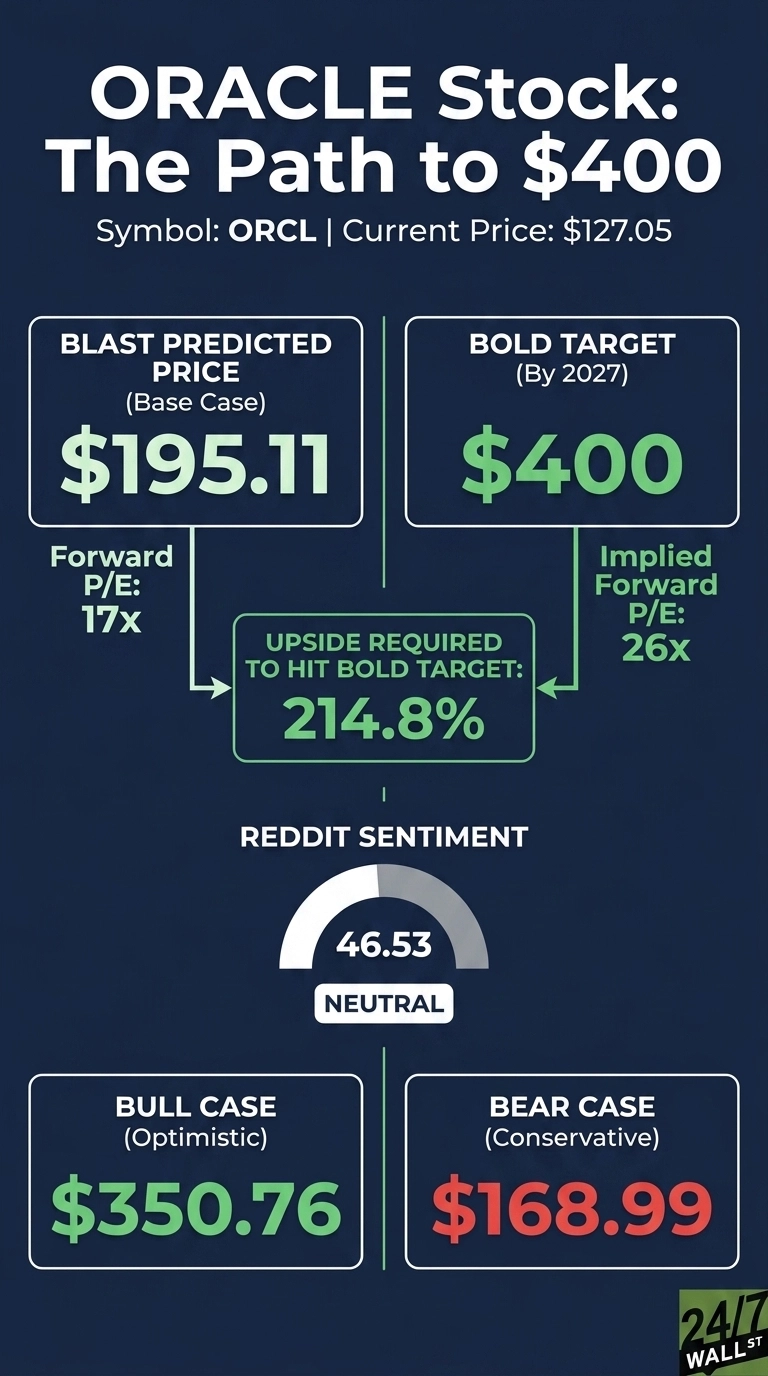
The consensus is loud. Eight strong buys, 29 buys, five holds, and one sell yield 86% bullish sentiment and an average analyst target of $249.24. Our model is more measured, pegging a base case of $195.11 with 53.57% upside at 90% confidence, an optimistic case of $350.76, and a conservative floor of $168.99.

Analysts anchored to pre-selloff multiples and have not marked their models to the reality of a mega-cap with 1.7 beta. The base case is right. The bull case needs execution.
The Path to $400 Per Share
Reaching $400 from today’s price of $127.05 would require a gain of 214.8%. With forward EPS of $9.30, a price of $400 implies a forward P/E of 43. Our base case of $195.11 already implies 17x, meaning $400 requires 26x of additional multiple expansion.
Is that achievable? Only if the RPO conversion story becomes undeniable. Oracle Cloud Infrastructure grew 93% YoY in Q4 and the multicloud AI database jumped 404%. CEO Clay Magouyrk noted “AI infrastructure revenue grew 243% year over year” with “demand that exceeds supply.”
Safra Catz projected OCI revenue reaching $144 billion by FY2030. If AI-linked EPS growth (currently 21.9% YoY) compounds and investors treat Oracle like a hyperscaler rather than a legacy database vendor, a 40x multiple on rising forward earnings becomes conceivable.
The primary risk: another leg of capex-driven cash burn that spooks bondholders and forces a dilutive equity raise.
Where Oracle Trades Today vs Its Earnings Power
At $127.05 against forward EPS of $9.30, Oracle trades at a 14x forward multiple. That is cheap for a business growing revenue 20.6% YoY with a PEG of 0.714.
Shares sit 27% below the 52-week high of $341.82 and just above the low of $120.03. Over the past decade the stock returned 258.98%. The valuation gap is real. Whether it closes depends on whether the RPO becomes revenue on schedule.
Is $400 Realistic?
The bold target: $400, a 214.8% gain from today. For it to work, Oracle must convert a meaningful slice of the $638 billion RPO into recognized revenue on schedule, sustain OCI growth above 60%, and restore free cash flow so the market stops flinching at every capex line.
What derails it: a dilutive equity raise that forces the multiple back into legacy-software territory. We’ve outlined the blueprint for how Oracle could reach $400 in 2027.
Contact [email protected] for any questions or corrections.
Vandita Jadeja is a financial publisher with over a decade of experience writing about financial topics, including investment, savings, retirement, insurance and banking. Vandita is a Chartered Accountant who loves to debunk financial concepts for readers.
Her work has appeared on sites that include The Motley Fool, InvestorPlace, and Benzinga. She covers investing and focuses on stock picks and price prediction for 24/7 Wall St.
When not looking for the next stock investment opportunity, she can be found traveling, reading, chasing sunsets and enjoying her iced latte.