Top Wall Street Strategist: The S&P 500 Could Hit As High As 8,800 This Year, But a 10-20% Drop May Come First
Fundstrat’s Tom Lee laid out a roadmap for where he saw the market going for the rest of the year on a CNBC Squawk Box interview on July 6, 2026, arguing the S&P 500 can grind to 8,000 by year-end,…

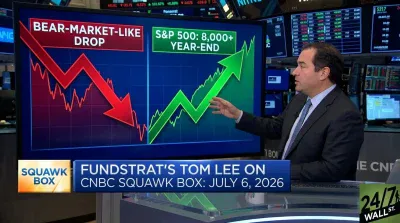
Fundstrat’s Tom Lee laid out a roadmap for where he saw the market going for the rest of the year on a CNBC Squawk Box interview on July 6, 2026, arguing the S&P 500 can grind to 8,000 by year-end, with upside to 8,400 to 8,800, but that would likely come only after surviving a summer-into-fall drawdown.
With the S&P 500 (^GSPC) trading at 7,537 on July 6, the index has already returned 9.22% year-to-date and 20.04% over the past year. Lee’s contention is that the market is actually cheaper today, despite the rally, because underlying earnings have grown substantially. As he put it: “July we’re going to get Q2 earnings right… the market’s P/E is actually lower now than it was in January by 1.1 full turn. And I think second quarter earnings are going to surprise to the upside again. So the market’s going to get cheaper again.”
Why Tom Lee Thinks the S&P 500 Can Reach 8,000 This Year
Lee’s target rests on 2026 S&P 500 earnings of roughly 400 and a multiple in the 20x-22x range. In his words: “8,000 is doable this year. Because 8,000 would be roughly 20 times 2026 earnings of 400… the P/E multiple could be 22 or better. So that would be even 8,400 or 8,800 kind of would be the upside into year-end.”
J.P. Morgan Asset Management’s 2026 outlook pegs S&P 500 earnings growth at 11% in 2025 and another 13% in 2026, with Magnificent 7 profit growth around 20%. Lee has also lifted his 2027 earnings estimate to 400 from 350 at the start of the year, a meaningful upgrade to the forward runway.
The 10-20% Pullback Lee Thinks Investors Should Expect
Lee warns that investors could be in for some pain before the end of the year: “Between now and year-end, there should be something that might feel like a bear market. Not in July, but maybe between August and October… Only 23% of fund managers are beating the large cap growth index. That’s the lowest number in almost five years. So I think there’s going to be a lot of dip buying this month.” He put the potential drawdown at 10-20%.
The setup for such a shakeout is already visible. The University of Michigan consumer sentiment collapsed to 44.8 in May 2026, deeply in recessionary territory. GDP growth has whipsawed from 4.4% in Q3 2025 to 0.5% in Q4, then back to 2.1% in Q1 2026.
The Four Risks That Could Shake the Market This Fall
Lee flagged four specific risks that he could see driving a pullback: “The market is going to test the new Fed because it is a new framework… a gradual unlock of the SpaceX shares… a cumulative shortage of petroleum products… margin debt is kind of high.”
The Fed backdrop reinforces Lee’s concerns. The Federal Funds target upper bound stands at 3.75%, down from 4.5% in September 2025, but Core PCE remains in the 90.9th percentile of the last 12 months, making any policy shift under the Fed’s new framework especially consequential.
On energy, the EIA’s May 2026 Short-Term Energy Outlook warned that Strait of Hormuz disruptions could push Brent crude toward $106 per barrel, aligning with Lee’s concerns about petroleum supply. Combined with elevated margin debt and the gradual unlock of SpaceX shares, those risks could create the kind of volatility Lee expects between August and October.
Why Lee Still Believes the Bull Market Will Win Out
Lee attached a roughly 60% probability to his roadmap and reminded viewers: “These are just our best guess because the future is uncertain. It’s just probability.” His bullish case depends on companies delivering stronger-than-expected Q2 earnings and the Fed avoiding a more aggressive stance on interest rates if inflation remains sticky. Even if the market falls 10% to 20% between August and October, Lee views that as a temporary correction within a longer-term bull market rather than the start of a prolonged downturn.
Investors should watch Q2 earnings results in mid-July, and upcoming Fed commentary for clues about where the market is heading next.
Contact [email protected] for any questions or corrections.
Thomas Richmond is a financial writer and content strategist with 5+ years of experience covering stocks and financial markets. He has published over 500 articles focused on individual stock analysis, helping investors better understand business fundamentals, stock valuations, and long-term opportunities.
Thomas previously served as a Content Lead at TIKR, a stock research platform, where he helped scale the company’s blog to hundreds of articles per month and contributed to a weekly newsletter reaching more than 100,000 investors.
Outside of work, Thomas enjoys weight lifting and soccer.