Palantir CEO: “Something Has Gone Completely Wrong” With OpenAI and Anthropic
Palantir (NASDAQ:PLTR | PLTR Price Prediction) is one of the most-watched tech stocks in the market, and for good reason. The big data and software giant, known for its intelligence platforms used by government entities and a range of corporate big…

Palantir (NASDAQ:PLTR | PLTR Price Prediction) is one of the most-watched tech stocks in the market, and for good reason. The big data and software giant, known for its intelligence platforms used by government entities and a range of corporate big data software platforms has been on a bumpy ride over the past year, actually down 2% over the past 12 months at the time of writing.
That said, this is also a company that’s up more than 400% over the past year, suggesting that investors in the AI company continue to be very bullish on its long-term prospects.
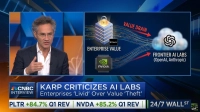
That said, one of the most interesting facets of this recent rise in Palantir is the company’s CEO Alex Karp’s warning is less about AI’s long-term promise and more about how frontier-model companies are monetizing it today. In a CNBC “Squawk Box” interview on July 1, Karp said, “I’m not throwing shade at them, but something has gone completely wrong,” while criticizing the token-based pricing model used by OpenAI and Anthropic. He argued that enterprise customers are paying for tokens that “create no value,” and that many businesses feel the AI stack is being sold in a way that does not justify the bill.
Let’s dive into this announcement, and what it may portend for investors in the AI and big data giant.
What to Make Of These Comments
I think Karp’s broader point was that the AI industry has become obsessed with consumption rather than outcomes. He described the typical enterprise mindset as one of resignation. That is, companies will burn through tokens, accept rising costs, and potentially hand over valuable IP without seeing a meaningful return.
I think the other thing that’s important to point out is that Karp is essentially saying this is a systemic problem. In other words, this isn’t a company-specific issue in any way.
In my view, this is an important distinction. Karp was not simply taking a swipe at Sam Altman or Dario Amodei. Rather, he was arguing that the current commercial structure of AI is misaligned with what buyers actually want. In his view (and mine for that matter), enterprises are not eager to rent intelligence by the token if the payoff is uncertain and the data exposure is high.
However, given the recent news around Meta’s potential offloading of its “excess capacity,” maybe there’s another narrative to pursue. I’m not going to get into that in great detail here, but there are question marks on both sides of this argument.
Why It Matters
For investors, I think this quote matters because it points to a real tension inside the AI boom. That is, usage growth does not automatically equal durable profit pools.
In other words, if enterprise customers keep pressuring OpenAI, Anthropic, and other model providers on price, the market may need to rethink how much long-term margin power these firms really have. Karp’s remarks also line up with a broader industry shift toward model routing, open models, and cheaper inference options, all of which could compress pricing over time.
There is also a second layer here. Karp’s criticism supports Palantir’s own strategic pitch. If the company can keep sensitive data inside the customer perimeter and run AI in a more controlled, enterprise-friendly environment, the company may be able to better position its products. For investors, the key message that’s becoming apparent to me is that Palantir wants to be viewed as the safer, more operationally-useful layer in AI, not just another model seller.
Is Palantir a Buy Or Not?
In my view, Palantir’s recent decline speaks to the lack of ultra-bullish sentiment in the market more than anything. Right now, there’s a glut of capacity about to hit the market, if companies like Meta choose to offload what they view as too much computing power. For companies that thrive on ever-increasing prices for data and analytics such as Palantir, that’s not good news.
That’s not to say the AI revolution isn’t real – I think it’s very real. However, the reality is that token-based pricing models may come under pressure, with customers eventually hitting the pause button if prices rise beyond a certain level.
What that level is exactly is very difficult to parse out. But for companies that are in the infrastructure, workflow, security and deployment areas of the market, it may be a better environment in a few years compared to companies operating on the cutting edge of developing frontier models.
We’ll have to see what this ultimately means for Palantir stock moving forward. Personally, I think this stock still looks expensive even after coming back down to earth a bit, but that’s just me. These comments certainly don’t support a bullish near-term market-wide view of the AI buildout, at least in my view.
Contact [email protected] for any questions or corrections.
Chris MacDonald is a 24/7 Wall St. contributor and long-time contributor to other notable finance publications, including The Motley Fool and InvestorPlace. With an MBA in Finance, and more than a decade of experience in venture capital and the corporate finance world, Chris brings a long-term perspective to his analysis of equities and alternative assets.
His love of investing and focus on finding quality undervalued stocks is complemented by recent research into alternative assets as well. He takes a long-term approach to analyzing companies and cryptos, with a focus on directing the reader to the most sustainable and important catalysts for each respective potential investment.