The 2031 Apple Extension Changes Everything: Why Broadcom’s Newly De-Risked Cash Machine Is a Strong Buy
I keep hitting the buy button on Broadcom (NASDAQ:AVGO | AVGO Price Prediction), and the pullback to $373.90 from the 52-week high of $494.18 gave me another window to add. This is a compounding machine that just had its floor…


I keep hitting the buy button on Broadcom (NASDAQ:AVGO | AVGO Price Prediction), and the pullback to $373.90 from the 52-week high of $494.18 gave me another window to add. This is a compounding machine that just had its floor cemented in concrete, and I want to explain why I have stopped waiting for a “better” entry.
The trigger, for me, was the July 6, 2026 announcement that Broadcom and Apple extended their custom ASIC supply agreement through 2031. Apple represents roughly 20% of Broadcom’s annual revenue, and the multi-year bear case has always been that Cupertino would design Broadcom’s wireless and RF content out. That thesis is now retired for five more years. A high-margin, predictable baseline now underwrites the AI portfolio on top of it.
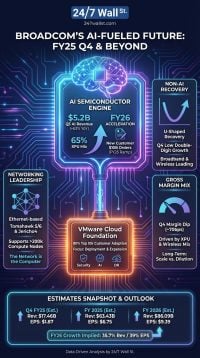
That AI portfolio is the second reason I keep buying. In Q2 FY2026, AI semiconductor revenue hit $10.80 billion, up 143% year-over-year, and CEO Hock Tan guided Q3 AI revenue to $16 billion, up over 200% year-on-year. He was blunt on the call: “For the full year 2026, we expect to achieve AI semiconductor revenue of $56 billion, up approximately 180% from fiscal 2025.” The visibility keeps extending. He then reiterated fiscal 2027 AI revenue “in excess of $100 billion” and pointed to 10 gigawatts of shipments in 2027 with more in 2028. That is booked capacity for six named customers.
The third reason is the cash. Q2 free cash flow came in at $10.26 billion, or 46% of revenue, with an adjusted EBITDA margin of 69%. Cash on the balance sheet doubled to $19.63 billion while total liabilities fell 3.76% year-over-year. Management returned capital aggressively: $7.8 billion in Q1 buybacks under a $10 billion authorization, plus a $0.65 quarterly dividend that marks the fifteenth consecutive annual increase since fiscal 2011. For a retirement-focused portfolio, that streak matters more than any quarter’s headline.
The valuation lands where a compounder should. Forward P/E of 20 against Q2 net income growth of 87.51% is the multiple I want to own, and the PEG of 0.4 underscores it. Analyst consensus target sits at $523.73 with 44 of 48 covering analysts rated Buy or Strong Buy.
Now the risk. Hyperscaler concentration is real. A handful of customers drive the AI ramp, and any capex reset at Google, Meta, or OpenAI would land on this income statement first. What keeps me buying anyway is the structure of the commitments Tan laid out on the call: multi-generational Google TPU agreements, 5 gigawatts of Anthropic compute beginning in 2027, OpenAI’s 1.3 gigawatts in 2027 stretching to a 10-gigawatt deployment by 2029, and Meta’s 3 gigawatts through 2028. Those are signed contracts. Layer the Apple ASIC baseline underneath, and the concentration risk gets absorbed by contractually secured demand that runs past this decade.
I am not trying to time the next 90 days. I am buying a business with a de-risked base, a booked AI ramp with visibility into 2028, and a capital return record that predates most of my portfolio. The buy button stays live until the thesis breaks, and today it looks stronger than the day I opened the position.
Contact [email protected] for any questions or corrections.
Alex Sirois is a financial writer with experience spanning both retail and institutional investing. He has written for InvestorPlace and held roles at BNY Mellon and Bernstein, giving him a perspective that bridges Main Street portfolios and Wall Street analysis.
Alex holds an MBA from George Washington University and has built his career across multiple industries, including e-commerce, education, and translation — a breadth of experience that informs how he breaks down complex financial topics for everyday investors. His writing is conversational, actionable, and grounded in long-term, buy-and-hold investing principles.
At 247 Wall St., Alex focuses on delivering analysis that is both accessible and useful, with a clear emphasis on helping readers make more informed decisions with their money.