Trump’s War on the Fed Isn’t Over, and Wall Street Is Still Betting on a Rate Hike
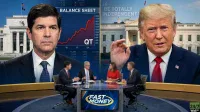
President Trump went on CNBC this morning to promise a second run at removing Fed Governor Lisa Cook, called the board under new Chair Kevin Warsh “a little bit hostile” and possibly “a board that wants to do the wrong…


President Trump went on CNBC this morning to promise a second run at removing Fed Governor Lisa Cook, called the board under new Chair Kevin Warsh “a little bit hostile” and possibly “a board that wants to do the wrong thing,” and Wall Street barely blinked. The VIX closed Friday at 15.81, in the lower quartile of the past year. Meanwhile, the two-year Treasury sits at 4.10%, well above the Fed funds rate of 3.62%. The bond market is pricing hikes.
What Trump actually said
Trump’s first attempt to remove Cook was kicked back by the Supreme Court. On CNBC this morning, he framed the loss as procedural, not substantive. “They sent it back, not based on the merits. They sent it back on process and procedure. So we’ll start the process and we’ll do perfect process and perfect procedure.”
National Security Director Kevin Hassett went further, arguing a Fed majority is “not necessarily going to be voting because they’re patriotic, but rather because they want to get Trump.” CNBC’s Steve Liesman characterized the court’s ruling as “just a little bump in the road” and added, “I don’t think he’s done yet.” Taken together, the messaging makes clear the White House intends to keep pressing on Cook’s seat until the composition of the board shifts.
The board math nobody is talking about
Count the seats. The Biden-appointed governors are Cook, Jefferson, and Barr. The Trump-appointed governors are Warsh, Bowman, and Waller. Warsh already has the chair. Removing Cook would shift the balance of the Board of Governors decisively, and any Trump replacement would presumably favor cuts, which is the entire point.
The irony is that Warsh’s own board, per J.P. Morgan’s read of the current lineup, is likely to run a more patient policy than the White House wants because Fed governors serve 14-year staggered terms, insulating them from any single administration. Trump is trying to short-circuit that design.
Why the market is betting on a hike, not a cut
Any Robinhood user scrolling through rate-cut memes should stop here. The Fed has held at 3.75% since December 11, 2025, a seven-month pause. Markets are now pricing a 64% probability of a rate hike by year-end and 76% by December.
Why? Look at the data the FOMC is actually reading. Core PCE, the Fed’s preferred inflation gauge, printed a 90.9 percentile reading for May, its 12-month high. CPI is sitting at its 12-month high of 333.979, up 0.5% month-over-month. Unemployment ticked down to 4.2% in June, so the labor-market excuse for cutting is thin. The June FOMC dot plot moved the median year-end funds rate projection to 3.8%, up from 3.4% in March, with nine of nineteen officials now penciling in at least one hike.
Trump wants lower rates. His own inflation data, and his own appointee running the board, are pointing the other direction.
Why Fed independence is not abstract for your portfolio
If you own a two-year Treasury, a mortgage REIT, a regional bank, or any duration-sensitive equity, this fight has a P&L. The two-year at 4.10% is telling you the market thinks the next move is up, not down. If Trump succeeds in installing a Fed that will cut anyway, you get the worst combination for bondholders, which is a Fed easing into an inflation upswing. Long yields would likely rise, not fall, because the term premium would widen to compensate for a politicized central bank. The 30-year is already at 4.98%. It could go higher.
The equity side is trickier. Consumer sentiment just hit a 12-month low of 44.8, deep in recessionary territory by the University of Michigan’s own thresholds. A Fed that cuts to please a president, into sticky inflation and a wobbling consumer, is the classic 1970s script. Gold, TIPS, and short-duration credit tend to win that trade. Long nominal bonds and unprofitable growth names tend to lose.
Watch the Cook litigation. Watch the September FOMC. If the White House pushes and the board flinches, the yield curve will tell you before the headlines do.
Contact [email protected] for any questions or corrections.
Omor Ibne Ehsan is a writer at 24/7 Wall St. He is a self-taught investor with a focus on growth, cyclical, and dividend equities that have strong fundamentals, value, and long-term potential. He also has an interest in high-risk, high-reward investments such as penny stocks.