Can Kevin Warsh Tighten Policy Without Crossing Trump?
The Federal Reserve’s new chair faces a political problem more than an economic one. Kevin Warsh needs to tighten policy in an inflation backdrop that is heating up while avoiding antagonizing the president who appointed him. On CNBC’s Fast Money…

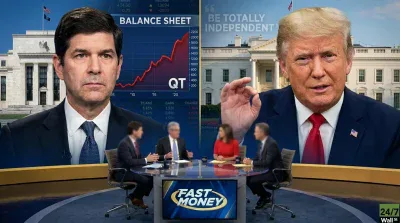
The Federal Reserve’s new chair faces a political problem more than an economic one. Kevin Warsh needs to tighten policy in an inflation backdrop that is heating up while avoiding antagonizing the president who appointed him. On CNBC’s Fast Money this past Friday, the panel zeroed in on how Warsh might thread that needle, and the answer points to the balance sheet rather than the funds rate.
President Trump has publicly told Warsh “to be totally independent” and “just do a great job”. Hiking the policy rate from the current 4% upper bound, after the Fed has already cut 75 basis points over the past eight months, would land Warsh in the headlines for the wrong reason. Quantitative tightening, by contrast, is technical, slow-moving, and rarely makes the evening news.
Why The Balance Sheet Is The Path Of Least Resistance
The broader macroeconomic case for resuming aggressive central bank balance sheet runoff is becoming incredibly straightforward for market participants. Core PCE, which remains the Federal Reserve’s absolute preferred inflation gauge, currently sits all the way at the 91st percentile of its trailing twelve-month range. At the same time, the headline Consumer Price Index advanced notably throughout April 2026 to print at an absolute index level of 332.4. JPMorgan’s chief economist captured this structural monetary shift perfectly during the panel discussion by bluntly warning investors that Goldilocks is officially leaving the building.
Federal Reserve Governor Christopher Waller’s high-profile public push to officially remove the easing bias from policy statements reinforces this hawkish pivot. Interest rate futures markets, which spent the vast majority of 2025 aggressively pricing in a steady series of cuts, are now actively factoring in the real possibility of an outright rate hike. The consensus among panel members is that there are now completely equal odds of either a hike or a cut acting as the Fed’s next strategic policy move.
Accelerating the structural pace of balance sheet reduction effectively tightens global financial conditions by altering the duration supply rather than just adjusting the headline federal funds rate. These underlying market mechanics are already becoming deeply visible across the long end of the curve. The benchmark 10-year Treasury yield climbed toward a significant multi-month high of 4.62% on May 21 as persistent inflation data prompted fixed-income investors to hedge their exposure. Long rates are effectively doing a massive chunk of new Fed Chair Kevin Warsh’s restrictive monetary work for him out in the open market.
The 2019 Warning
History shows that this exact central bank strategy has run into severe operational trouble before. As one prominent panelist noted during the discussion, the market still remembers the whole 2019 incident when rapid quantitative tightening drained commercial bank reserves much faster than the global financial system could actually handle. BlackRock’s macro team highlighted a strikingly similar dynamic when they tracked the recent collapse in U.S. reserves that forced the Fed to completely halt its QT2 program in December 2025 and transition into asset purchases. Treasury Secretary Scott Bessent’s famous observation that the central bank balance sheet functions in a way that no one truly understands perfectly captures this ongoing uncertainty.
Why The VIX At 16 Looks Wrong
Markets are pricing none of this complexity, as VIX closed at $16.76 on May 21, down 14% over the past month and sitting in the lower 40th percentile of the past year. Consumer sentiment tells a different story. The University of Michigan index printed at 49.8 in April, the lowest reading in the 12-month series and well into recessionary territory. Inflation expectations hit their highest level in seven months, and bottleneck inflation from commodities is expected to worsen.
This disconnect should concern investors positioning into the back half of 2026. Options markets are pricing complacency. Consumers are pricing distress, all while bond markets are pricing tightening. The new Fed chair must reconcile all three, and the unemployment rate at 4% gives him political cover to lean hawkish without triggering a backlash over jobs.
What To Watch Next
The signal will come from the runoff caps rather than the dot plot. If Warsh announces an acceleration of Treasury and MBS runoff at his first FOMC, it will be a hawkish move dressed in technical language. The 10-year yield has already pushed above the prior cycle high. Equity multiples, especially in semis, were built on a different rate regime. The FRED Core PCE series is the cleanest scoreboard for whether the strategy is working. Cross that 3% threshold on a year-over-year basis, and the political cover for incrementalism disappears.
Contact [email protected] for any questions or corrections.
David Beren has been a Flywheel Publishing contributor since 2022. Writing for 24/7 Wall St. since 2023, David loves to write about topics of all shapes and sizes. As a technology expert, David focuses heavily on consumer electronics brands, automobiles, and general technology. He has previously written for LifeWire, formerly About.com. As a part-time freelance writer, David’s “day job” has been working on and leading social media for multiple Fortune 100 brands. David loves the flexibility of this field and its ability to reach customers exactly where they like to spend their time. Additionally, David previously published his own blog, TmoNews.com, which reached 3 million readers in its first year. In addition to freelance and social media work, David loves to spend time with his family and children and relive the glory days of video game consoles by playing any retro game console he can get his hands on.