Potential Buyers Line Up for Unity Software as Valuation Hits Rock Bottom
Unity Software's stock has cratered while its AI ad engine and mobile game dominance keep growing, and at least five deep-pocketed giants are now circling a company that may be too strategically valuable to stay independent.

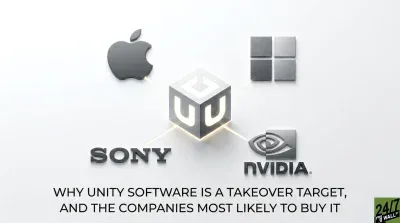
Unity Software (NYSE:U | U Price Prediction) occupies a curious intersection: a strategic asset with a depressed valuation. Shares closed most recently at $30.68, down 30.5% year to date, giving the company a market cap of roughly $13.4 billion. Yet the underlying business is accelerating: Q1 2026 revenue reached $508.24 million, up 16.8% year over year, and Vector, the AI ad engine, was 80% larger than a year ago.
CEO Matt Bromberg was blunt on the Q1 call: “There is no company in the world better positioned to win in this marketplace than we are.” CFO Jarrod Yahes added that “there is a high threshold as we evaluate M&A opportunities.” Unity has signaled discipline on M&A, yet the assets, the Unity 6 engine, Unity Runtime behavioral data, Vector, and roughly 70% mobile game creation market share, make it a magnet for larger platforms.

4. Apple: The Longest Shot
Apple (NASDAQ:AAPL), at a $317.31 share price and a $4.7 trillion market cap, has the cash. Vision Pro needs 3D content. But Apple prefers acqui-hires (i.e., buying a business primarily to recruit its talented employees), not $13 billion platform deals, and Unity’s ad business would clash with Apple’s privacy stance. Despite a strategic fit, cultural and regulatory friction dwarfs any strategic fit.
3. Microsoft: Regulatory Baggage
Microsoft (NASDAQ:MSFT) has the financial firepower ($2.9 trillion market cap, 46.3% operating margin) and gaming rationale via Xbox. Satya Nadella’s $37 billion AI run rate gives him ad-tech logic too. Post-Activision antitrust scrutiny makes another mega gaming deal a slog.
2. Sony: The Natural Fit
Sony (NYSE:SONY) is the intuitive buyer: PlayStation runs on developers who overwhelmingly use Unity. At a $20.68 share price, Sony has a $121.4 billion market cap, and its ¥500 billion buyback signals capital discipline. The obstacle is that swallowing a $13 billion U.S. software firm would be outside Sony’s typical M&A comfort zone.
1. Nvidia: The Strongest Case
Nvidia (NASDAQ:NVDA) fits best. Omniverse, Isaac GR00T, and DRIVE Hyperion all need a real-time 3D engine and developer network. Nvidia’s $4.9 trillion market cap and 63% profit margin mean Unity represents a rounding error on Nvidia’s balance sheet. Jensen Huang says, “Agentic AI has arrived,” and Unity Runtime’s behavioral data would supercharge simulation and robotics training. Antitrust risk is lower than Microsoft’s, and the industrial logic is highest. (For readers tracking this theme, 24/7 Wall St.’s Next Nvidia Playbook report frames the broader compute-plus-content stack.)
Where Private Equity Fits
A Thoma Bravo-style buyer could absorb Unity’s $403.9 million FY25 free cash flow and compress margins. But $2.15 billion in cash combined with a $2.24 billion convertible note stack complicates LBO math. PE ranks below Nvidia and Sony, roughly level with Microsoft, and ahead of Apple.
Contact [email protected] for any questions or corrections.
Trey has been an editor and author at 24/7 Wall St. for more than a decade, where he has published thousands of articles analyzing corporate earnings, dividend stocks, short interest, insider buying, private equity, and market trends. His comprehensive coverage spans the full spectrum of financial markets, from blue-chip stalwarts to emerging growth companies.
Beyond 24/7 Wall St., Trey has created and edited financial content for Benzinga and AOL's BloggingStocks, contributing additional hundreds of articles to the investment community.
Trey's editorial expertise extends across multiple publishing environments. He served as production editor at Dearborn Financial Publishing and development editor at Kaplan, where he helped shape financial education materials. Earlier in his career, he worked as a writer-producer at SVE. His freelance editing portfolio includes work for prestigious clients such as Sage Publications, Rand McNally, the Institute for Supply Management, the American Library Association, Eggplant Literary Productions, and Spiegel.
Outside of financial journalism, Trey writes fiction and has been an active member of the writing community for years, moderating workshop sessions at regional conventions.