I’m Buying Apple’s AI Advantage That Keeps It Ahead of the Mag 7 At Least Until This Point
Apple keeps beating earnings while its Mag 7 rivals burn billions on data centers, and one investor thinks he has found the reason the gap will only widen from here.

This post may contain links from our sponsors and affiliates, and Flywheel Publishing may receive compensation for actions taken through them.
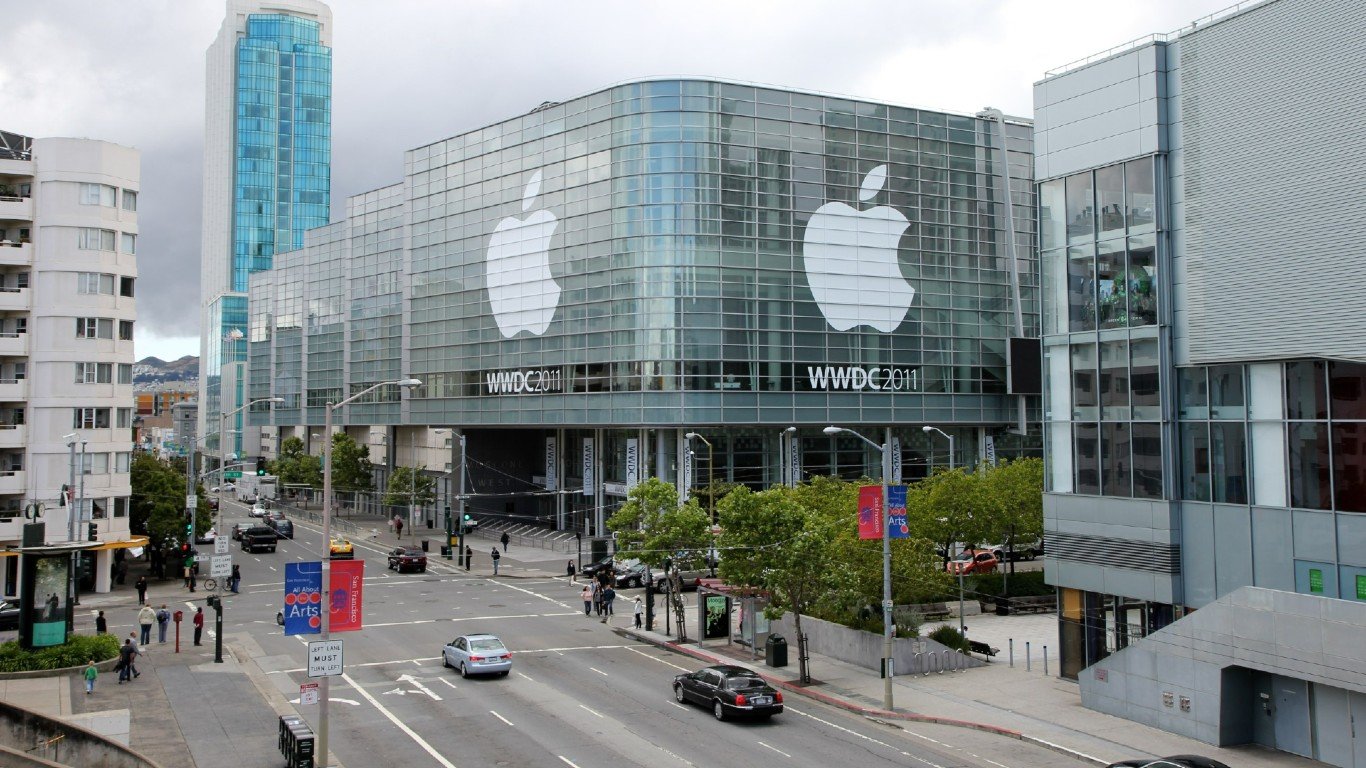
I keep hitting the buy button on Apple (NASDAQ:AAPL | AAPL Price Prediction) because I have finally found a mega-cap AI story where I do not have to underwrite a $400 billion data center bill to believe in the upside. That is the whole thesis in one sentence, and the receipts have only gotten better every quarter I have added.
The Capital-Light AI Bet I Cannot Stop Making
Apple’s edge is an asset-light, consumer-facing AI model that outsources heavy training to partners and leans on on-device processing. Tim Cook framed it plainly on the last call: “Apple Intelligence is woven into the core of our platforms, powered by Apple silicon and designed from the ground up to deliver intelligence that is fast, personal, and private.” The distribution moat sits on an installed base above 2.5 billion active devices. That is the AI shipping channel I get for free with the stock.
The Q2 FY26 numbers back the conviction. Revenue hit $111.184 billion, up 16.6% year over year, with EPS of $2.01 versus a $1.9404 estimate, the 8th straight beat. iPhone did $56.994 billion on iPhone 17 demand, Services printed an all-time record $30.976 billion, and Services gross margin came in at 76.7%. Cash and equivalents jumped 61.82% to $45.572 billion. Return on equity sits at 141.5% and return on invested capital at 53.35%. Those are the fingerprints of a business that does not need a hyperscaler’s balance sheet to compound.
Then there is the capital return. Management authorized a fresh $100 billion in buybacks and raised the dividend 4% to $0.27 per share. Projected free cash flow of roughly $140 billion funds that firepower without diluting the AI investment. R&D is still accelerating faster than the company overall, per Cook.
Why Apple, Not Microsoft
The natural alternative is Microsoft (NASDAQ:MSFT), and I own a smaller position there. Microsoft is a phenomenal business, with Azure growing 39% in constant currency and a $625 billion RPO backlog. The issue for repeat buys is the cost. Microsoft’s Q2 FY26 CapEx was $37.5 billion in a single quarter, with roughly two-thirds on short-lived GPU and CPU assets. Apple’s comparable Q1 FY26 capital spend ran about $2.37 billion. That gap shows up in returns: Microsoft’s ROE is 34% against Apple’s 141.5%. Microsoft’s forward P/E of 20 looks cheaper than Apple’s 35, but the market has already voted on which model it prefers this year: MSFT is down 18.21% year to date while AAPL is up 22.99%.
The Risk I Am Not Ignoring
Valuation is the real risk. Paying 41x trailing earnings and 10.86x sales for a hardware-anchored business is not cheap, and analyst consensus of $318.25 already sits below the current $333.74. Add in tariff and Greater China exposure, and a multiple compression scenario is real. What keeps me buying is that gross margin expanded to 49.3%, Greater China grew 28% in Q2, and the buyback authorization gives me a structural bid underneath the price.
What Keeps the Buy Button Active
The September hardware refresh is the next lever, and Polymarket puts 96.6% odds on an iPhone 18 launch in 2026 and 90% on a foldable iPhone before 2027. Every one of those units ships Apple Intelligence into a paying customer’s pocket without Apple renting a gigawatt of power to do it. I am going to keep buying Apple until the market decides that monetizing AI matters less than spending on it, and I do not see that day coming.
Contact [email protected] for any questions or corrections.
Alex Sirois is a financial writer with experience spanning both retail and institutional investing. He has written for InvestorPlace and held roles at BNY Mellon and Bernstein, giving him a perspective that bridges Main Street portfolios and Wall Street analysis.
Alex holds an MBA from George Washington University and has built his career across multiple industries, including e-commerce, education, and translation — a breadth of experience that informs how he breaks down complex financial topics for everyday investors. His writing is conversational, actionable, and grounded in long-term, buy-and-hold investing principles.
At 247 Wall St., Alex focuses on delivering analysis that is both accessible and useful, with a clear emphasis on helping readers make more informed decisions with their money.