Prediction: Up 144% YTD, Is Arm Holdings The Next Nvidia?
Arm Holdings has staged one of the sharpest re-ratings in large-cap tech this year, but a brutal pullback from its highs raises a critical question about whether the royalty model can justify a valuation that makes even Nvidia look cheap.

Arm’s run in 2026 has been one of the sharpest re-ratings in large-cap tech. Shares of Arm Holdings (NASDAQ:ARM | ARM Price Prediction) trade at $271.49 as of July 20, 2026, up 144.43% year to date on the back of a data center royalty explosion and the launch of Arm’s first production silicon.
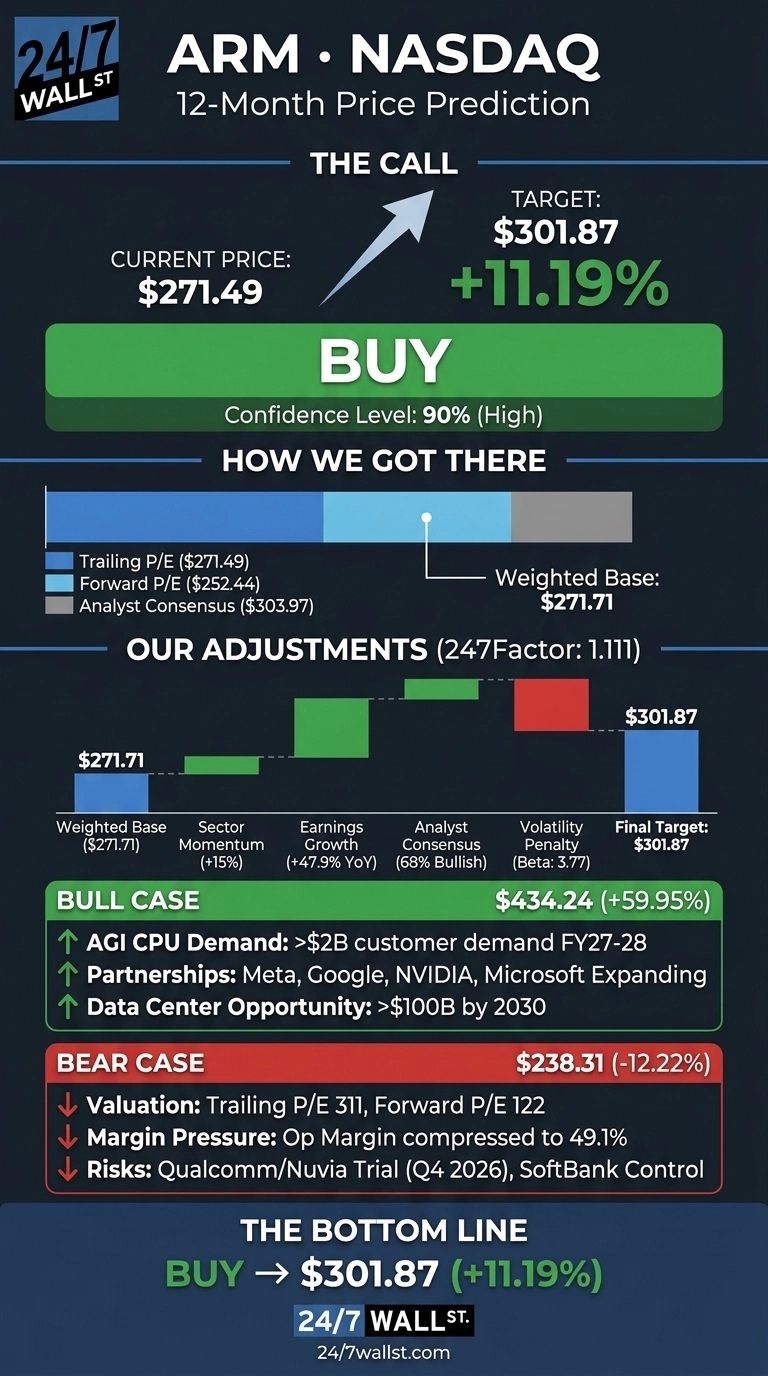
Our 24/7 Wall St. price target for Arm is $301.87, implying 11.19% upside over the next twelve months. The action is buy, with a confidence level of 90%.
24/7 Wall St. Price Target Summary
| Metric | Value |
|---|---|
| Current Price | $271.49 |
| 24/7 Wall St. Price Target | $301.87 |
| Upside | 11.19% |
| Recommendation | BUY |
| Confidence Level | 90% |
A Volatile Path to a 144% YTD Gain
Arm bottomed near $105.78 in January before ripping to a June high of $396.34 and pulling back to today’s level. The stock is off 17.38% over the past week and 36.21% over the past month, sitting 33% below its 52-week high of $452.70.
In Q4 FY2026, Arm posted revenue of $1.49 billion, up 20.06% year over year, with non-GAAP EPS of $0.60 beating the $0.5793 consensus. License revenue jumped 29% and data center royalty revenue more than doubled year over year. Full-year FY2026 revenue reached $4.92 billion, up 22.79%, a third straight year above 20% growth.

Why Bulls See Arm Following Nvidia’s Playbook
The bull case rests on more than $2 billion in customer demand for the Arm AGI CPU across FY27 and FY28. Meta is the lead partner on a multi-generation roadmap targeting 3+ billion users.
Google is replacing x86 host processors with custom Arm-based Axion CPUs in next-gen TPUs. NVIDIA announced Vera, its next Arm-based CPU. Microsoft is expanding Cobalt across Azure. Arm claims roughly 50% CPU compute share among top hyperscalers.
Management is tracking toward a $15 billion silicon business forecast against a data center CPU market that could exceed $100 billion by 2030. If the AGI CPU ramp materializes, the bull-case scenario points to $434.24 within twelve months, a 59.95% return.
What Could Go Wrong
Valuation is the biggest hurdle. Arm trades at a trailing P/E of 311 and a forward P/E of 122. Non-GAAP operating margin compressed from 52.8% to 49.1% as R&D spending jumped 43% to $1.911 billion. Bulls note this reflects deliberate investment in AGI CPU engineering that should scale as royalties ramp.
The Qualcomm/Nuvia trial expected in Q4 calendar 2026, SoftBank’s controlling stake, and export-control risk all weigh. The bear scenario points to $238.31, a 12.22% drawdown.
How Arm Compares to Nvidia and Broadcom
NVIDIA (NASDAQ:NVDA) trades at $202.81 with a YTD gain of just 8.88%, versus Arm’s 144%. Arm trails Nvidia in scale, yet its royalty model captures a slice of every hyperscaler’s custom silicon roadmap, including Nvidia’s own Vera CPU. That relationship makes our target look conservative if Arm’s per-chip take rate expands.
Broadcom (NASDAQ:AVGO) is the sharper comp on custom AI silicon economics. It posted Q2 FY2026 AI semiconductor revenue of $10.8 billion, up 143% YoY, and guided Q3 AI revenue to $16 billion.
Broadcom already runs a hyperscaler custom silicon business at scale, exactly where Arm is heading. Arm’s $271 price implies investors are willing to pay for the same trajectory earlier, making our 11% upside target measured rather than aggressive.
What Would Confirm or Break the Thesis
The 24/7 Wall St. price target of $301.87 with 90% confidence backs a buy. The tipping factor is the AGI CPU demand book: $2 billion locked in across FY27-FY28 represents concrete, contracted demand.
The setup looks constructive if Q1 FY27 lands inside guidance and data center royalty growth stays north of 50%. The thesis weakens if operating margins slip below 45% or the Qualcomm/Nuvia trial produces a materially adverse ruling.

Extending the 24/7 Wall St. price target model forward and blending base and bull-case trajectories, here is where Arm could trade if the AGI CPU roadmap executes.
| Year | 24/7 Wall St. Price Target |
|---|---|
| 2026 | $301.87 |
| 2027 | $335 |
| 2028 | $360 |
| 2029 | $378 |
| 2030 | $395.91 |
These projections assume Arm executes on the $15 billion silicon business forecast and holds hyperscaler CPU share near 50%. Significant upside is possible if agentic AI CPU demand outpaces the 4x-per-gigawatt baseline, and downside if licensing disputes or export controls disrupt the royalty ramp.
Contact [email protected] for any questions or corrections.
Vandita Jadeja is a financial publisher with over a decade of experience writing about financial topics, including investment, savings, retirement, insurance and banking. Vandita is a Chartered Accountant who loves to debunk financial concepts for readers.
Her work has appeared on sites that include The Motley Fool, InvestorPlace, and Benzinga. She covers investing and focuses on stock picks and price prediction for 24/7 Wall St.
When not looking for the next stock investment opportunity, she can be found traveling, reading, chasing sunsets and enjoying her iced latte.