3 Cybersecurity Stocks to Buy Before Threats Get Worse in Late July
AI-powered attacks are accelerating faster than most security budgets can absorb, and a handful of platform vendors are capturing a disproportionate share of that urgent spend. Three Nasdaq-listed cybersecurity names just posted beat-and-raise quarters, and their second-half setups look even…


Cyber threats are escalating faster than most enterprise budgets can absorb, and the platform vendors capturing the largest share of that spend are pulling away from the pack. AI-generated phishing, ransomware, and identity attacks are pushing CISOs toward consolidated security stacks.
That is showing up cleanly in the numbers for the three names below. Each is US-listed on Nasdaq, each posted a beat-and-raise quarter, and each has a defensible moat that will benefit them in the second half of 2026.
CrowdStrike (CRWD)

CrowdStrike (NASDAQ:CRWD | CRWD Price Prediction) is the AI-security bellwether, and Q1 FY27 confirmed the recovery from the July 2024 Falcon sensor incident is complete on the operating side. Revenue hit $1.39 billion, up 25.6% year over year, beating the $1.36 billion consensus. Non-GAAP EPS of $1.10 topped the $1.07 estimate, marking eight consecutive EPS beats. Net new ARR came in at a record Q1 $255.8 million, up 32%, pushing total ARR to $5.51 billion, up 24%. Free cash flow reached $468.5 million, a 34% FCF margin.
The bull case is platform depth. 51% of customers now run six or more modules, Charlotte AI is monetizing, and the QuiltWorks coalition with OpenAI and Anthropic positions Falcon as connective tissue for enterprise AI deployments. CEO George Kurtz framed the quarter bluntly: “In Q1, the worlds of cybersecurity and frontier AI collided: this was the Mythos moment. CrowdStrike is AI security infrastructure, critical to successful AI adoption.” Management raised FY27 revenue guidance to $5.91 billion to $5.96 billion. The stock split 4-for-1 on July 2, and shares are up 60.45% year to date on a split-adjusted basis.
Risk: Legal and remediation costs tied to the 2024 outage still linger, stock-based comp ran $317.6 million in Q1, and forward valuation is rich at roughly 159x forward earnings. That is the price of leadership.

Fortinet (FTNT)

Fortinet (NASDAQ:FTNT) is the value-relative name in this trio, and the Q1 FY26 report made the hardware refresh cycle impossible to ignore. Revenue of $1.85 billion rose 20.1% year over year and cleared consensus by 6.68%. Non-GAAP EPS came in at 82 cents versus the 62-cent estimate, a 32.26% surprise, the largest beat in five quarters. Product revenue jumped 41% to $645.1 million, billings grew 31% to $2.09B, and free cash flow hit a record $1.01 billion.
Fortinet holds the #1 firewall position with 55% unit market share, and FortiOS 8.0 introduced AI-driven and quantum-safe capabilities alongside the new FortiGate G Series. Partnerships with Anthropic (Project Glasswing), OpenAI, NVIDIA and Google Unified Security widen the SASE and AI security surface area. Margins are best-in-class: 80.8% gross margin, 30.6% operating margin and 27.3% net margin. Management raised FY26 revenue guidance to $7.71 billion to $7.87 billion.
Shares are up 95.5% year to date, trading at roughly 53x forward earnings. CEO Ken Xie summarized the setup: “Billings grew 31% year over year, driven by the continued convergence of networking and security, an approach Fortinet has led for 26 years, and by an increasingly complex threat environment that is being intensified by AI.”
Risk: Tariff exposure and longer enterprise sales cycles could pressure the hardware line if macro softens.

Palo Alto Networks (PANW)
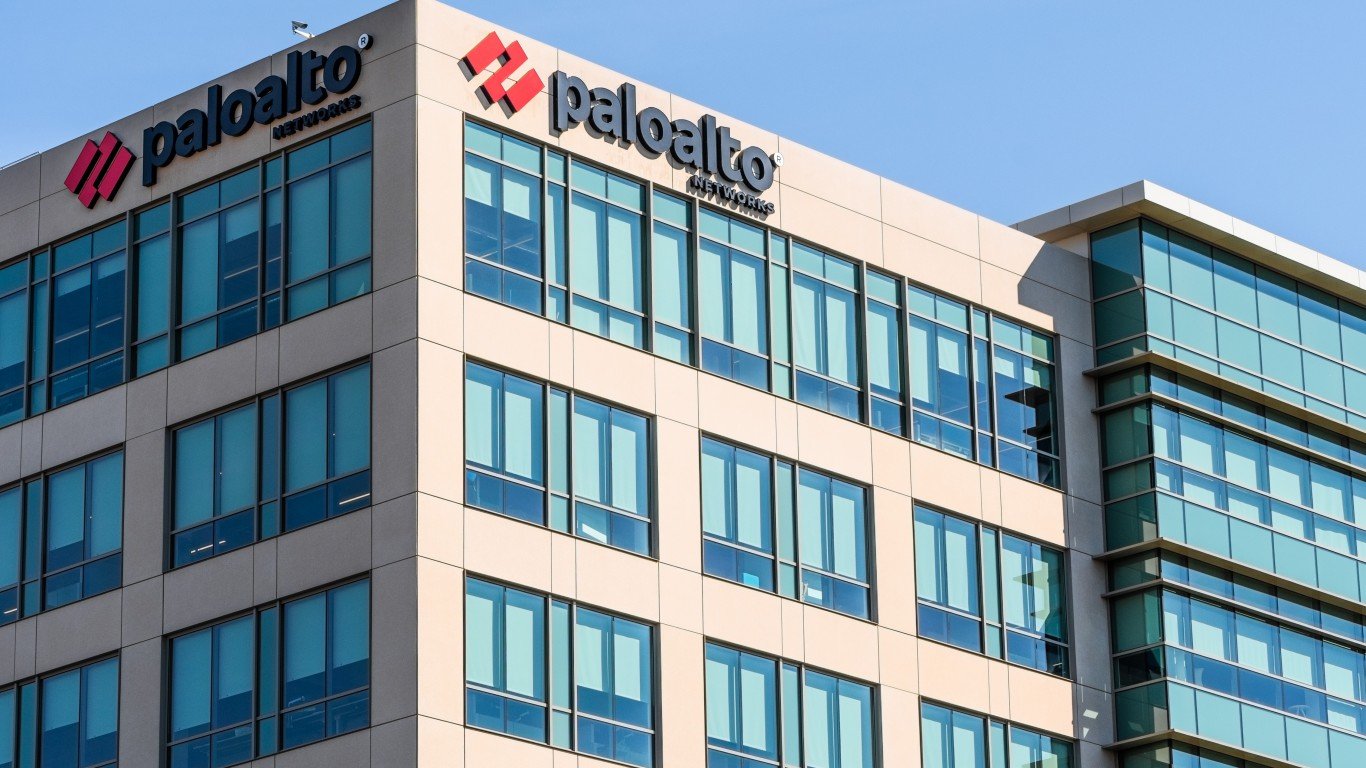
Palo Alto Networks (NASDAQ:PANW) is the platformization story, and Q3 FY26 was the clearest evidence yet that the strategy is working. Revenue of $3 billion grew 31.1% year over year, beating the $2.94B consensus. Non-GAAP EPS landed at 85 cents versus the 80 cents expected. The signature metric, Next-Generation Security ARR, reached $8.1 billion, up 60% year over year. Remaining performance obligation climbed to $18.4 billion, up 36%. Free cash flow of $788 million supported a trailing 12-month adjusted FCF margin of 38.5%, and management is targeting 40% by FY28.
The CyberArk and Chronosphere acquisitions contributed $388 million to Q3 revenue, extending Palo Alto into identity and observability. CEO Nikesh Arora tied the momentum directly to AI: “Q3 was a standout quarter for Palo Alto Networks, with accelerating organic bookings growth as customers turn to us to secure their AI deployments at scale.” Q4 revenue guidance of $3.345B to $3.355B implies roughly 32% growth. Shares are up 78.54% year to date.
Risk: Q3 carried a GAAP operating loss of $183 million because of acquisition-related costs, share-based comp ran $517 million, and the trailing P/E sits at roughly 257. Integration risk on CyberArk and Chronosphere is the swing variable through fiscal year-end.

What to Watch Next
The July setup favors the platform leaders. Ransomware activity is intensifying, enterprises are consolidating vendors, and the three names above are converting that shift into ARR, FCF and raised guidance. Watch net new ARR at CrowdStrike, product revenue at Fortinet as the hardware refresh runs, and NGS ARR at Palo Alto Networks for confirmation that the second-half thesis holds.
Contact [email protected] for any questions or corrections.
Joel South covers large-cap stocks, dividend investing, and major market trends, with a focus on earnings analysis, valuation, and turning complex data into actionable insights for investors.
He brings more than 15 years of experience as an investor and financial journalist, including 12 years at The Motley Fool, where he served as an investment analyst, Bureau Chief, and later led the Fool.com investing news desk. He has also co-hosted an investing podcast and appeared across TV and radio discussing market trends.